Politics Japanese Election 2024

Lothor

Freelance proofreader
Donor
Ten-year veteran
Joined
26 Sep 2015
Messages
2,612
Reaction score
3,543
During the run-up to the UK election, I was following the opinion polls on the Wikipedia page. I've just checked to see if there is a similar one for Japan, and there is. It's here, and it's more interesting than expected. There were a few polls in June that put the CDP ahead of the LDP. I would have thought that some opinion polls suggesting the possibility of a new party in power would have been newsworthy, but I can't remember any mention of such polls in the media.
 
I can't remember having heard of any poll that put the CDP ahead of the LDP. The most CDP-friendly English-language report I found so far came from JT (of all outlets):


Unfortunately, the opposition parties were unable to field joint candidates:

Ruling out any electoral cooperation with the Japanese Communist Party (JCP), he has courted the Democratic Party for the People — with which it shares a history in the DPJ — and Nippon Ishin no Kai to join forces in several single-seat districts. In the last few weeks before official campaigning kicks off on Oct. 15, the party has been accelerating negotiations with other parties to agree on joint candidates in those districts to form a united front against the ruling LDP-Komeito coalition and avoid splitting the opposition vote. However, two weeks ahead of the election, last-minute adjustments could hardly stir the waters in a way that favors the CDP. Noda has inherited a political landscape in which each party has maximized its own interests for years, opting for cooperation only under limited circumstances.

As always, here are Tobias Harris' insights:

 
Apparently the CDP is the new incarnation of the Democratic Party of Japan. I didn't realize they were defunct. If that's the case, it wouldn't be unprecedented for the CDP to take control of Parliament in the sense that the Democratic Party has done so in the past. It'll be interesting to see how things turn out.
 
At last! A news story that doesn't have the 'LDP will inevitably win' angle. This may be a more interesting election, where the result is not a foregone conclusion. It being a Kyodo article, I'm a bit sceptical about the reasoning: my view is that the failure of the LDP to make progress in resolving any of Japan's main issues is a greater concern to the electorate than the misreporting of income - financial scandals being par for the course with the LDP.

 
Another interesting question will be with whom the LDP will form a coalition if it does not achieve a majority with Komeito. The most likely coalition partner would be Ishin no Kai, another conservative, right-wing, but more libertarian party.

The Guardian had a piece on "soft-spoken" Ishiba, who, after less than three weeks, had to back-pedal on several promises to appease the right:
  • Changing the law on married surnames: off the table.
  • Lifting the ban on gay marriages: requires further examination.
  • Reforms to Japan's male-only succession laws: no comment.
  • Contrary to earlier promises not to endorse twelve candidates involved in the slush fund scandal, they can now run in the election.
  • While not visiting the shrine in person, Ishiba—for the first time—sent an offering to Yasukuni, angering neighbours.
Same old.


Yesterday, Jiji released the results of a survey conducted from 11-14 October. According to the results, support for Ishiba's cabinet came to 28%, marking the lowest for new governments dating back to 2000. Other polls conducted by Nikkei and Yomiuri, TBS, and the one by Kyodo posted by @Lothor also point to challenges for the LDP to secure a majority.

 
The LDP secretary-general of Shimane is "disappointed" because 5 out of 6 local election candidates in his prefecture are women.

In the Oct. 27 House of Representatives election, three women are running in Shimane Prefecture's No. 1 district including an LDP candidate, while two women are running for opposition parties against one male LDP candidate in the prefecture's No. 2 constituency. After commenting on the abundance of female candidates in the prefecture, Shigeru Sonoyama, the LDP prefectural chapter secretary-general and prefectural assembly member, stated, "I believe that this is a sign that women have been sought, not only by my family, but by society as a whole."

Sonoyama commented toward the end of the meeting, during which Yoshiko Ishiba, the wife of Prime Minister Shigeru Ishiba, held a talk. After the conference, Sonoyama told the Mainichi Shimbun, "Men have done politics, social activities and other things, but that is no longer so. I meant that it was deeply moving."

 
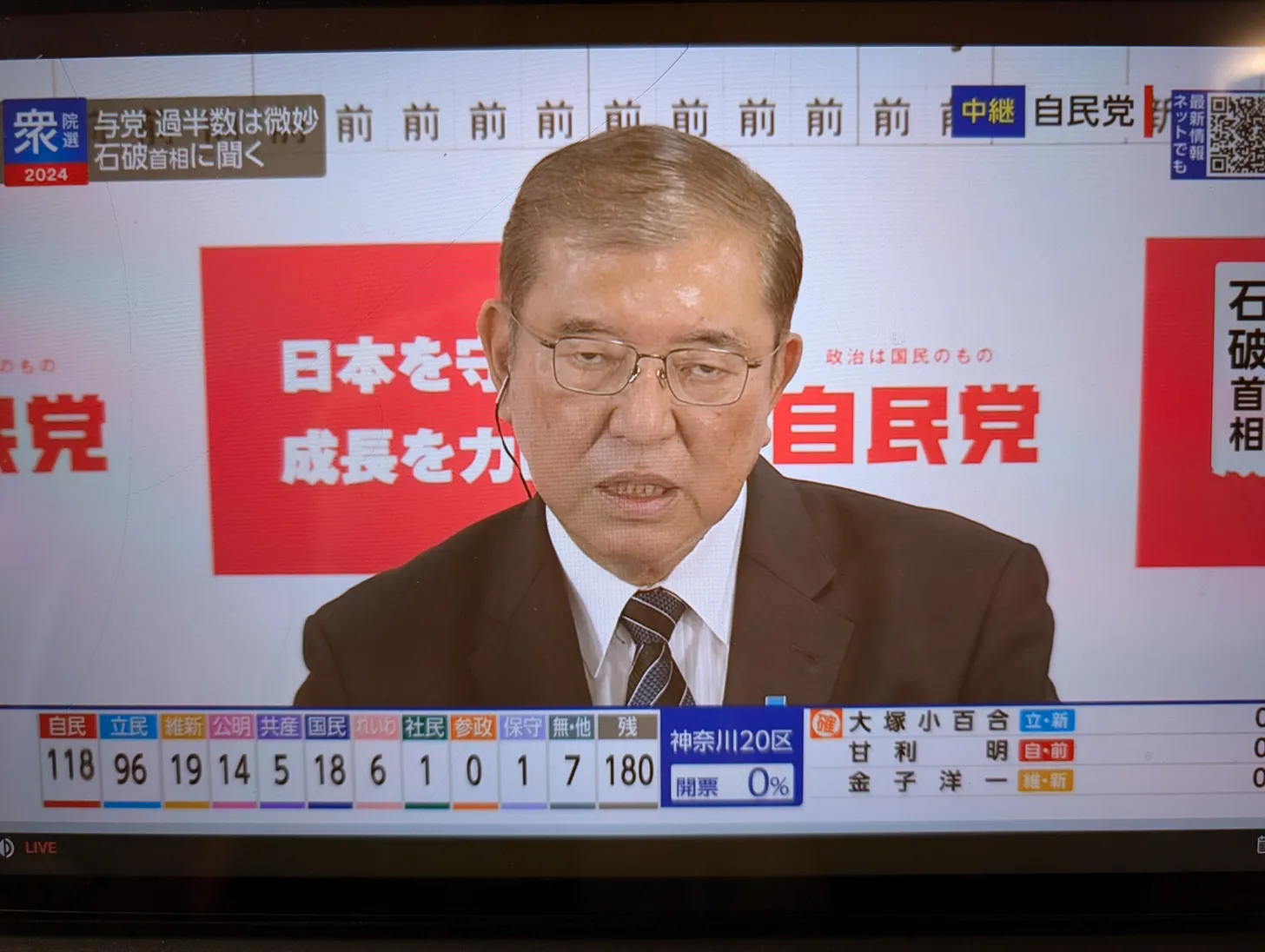
Looking like a hung parliament!

One thing's certain: the ruling coalition lost their majority in the Lower House, and the opposition will see significant gains. A grand coalition, perhaps?

I'm disappointed that Takaichi and Aso were re-elected in their districts.

NHK just reported that 4 of the 46 LDP scandal-implicated candidates have won; 12 have lost.
 
2024-lower-house-election.webp


The LDP and its ruling coalition partner, Komeito, lost their majority in the lower house of parliament for the first time since 2009 in Sunday's general election, casting doubt over Prime Minister Shigeru Ishiba's government less than a month into his term. They secured 215 seats, falling short of the 233 seats needed for a majority in the 465-seat chamber. Opposition parties gained 235 seats, setting off a scramble from both sides to form a majority coalition.

The main opposition Constitutional Democratic Party (CDP) won 148 seats, up from 98 in the previous assembly, while the Democratic Party for the People increased its seats from seven to 28 amid public frustration over a political funding scandal involving multiple LDP lawmakers. Previously, the LDP held 247 seats, enough for a standalone majority, with Komeito holding 32, giving the coalition a 60% share in the House of Representatives. The last time the coalition lost its majority was 15 years ago when the Democratic Party of Japan (DPJ)—a predecessor of the CDP—took control of parliament. Despite this setback, the LDP-Komeito coalition retains its majority in the upper house, where elections are set for next year. Komeito leader Keiichi Ishii, who took office just last month, lost his seat in the lower house, highlighting the coalition's current struggles.


Paywall alert:
 
Here's Tobias Harris' take on "Observing Japan:"

At this point, there are four possible outcomes of post-election negotiations.

  1. LDP-Kōmeitō minority government, with limited external cooperation with the DPFP and Ishin: probably the most likely outcome, but not a particularly stable outcome, with the government that emerges fragile, vulnerable to a no-confidence motion if it does not satisfy opposition demands on political reform but also vulnerable to intra-LDP conflict.
  2. LDP-Kōmeitō-Ishin and DPFP coalition government: either Ishin or the DPFP may shift its thinking on a coalition, depending on what policy promises or positions the LDP and Kōmeitō offer (or even the premiership for Tamaki, as mentioned yesterday), but neither party seems inclined to help the LDP at this point. Any talks between these parties in the coming days bear scrutiny, as either would have enough seats to secure a majority.
  3. LDP-Kōmeitō-CDP grand coalition: CDP leader Noda Yoshihiko ruled this out before the general election, and there is little reason to think that, having just scored major gains at the LDP's expense by campaigning against the LDP's corrupt practices. The party will likely keep the pressure on the LDP heading into upper house elections next year and look for an opportunity to deploy a no-confidence motion at a moment of maximum strategic advantage.
  4. CDP-Ishin-DPFP coalition: Depending on where the parties wind up, this option may not be realistic anyway, at least not without Kōmeitō or some LDP breakaway group joining with them. But even if somehow the three parties could reach a majority, the negotiations might be even more difficult than LDP-Kōmeitō negotiations with these parties. It may be difficult for these parties to agree on anything other than specific political reforms, to say nothing of the distribution of posts.

PM Ishiba

Someone's not too exalted.

 
I am linking Tobias Harris' excellent analysis of the political turmoil Japan finds itself in after last Sunday's elections.


Our neighbour's son was running for Kokumin Minshutō (国民民主党) and won a seat. He's half-Peruvian, so that made headlines in the Spanish-speaking news outlets:


It was exhilarating to see how many households put up his campaign posters.


One more legalistic piece of news:

On Monday, lawyers filed lawsuits in high courts across Japan, seeking to annul the results of the previous day's general election and call for a rerun. They argued that disparities in vote weight violated the constitutional principle of equality. Boundary changes and the redistribution of single-seat constituencies in the recent House of Representatives election led to a slight decrease in the maximum vote weight disparity from the 2021 election to a 2.06-fold difference. A 2022 legal revision added ten single-seat electoral districts to five prefectures, removed one from 10 other prefectures, and redrew boundaries in another 10, affecting 140 constituencies.


The lawyers filed the lawsuits with 14 high courts and their branches on Monday, challenging all of the 289 single-seat electoral district results. The country has taken steps to rectify the situation since the Supreme Court ruled the vote weight disparities of over 2.0-fold seen in the 2009, 2012 and 2014 lower houses elections were in a "state of unconstitutionality." It has never nullified election results. The top court said the maximum disparity of 2.08-fold in the 2021 lower house election was constitutional as parliament had made efforts to redress differences in the weight of votes. According to government data, Hokkaido's No. 3 district had the highest number of eligible voters at 461,457 and Tottori Prefecture's No. 1 district the lowest with 224,060 voters as of Oct. 14.

 
Today, PM Ishiba was reappointed by parliament to continue as Japan's leader, despite the Liberal Democratic Party (LDP) losing its majority in the lower house during last month's snap general election. Ishiba will now head a minority government. Both chambers of the Diet voted in favour of Ishiba as prime minister. Although the LDP and its coalition partner, Komeito, could not secure a majority in the October 27 election, opposition parties failed to unite to form one. Ishiba was selected in a runoff vote in the lower chamber's House of Representatives, defeating Yoshihiko Noda, leader of the main opposition Constitutional Democratic Party. In the second round, Ishiba secured 221 votes, while Noda received 160 out of 465 total votes cast. An additional 84 votes were invalid as some lawmakers chose candidates who did not advance to the final round.


Japanese Lower House seats

Nikkei Asia


On Monday, Ishiba held talks before convening the Diet session with Noda and DPFP leader Yuichiro Tamaki. Noda asked for a transparent policy decision-making process, especially on political reforms, Ishiba told reporters. "What is important is ensuring the country is at peace and improving people's lives," he said. "I think I was able to share that belief with members of the DPFP and the CDP," Tamaki told reporters on Friday that he would not release his party members to vote for anyone but himself in the second round of the parliamentary vote. But on Monday, the married politician held a news conference, acknowledged having had an affair with a woman as reported by a Japanese weekly magazine and apologized for his conduct.


Paywall alert:
 
Back
Top Bottom