


- 14 Mar 2002
- 21,050
- 18,903
I'm sure @Ukigumo would get one of these. 
A distinctive randoseru (ランドセル) school backpack has been drawing attention on social media. Commenters say it resembles the armour worn by Sengoku-period warlords and note its weighty appearance. The design, however, grew from a practical aim. Its maker wanted to find a use for leftover leather.
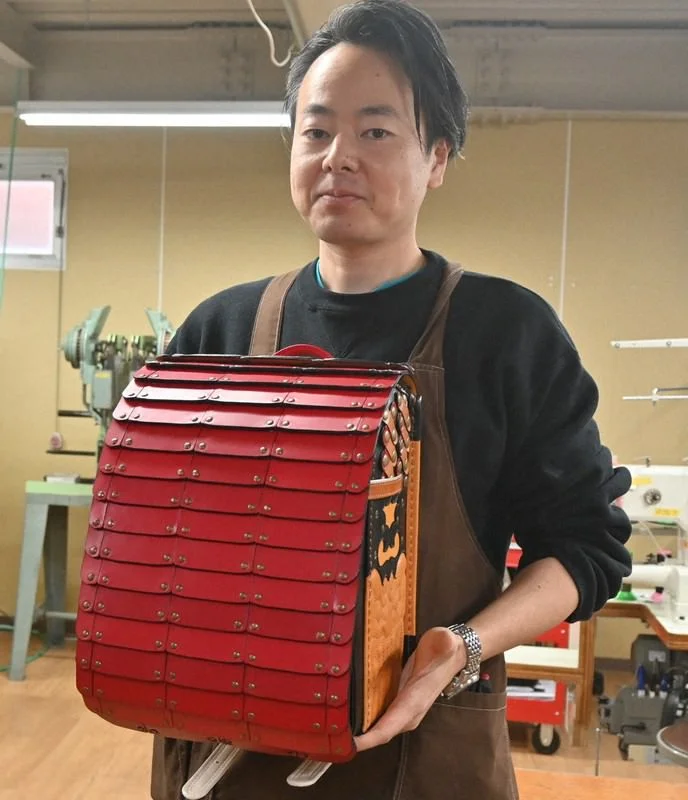
The backpack bears the name Akairokozane-Ōdōbyō Hainōgusoku (赤糸威大鋲背嚢具足), a phrase that roughly translates as "armour fashioned with red-laced plates and large brass rivets". Noriki Okada, a 44-year-old craftsman at Murase Kabanko Co. (村瀬鞄行) in Nagoya's Nakamura Ward, produced it from red leather. He modelled the design on armour associated with the Ii clan (井伊氏) of the Hikone domain, whose warriors were known as the "red regiment."
The piece gained wider notice in 2024. At the Japan Leather Award (日本革市皮革製品コンテスト), one of the country's largest competitions for leather goods, it received the Artistic Design Award. Judges cited its commanding form and its use of scrap materials that might otherwise have been discarded.

 mainichi.jp
A distinctive randoseru (ランドセル) school backpack has been drawing attention on social media. Commenters say it resembles the armour worn by Sengoku-period warlords and note its weighty appearance. The design, however, grew from a practical aim. Its maker wanted to find a use for leftover leather.
The backpack bears the name Akairokozane-Ōdōbyō Hainōgusoku (赤糸威大鋲背嚢具足), a phrase that roughly translates as "armour fashioned with red-laced plates and large brass rivets". Noriki Okada, a 44-year-old craftsman at Murase Kabanko Co. (村瀬鞄行) in Nagoya's Nakamura Ward, produced it from red leather. He modelled the design on armour associated with the Ii clan (井伊氏) of the Hikone domain, whose warriors were known as the "red regiment."
The piece gained wider notice in 2024. At the Japan Leather Award (日本革市皮革製品コンテスト), one of the country's largest competitions for leather goods, it received the Artistic Design Award. Judges cited its commanding form and its use of scrap materials that might otherwise have been discarded.
To minimize waste, he also used sections with wrinkles and scratches. Each part was meticulously fine-tuned by hand through repeated adjustments, taking over half a year to complete. Because the work prioritized artistry over practical weight and durability, the finished backpack weighs about 2.1 kilograms, compared with the average 1.3 kg. "We recommend it for display purposes," he said with a laugh. Each armor-style backpack sells for 500,000 yen (roughly $3,170) and is made to order. More than 10 inquiries have come in, mostly from overseas. Okada is currently producing two for customers.
Japanese craftsman turns leather scraps into samurai armor-style school backpack - The Mainichi
NAGOYA -- A unique


