


- 14 Mar 2002
- 21,050
- 18,903
When Liz Truss flew to Tokyo five years ago to sign Britain's first post-Brexit trade deal, she made sure to pack something essential — a small jar of Stilton from Fortnum & Mason, the kind of cheese that seems to belong more in a Georgian parlour than in a modern trade negotiation. For Truss, then the U.K.'s trade secretary, cheese was not just a product but a point of pride. Back in 2014, she had famously declared it a "disgrace" that Britain wasn't exporting more of it. So when the talks with Tokyo reached their final, delicate stage, she reportedly fought tooth and nail to make sure Stilton and cheddar found their way into the Japanese market.
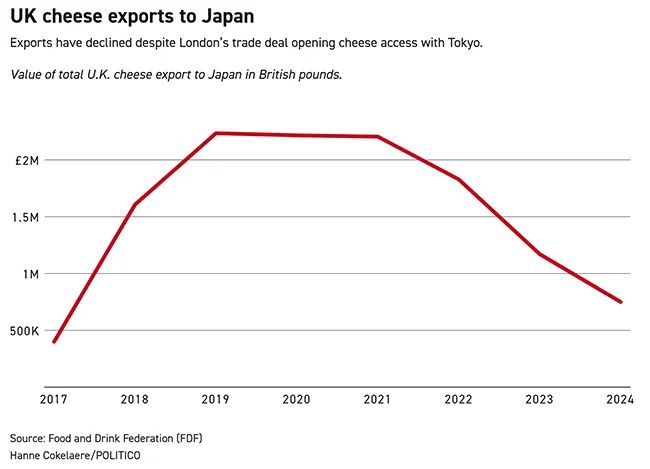
When the deal was signed on 22 October 2020, she presented Japan's then (and new) foreign minister, Motegi Toshimitsu, with the jar of Stilton — a small but fragrant symbol of Anglo-Japanese economic cooperation. The agreement itself mostly mirrored the existing EU-Japan trade deal that the U.K. had enjoyed before Brexit. However, it did promise to gradually cut Japan's cheese tariffs — 29.8% on cheddar — to zero by 2033. It also granted name protection to a handful of British varieties, from Buxton Blue and Swaledale Ewes to Teviotdale and a few others. Five years later, however, the remarkable British cheese renaissance in Japan has failed to materialise. Sales have dropped sharply, with the value of U.K. cheese exports to Japan down by about two-thirds since Truss's trip — not quite the dairy boom she might have imagined. A persistently weak yen has made imported cheese expensive, leaving Japanese consumers as unmoved by British cheddar as they were before all the diplomacy, gifts, and grand speeches about free trade.

 www.politico.eu
When the deal was signed on 22 October 2020, she presented Japan's then (and new) foreign minister, Motegi Toshimitsu, with the jar of Stilton — a small but fragrant symbol of Anglo-Japanese economic cooperation. The agreement itself mostly mirrored the existing EU-Japan trade deal that the U.K. had enjoyed before Brexit. However, it did promise to gradually cut Japan's cheese tariffs — 29.8% on cheddar — to zero by 2033. It also granted name protection to a handful of British varieties, from Buxton Blue and Swaledale Ewes to Teviotdale and a few others. Five years later, however, the remarkable British cheese renaissance in Japan has failed to materialise. Sales have dropped sharply, with the value of U.K. cheese exports to Japan down by about two-thirds since Truss's trip — not quite the dairy boom she might have imagined. A persistently weak yen has made imported cheese expensive, leaving Japanese consumers as unmoved by British cheddar as they were before all the diplomacy, gifts, and grand speeches about free trade.
Overall, British food and drink exports to Japan have been volatile. "The story for cheese exports, unfortunately, shows a clear decline in recent years," said George Hyde, the Food and Drink Federation's head of trade. "U.K. cheese sales to Japan peaked at £2.2 million in 2019 but have fallen every year since, and were down two-thirds in 2024 despite tariff advantages." A major factor is the weak Japanese yen compared to the strong British pound. Since Truss signed the trade deal in 2020, the pound has risen 47% in value against the yen. In August, inflation in Japan stood at 2.7% — its lowest point since November 2024. Japanese tariffs on multiple British cheeses remain obstructively high, at 25, 14, and 18.6%. This is because they will be lowered over 15 years, following the trade deal coming into effect at the start of 2021.
Liz Truss’ dream of boosting British cheese exports falls flat in Japan
It’s been five years since the U.K. and Japan signed their trade deal. But Japanese consumers still aren’t buying British.
www.politico.eu


