

Navigation
Install the app
How to install the app on iOS
Follow along with the video below to see how to install our site as a web app on your home screen.
Note: This feature may not be available in some browsers.
More options
Style variation
System
Light
Dark

You are using an out of date browser. It may not display this or other websites correctly.
You should upgrade or use an alternative browser.
You should upgrade or use an alternative browser.
How do you know... ON/KUN and beyond
- Thread starter Putrefaction
- Start date

Putrefaction
不幸中の幸い. . . がない.
- 7 Nov 2008
- 905
- 24
- Thread starter
- #52
Well, I've always wanted to write with my left hand. New language = fresh start, so I am doing this. I also do English to keep the speed and stuff up...not so great though, looks like a 6 year old being tazered.


Putrefaction
不幸中の幸い. . . がない.
- 7 Nov 2008
- 905
- 24
- Thread starter
- #55
I now have 205 memorized. Though I can't do it reverse...meaning I can identify the Kanji for, let's say, speak, but I can't write it if you asked me to. I should really work on that. The last 10 I have memorized (195-205) I have to go over because they're slipping in my head.
Oh Glenn, I just looked at the Kanji for "God" (something like a tree and speak in it or something like that). In RTK2 I remember that "Goddess" was clearly just a woman.
Oh Glenn, I just looked at the Kanji for "God" (something like a tree and speak in it or something like that). In RTK2 I remember that "Goddess" was clearly just a woman.

Glenn
一切皆苦
- 8 Jan 2004
- 7,842
- 200
I believe you're looking at page 12, frame 3, right? "Goddess" is the gloss for 女神, not 女. You're supposed to know what the characters mean by the time you get to that book; they aren't in there again. The keywords for the characters aren't even in the indices. That's why I said you're not even supposed to open the second book until you've finished the first one.
By the way, 神 ("god") isn't "tree" and "speaketh/monkey" (I think that's what he used), it's "display/altar" (alright, don't remember exactly what that keyword was either) and "speaketh/monkey." Or しめすへんに「申す」. At any rate, 示+申.
By the way, 神 ("god") isn't "tree" and "speaketh/monkey" (I think that's what he used), it's "display/altar" (alright, don't remember exactly what that keyword was either) and "speaketh/monkey." Or しめすへんに「申す」. At any rate, 示+申.
Putrefaction
不幸中の幸い. . . がない.
- 7 Nov 2008
- 905
- 24
- Thread starter
- #57
Hm. Perhaps I'm just confused and/or retarded.
In any case, why is it that the more Kanji I learn, the harder it gets? Is it a memory thing, like a safe that holds too much so some things slip out? You'd think that it'd get easier as the more you learn the more you can infer.
In any case, why is it that the more Kanji I learn, the harder it gets? Is it a memory thing, like a safe that holds too much so some things slip out? You'd think that it'd get easier as the more you learn the more you can infer.
Glenn
一切皆苦
- 8 Jan 2004
- 7,842
- 200
I suppose it has to do with how well the ones you've studied are stuck in there. If you kind of know one character and it kind of looks like another character, you pretty much don't know either of them. You know? I does get easier, though, as you become more familiar with the components and what they mean and how they're read (that doesn't help at all with kun-yomi, though).
Putrefaction
不幸中の幸い. . . がない.
- 7 Nov 2008
- 905
- 24
- Thread starter
- #59
Yeah, I know what you mean: Before I look at what the words mean I try to infer. I actually came close with some and exact on others. For one iteration of faith, 信, I noticed that it was a man, and word. A man's word is all he has so therefore you have to take it on faith. I looked and indeed it was faith! Another one I almost got right was 働, I saw it as a man, heavy, strength, and thought move. It was work, and the one right before that was heavy strength, or move.
Glenn
一切皆苦
- 8 Jan 2004
- 7,842
- 200
Yeah, I think those are pretty straightforward, so you can kind of guess what they mean. However, there are quite a few you won't be able to guess. There will be those that'll make you wonder "how on earth do those things come to mean that?!" I gave up on trying to guess meanings after a while.
By the way, I don't think you're retarded, especially because you can use "infer" correctly.
By the way, I don't think you're retarded, especially because you can use "infer" correctly.
Putrefaction
不幸中の幸い. . . がない.
- 7 Nov 2008
- 905
- 24
- Thread starter
- #61
I have only come across one of those, and I was hoping my book made an error. To buy is 買. Now from what I know, it is a net, and money. To net money is not really to buy, unless you use shell as goods. 脂 to me, is moon, seven/cut, and day. Midnight, I'd have to wager. It's fat. How the moon cutting the sun = fat I'll never know. 詐 = word make, and from "illness" i can infer this means to "make up words", or lie. Yep. Anyways, I have been neglecting grammar and I really should get back to it...it's going to kick my ***.
Glenn
一切皆苦
- 8 Jan 2004
- 7,842
- 200
The 月 in 脂 is an abbreviation of 肉, actually (it's called 肉月 (にくづき)). That should help it make more sense for you. And 旨 means "tasty." If you keep eating tasty flesh (or meat, whatever) without abandon, you'll soon get fat. How's that?
Oh, it might help to point out that 旨 is 匕 ("spoon") plus 日. The kinds of foods you spend all day spooning in your mouth are the tasty ones, right?
Oh, it might help to point out that 旨 is 匕 ("spoon") plus 日. The kinds of foods you spend all day spooning in your mouth are the tasty ones, right?
Putrefaction
不幸中の幸い. . . がない.
- 7 Nov 2008
- 905
- 24
- Thread starter
- #63
Hahaha oh, man, I thought that was seven or cut, like how seven+knife = cut in setsu or something. Your explanation really makes sense...if I may take the subject onto grammar, I think I posted my hardships in here. I'm still having a bunch of problems, I'm going to re-start them tomorrow. So if I wanted to say "see" it'd just be 見(masu)? I have no idea why I find this hard, I mean if someone just tells me then I can understand - kaerimasu, mimasu, ikimasu, I can do all of them, but I'm just not sure...why.
Putrefaction
不幸中の幸い. . . がない.
- 7 Nov 2008
- 905
- 24
- Thread starter
- #65
Hm. Did you have a lot of trouble with conjugation and stuff in the beginning? As the topic title states once I knew how to use the Kanji I had no trouble with it, but for some reason this is quite a block.
Putrefaction
不幸中の幸い. . . がない.
- 7 Nov 2008
- 905
- 24
- Thread starter
- #67
Just, in general. Here's a Genki ex.
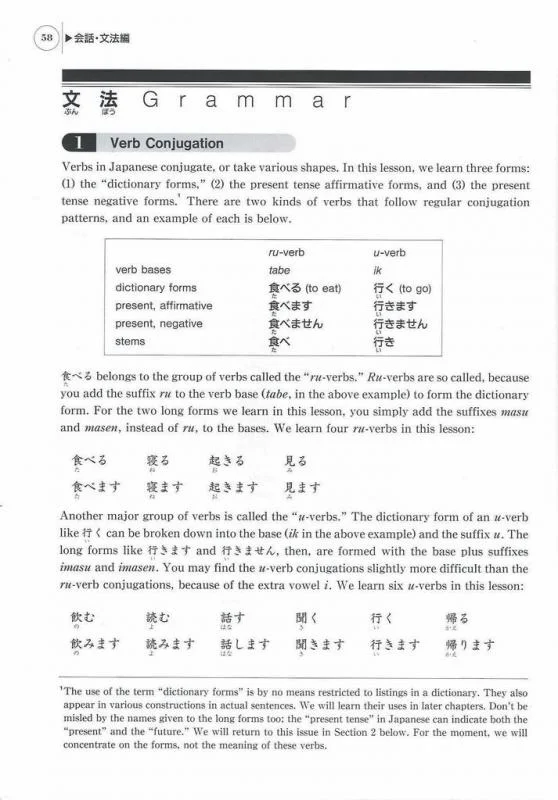
First one is simple after reading the text. -ru + masu. Then it goes to the -u verbs which took me a few seconds but I got it, instead of -#u + masu, you instead have -#u + -#i, and then masu. No biggie.
This is where I am stuck.
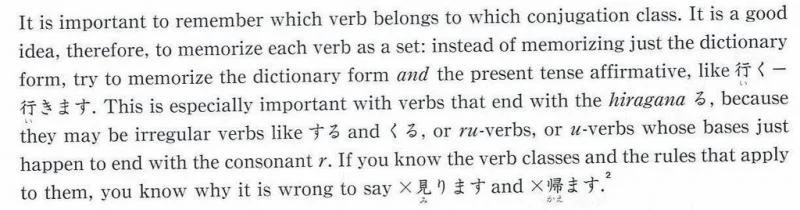
So I get the first part and it's natural, of course I remember the whole thing as "iku" and then "ikimasu". The sentence that starts with "This is especially..." is like...wait what? "suru" = shimasu? I remember reading that somewhere that is "to do" and i always thought it was shiru (before just today where i learned it was to speak, I believe, or is that shi/ra). "kuru" I am not sure what it means, unless this is the symbol whose On is "Rai"? (come). I think it is, somethign in my head remembers Rai/Ku(ru). I understand the last sentence because Miru is a ru verb and not a -u verb, kaerimasu is a -u verb (kaeru).
I dunno, maybe I'm just packing **** in there too complicated, like a tetris puzzle, leaving a lot of gaps, not clearing the important information...
--e
Perhaps it's because of my location but I've been told I have an "abrasive" language, so please forgive, it's a hard habit to kick especially when frustrated
First one is simple after reading the text. -ru + masu. Then it goes to the -u verbs which took me a few seconds but I got it, instead of -#u + masu, you instead have -#u + -#i, and then masu. No biggie.
This is where I am stuck.
So I get the first part and it's natural, of course I remember the whole thing as "iku" and then "ikimasu". The sentence that starts with "This is especially..." is like...wait what? "suru" = shimasu? I remember reading that somewhere that is "to do" and i always thought it was shiru (before just today where i learned it was to speak, I believe, or is that shi/ra). "kuru" I am not sure what it means, unless this is the symbol whose On is "Rai"? (come). I think it is, somethign in my head remembers Rai/Ku(ru). I understand the last sentence because Miru is a ru verb and not a -u verb, kaerimasu is a -u verb (kaeru).
I dunno, maybe I'm just packing **** in there too complicated, like a tetris puzzle, leaving a lot of gaps, not clearing the important information...
--e
Perhaps it's because of my location but I've been told I have an "abrasive" language, so please forgive, it's a hard habit to kick especially when frustrated
Glenn
一切皆苦
- 8 Jan 2004
- 7,842
- 200
Well, first of all -- you have a scanner?! Sweet!
Second of all, I didn't find anything you wrote abrasive.
Finally getting on to your concerns: I wouldn't worry too much about things you haven't already learned. I'm guessing する and 来る (yes, it is the rai character) will come in the next lesson or so. Just for now know that they are irregular, and remember to learn verbs in different forms when you come across them for now so that you will know how to conjugate them. Other than that it seems you've got it.
P.S. Shiru (知る) means "get to know" (usually just glossed as "know," which inevitably leads to the question "why do you say shitteimasu to mean 'know?'").
Second of all, I didn't find anything you wrote abrasive.
Finally getting on to your concerns: I wouldn't worry too much about things you haven't already learned. I'm guessing する and 来る (yes, it is the rai character) will come in the next lesson or so. Just for now know that they are irregular, and remember to learn verbs in different forms when you come across them for now so that you will know how to conjugate them. Other than that it seems you've got it.
P.S. Shiru (知る) means "get to know" (usually just glossed as "know," which inevitably leads to the question "why do you say shitteimasu to mean 'know?'").
Putrefaction
不幸中の幸い. . . がない.
- 7 Nov 2008
- 905
- 24
- Thread starter
- #69
I have a scanner, camera, and a Genki eBook Yes, I remember that that character is learn or interchangeably know, I fear that if I ask that question or look at it more than one time my head will explode...I'd do it as "shimasu" or "shirimasu" aaahhh!
Yes, I remember that that character is learn or interchangeably know, I fear that if I ask that question or look at it more than one time my head will explode...I'd do it as "shimasu" or "shirimasu" aaahhh!
Putrefaction
不幸中の幸い. . . がない.
- 7 Nov 2008
- 905
- 24
- Thread starter
- #71
Yeah, everyone says that when I progress I'll laugh at the mistakes I made and what I found "hard". As for what you wrote, everything flew straight over my head. I understood "shirimasu", so I guess it's a -u verb. Wait holy crap, is this what "kaimashita" means? I've known it was to buy, and I know kai/kau is buy, so kaimashita must mean "buy do", in a sentence, watashi wa hon o kaimashita, "I book buy do (bought)"!!
Glenn
一切皆苦
- 8 Jan 2004
- 7,842
- 200
Eh, close. You got the meaning right, but the mechanics wrong. 買います becomes 買いました for past tense; する is nowhere in there. That's just how the polite verb suffix ます conjugates.
Yeah, now that you mention it, I guess all those forms are brand new to you. I was trying to be comprehensive, but I guess I should have just gone with 知ります and します.
Yeah, now that you mention it, I guess all those forms are brand new to you. I was trying to be comprehensive, but I guess I should have just gone with 知ります and します.
Putrefaction
不幸中の幸い. . . がない.
- 7 Nov 2008
- 905
- 24
- Thread starter
- #73
Oh, whoops. See what happens when I infer wrongly, haha. Well, I'm sure I'll get them in a few days...I'm doing Japanese intensively. Now I'm doing Kanji 209-216 and calling it a night. Blargh.
Putrefaction
不幸中の幸い. . . がない.
- 7 Nov 2008
- 905
- 24
- Thread starter
- #75
Well, I've done about 232 Kanji as of today...like before, I can identify and define the Kanji, but if you ask me, for example, ask me to draw the Kanji for kyuu (rank), I couldn't do it. If it were in front of me and you asked me to define it I could definitely do it.
Hoping it'll be 250 by the end of the night.
Hoping it'll be 250 by the end of the night.


