

Navigation
Install the app
How to install the app on iOS
Follow along with the video below to see how to install our site as a web app on your home screen.
Note: This feature may not be available in some browsers.
More options
Style variation
System
Light
Dark

You are using an out of date browser. It may not display this or other websites correctly.
You should upgrade or use an alternative browser.
You should upgrade or use an alternative browser.
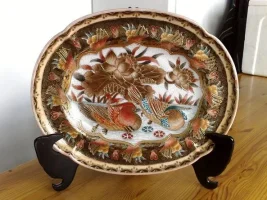
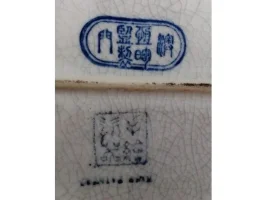
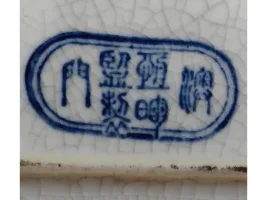
Help me translate signature mark
- Thread starter titatoli
- Start date

- 21 May 2003
- 14,310
- 4,404
?? Maybe .................
it takes an expert in Asian antiques to understand what the companies marks mean?? Seems strange no one answered this question.
Uncle Frank
it takes an expert in Asian antiques to understand what the companies marks mean?? Seems strange no one answered this question.
Uncle Frank


- 20 Aug 2003
- 4,910
- 416
Maybe this will be a good place to start.
Japanese porcelain marks
Antique China Porcelain & Collectibles
Topics - gotheborg.com
One of those shows English. One word that seems decipherable looks like "Patented".
Japanese porcelain marks
Antique China Porcelain & Collectibles
Topics - gotheborg.com
One of those shows English. One word that seems decipherable looks like "Patented".
@Uncle Frank - not an expert on antiques but an expert on seal script.
I am afraid the above is incorrect except for 門.
It cannot be 総門, as the left-hand side radical of the character to the extreme right (on the picture) is 氵 and not 糸. The bottom part of the latter are two hands, which can form many radicals in modern script. I wil have to look it up in a dictionary, so bear with me. I agree with the 門 character.
The middle bottom is not 黎明. First the top left radical of the first character is not 禾 but 未, and the right top is not 勿 but 刀. Bottom radical of this character doesnt ring a bell, so it would require some research. The other charatcer is 暉 and not 明 (though the meaning of both is similar). The right hand side of the bottom-right character seems to be somewhat similar to one of many seal script forms of the 月 but it is not.
The top middle text. Left hand side character is not 堅. Top right radical it is not 又, and the bottom one is definitely not 土. The correct character is 監. The right hand side character is slightly blured so I'd appreciate a more clear picture, especially of its right-hand side, as the left one seems to be 心. In fact, a clear picture of the second seal would be most helpful, too.
Edit: I think the bottom-left character preceding 暉 is 製, which means manufactured by/in. 暉 can be either first character of person's name / alias, or factory name. Note that 暉 is a variant of 輝, though looking at the seal script on the seal, it is definitely written as 暉.
Hi,
I tried to read them.
They are old style of kanji.
They can be read like that...
<総門(somon)main gate><黎明(reimei) daylight> <堅?(?)>
I am afraid the above is incorrect except for 門.
It cannot be 総門, as the left-hand side radical of the character to the extreme right (on the picture) is 氵 and not 糸. The bottom part of the latter are two hands, which can form many radicals in modern script. I wil have to look it up in a dictionary, so bear with me. I agree with the 門 character.
The middle bottom is not 黎明. First the top left radical of the first character is not 禾 but 未, and the right top is not 勿 but 刀. Bottom radical of this character doesnt ring a bell, so it would require some research. The other charatcer is 暉 and not 明 (though the meaning of both is similar). The right hand side of the bottom-right character seems to be somewhat similar to one of many seal script forms of the 月 but it is not.
The top middle text. Left hand side character is not 堅. Top right radical it is not 又, and the bottom one is definitely not 土. The correct character is 監. The right hand side character is slightly blured so I'd appreciate a more clear picture, especially of its right-hand side, as the left one seems to be 心. In fact, a clear picture of the second seal would be most helpful, too.
Edit: I think the bottom-left character preceding 暉 is 製, which means manufactured by/in. 暉 can be either first character of person's name / alias, or factory name. Note that 暉 is a variant of 輝, though looking at the seal script on the seal, it is definitely written as 暉.
Last edited:
Oh!!
I was not sure my idea was right, so I showed photos of my mobile phone to a teacher who taught Japanese.
I had thought 塩? 藍?(but has no くさかんむり kusakannmuri) 堅? 監? We are sorry that both of us are not clear about such old plates:sorry:We disccused about these kanji watching the image. She said that I might be right and said that she would check old kanji dictionary later. But she and I haven't checked...really sorry for all :sorry:
but it was very interesting trial for me to read kanji on bottom of an old plate.
---------- Post added at 01:46 ---------- Previous post was at 01:13 ----------
I will try to check them again!
I was not sure my idea was right, so I showed photos of my mobile phone to a teacher who taught Japanese.
I had thought 塩? 藍?(but has no くさかんむり kusakannmuri) 堅? 監? We are sorry that both of us are not clear about such old plates:sorry:We disccused about these kanji watching the image. She said that I might be right and said that she would check old kanji dictionary later. But she and I haven't checked...really sorry for all :sorry:
but it was very interesting trial for me to read kanji on bottom of an old plate.
---------- Post added at 01:46 ---------- Previous post was at 01:13 ----------
I will try to check them again!
Japanese teacher will not know the answer to this question, only someone who studies calligraphy, and studies it for quite a long time. The seal script forms, and even some clerical script forms can be VERY different (I do not mean the visual appearance, as this is sort of a given, but their radicals) from the standard script forms. In fact, an average Japanese person cannot even read cursive script, or at least larger part of character written this way. Don't be sorry. Those who try and research should not be sorry. Seal script dictionaries are very specialised books and are a rare sight in Japanese homes. The knowledge of seal script is even rarer. Again, this is a very narrow discipline, as even many calligraphers cannot read seal script. I have been studying seal script for a few years now, and it took me quite some time to decipher this text, even then I still cannot find those two remaining characters. I'd probably need to consult this with my calligraphy teacher, who specilises in research of Chinese characters for nearly 60 years. If you want to confirm what I wrote in my above post, print my text, go to kinokuniya, ask for a 篆書大字典 and check it. Mind you, I had to consult three disctionaries, so one may not do much good.

- 14 Mar 2002
- 21,054
- 18,909
I have a lamp 14 to 16 inches tall is my lamp worth.
You must provide us with more details than an approximate size. Is it Japanese? How about a photo?
- 21 May 2003
- 14,310
- 4,404


