


- 14 Mar 2002
- 21,050
- 18,903
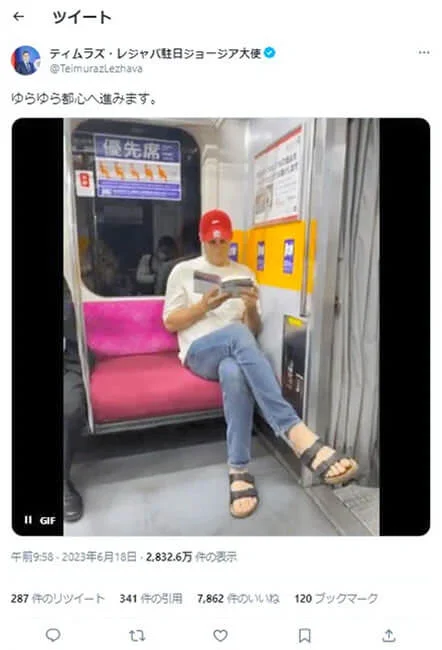
The Georgian ambassador to Japan, Teimuraz Lezhava, sparked a lively debate after tweeting a short video of himself riding a subway car in a priority seat reserved for passengers who are elderly, pregnant or have a disability. Mr Lezhava is no stranger to Japan: he has lived in this country for many years, graduated from a university here and worked for a company in Japan before he was appointed charge d'affaires of the Embassy of Georgia in 2019. He has served as ambassador since 2021.
When he and his family took the train on a Sunday in June, he reckoned there was no reason to put up with standing when the seat was unoccupied: "All you have to do is offer the seat when someone in need comes along." This caused a Twitter storm.
Masaya Kobayashi, a professor of public philosophy at the Graduate School of Chiba University, welcomes the debate and bemoans the mindset that comes with a lack of flexible thinking and forces an opinion on others, as illustrated by the prevailing view that priority seats should be kept free for those in need.
A nationwide online survey by the transport ministry last November asked people aged 20 and older about the consideration they give to others while using public transportation:
On why respondents wouldn't offer their seats, 42.7 per cent said they were unsure whether the passenger needed a priority seat, 30.8 per cent said they were not feeling well or had injuries themselves, and 18.8 per cent said they needed priority seats because of their physical frailty.
I have seen cases where (elderly) passengers offered seats declined them, as if they were being offended for "being considered old and frail".
When he and his family took the train on a Sunday in June, he reckoned there was no reason to put up with standing when the seat was unoccupied: "All you have to do is offer the seat when someone in need comes along." This caused a Twitter storm.
The diplomat said that priority train seats are also available in his home country, "Many Georgians would think the same way." In response to those who believe priority seats should be left vacant, Lezhava said: "That is probably because if everyone chooses not to sit in the first place, there is no need for anyone to take the trouble of offering the seat." Unwittingly, Lezhava pointed a finger at the state of disconnect in contemporary Japanese society. "With people becoming less and less associated with each other, they shy away from communication that arises when they concede the seat to each other, finding it troublesome," he said.
At the same time, he had nothing but praise for the sense of unity in Japanese society that places importance on group harmony rather than the individual, calling it highly reasonable and advantageous. But there is also a downside, he believes, because it forces people not to make decisions that might be at odds with the majority. In short, Lezhava noted Japanese are loathe to be put in a situation where they stand out. "It's not good to impose excessive peer pressure," Lezhava continued. "I want to be strong enough to resist (such social pressure)."
Masaya Kobayashi, a professor of public philosophy at the Graduate School of Chiba University, welcomes the debate and bemoans the mindset that comes with a lack of flexible thinking and forces an opinion on others, as illustrated by the prevailing view that priority seats should be kept free for those in need.
A nationwide online survey by the transport ministry last November asked people aged 20 and older about the consideration they give to others while using public transportation:
- Nearly 60 per cent said they do not sit in priority seats when using public transportation (42.3 per cent said they seldom do so, and 17 per cent never occupy a priority seat)
- 7.4 per cent said they sit "often" in a priority seat
- 3.3 per cent "sometimes"
- 80 per cent give up their seats for seniors, passengers with disabilities and others in need (57.7 per cent "often", 23.9 per cent "sometimes".
On why respondents wouldn't offer their seats, 42.7 per cent said they were unsure whether the passenger needed a priority seat, 30.8 per cent said they were not feeling well or had injuries themselves, and 18.8 per cent said they needed priority seats because of their physical frailty.
I have seen cases where (elderly) passengers offered seats declined them, as if they were being offended for "being considered old and frail".


