gen has (para) but no words found using that reading

cloa513

Sempai
Joined
28 May 2016
Messages
355
Reaction score
106
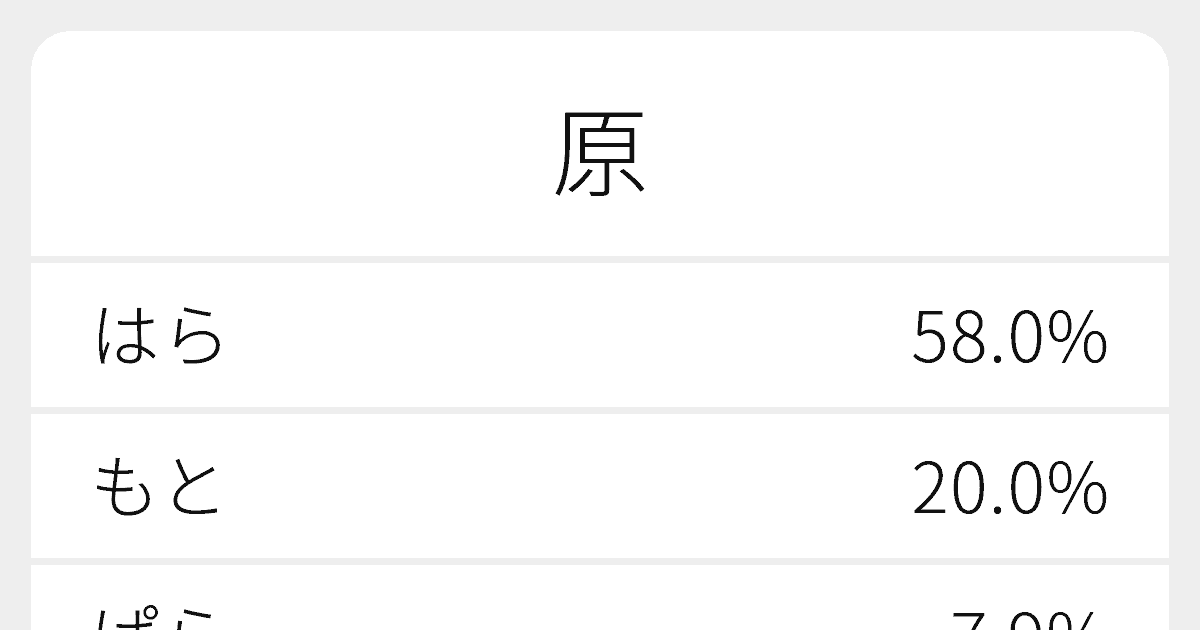
My son has second grade kanji reading book and it lists for the kanji 原 a reading in brackets of ぱら as well as げん and はら and I have found no words using that para reading. Does anyone know one? Is it for names? Being him he wouldn't ask the teacher. His Japanese mother doesn't know any. His textbooks have no information.
 
Looks like a typo. Even if it exists in some obscure place it doesn't seem like it should be included in a 2nd grade reader.
 
It probably meant to say ばら (bara) instead, and as @mdchachi says, is a typo.
 
In the kanji learning、
It is difficult about telling the kanji when I do not understand difference between sound reading and Japanese reading.
音読み(onyomi) : There are many things that a meaning does not understand only by having heard it by a reading based on old pronunciation of China.
訓読み(kunYomi) : There are many things that a meaning is identified just to have heard it by a Japanese reading to express the meaning of the kanji.


音読み(onyomi) : ゲン (Gen) The meaning of this is. もと。おおもと。はじめ。おこり。「原因」「原始」"cause" "beginning"
訓読み(kunYomi) : はら (Hara) flat land

はら(Hara)は日本の地名や人名で使われる。It forms, and (Hara) is used by the Japanese place name and person's name..
地名コレクション The place name collection
苗字 surname
・原口 (Haraguchi) 原田(Harada) 上原(Uehara) 中原(Nakahara)

"Hara" may change by a reading in "Bara" "Para" "Wara".
藤原(Fujiwara)
秋葉原(Akihabara)
野っ原(Noppara)

2年生・原っぱの「原・はら」を原因の「原・ゲン」でなぜ使うの?漢字の意味の変転・授業in沖縄
 
は, ひ, ふ, へ and ほ often changes to ぱ, ぴ, ぷ, ぺ and ぽ, respectively, after 促音(small tsu っ) or 撥音(ん) in a compound word. This is a kind of 連濁.
examples
発(はつ e.g. 開発 かいはつ)
出発 しゅっぱつ
奮発 ふんぱつ

品 (ひん e.g. 送品 そうひん)
逸品 いっぴん
返品 へんぴん

風(ふう e.g. 和風 わふう)
疾風 しっぷう
寒風 かんぷう

変(へん e.g. 改変 かいへん)
一変 いっぺん
天変 てんぺん

砲(ほう e.g. 大砲 たいほう)
鉄砲 てっぽう
艦砲 かんぽう

Here's examples of the reading ぱら.

All the examples are after small tsu in the page, and most of them are proper nouns(location names). The only two exceptions are 野っ原(のっぱら), as nagashima-san provided, and 草っ原(くさっぱら). (Note that the readings are のはら and くさはら(そうげん is also possible) if small tsu isn't there.)
 
Back
Top Bottom