On Friday, the Japanese government announced that China would be lifting its long-standing ban on Japanese beef imports, allowing trade to resume after a 24-year suspension. Beef exports from Japan to China were halted in 2001 following the outbreak of mad cow disease (bovine spongiform encephalopathy) in Japan. Officials in Tokyo stated they will continue to engage in bilateral consultations with China to ensure the agreement's formal implementation and to facilitate an early resumption of beef exports.
The latest development regarding beef shipments follows the lifting by China in June of its blanket ban on Japanese seafood imports, introduced in 2023 after Japan began releasing treated radioactive wastewater from the crippled Fukushima Daiichi nuclear power plant into the sea. Chinese customs authorities have registered three Japanese marine product exporters, its website showed Friday. The positive moves in bilateral relations reflect China's desire to strengthen ties with Japan as Beijing's rivalry with Washington intensifies.
Japan's government said Friday China completed a key step toward resuming Japanese beef imports, paving the way for their restart after a 24-year hiatus.
Why now? For years, China has been smuggling wagyu beef via Thailand, and the wealthy elite and high-ranking Communist Party officials have been enjoying it. Announcing this at this timing looks like support for the Ishiba Cabinet and the LDP, who are struggling in the House of Councillors election.
It All Started with a Meeting in Bangkok... Five-Year Pursuit of the Wagyu Smuggling Route Shifts to Central Asia
Target: Wagyu Beef
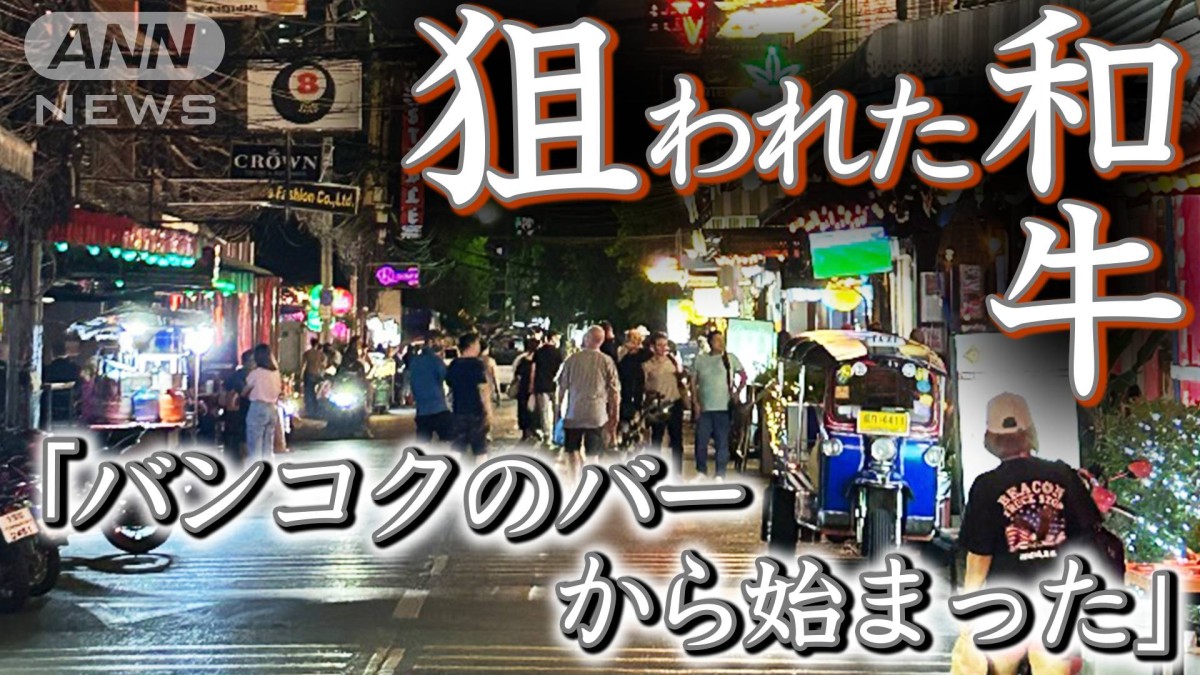
"It started from a bar in Bangkok."
One summer day in 2018, at a back-alley bar just off a main street in Bangkok, Thailand, I, then working at the Bangkok bureau, was drinking with a friend at the counter.
"I import beef," said a man sitting next to us, mixing English and Japanese. He was a Cambodian man who ran a yakiniku restaurant in Phnom Penh. He proudly showed me a photo of Wagyu he had eaten while visiting Japan.
When I asked, "Do people in Phnom Penh eat Wagyu too?" he laughed and said, "Wagyu is too expensive in Cambodia. Only important people eat it."
He then told me he had come to Bangkok to buy meat and transport it back by truck.
Thinking to myself, "Customs between Thailand and Cambodia are pretty lax, so it might be possible," I parted ways with him without even exchanging contact information.
Little did I imagine that five years later, I would be searching for him to solve the mystery surrounding Wagyu.
"Could We Investigate China's Black Market Wagyu Route from the Japanese Side?"
In the fall of 2022, after returning to Japan, I was covering livestock topics, focusing on how the livestock industry was tackling sustainability goals (SDGs) by reducing methane gas from cattle burps.
Through these reports, I met progressive livestock farmers and Wagyu wholesalers active in overseas exports.
Then in October 2022, I was contacted by a colleague from the China bureau: "China may finally lift its ban on importing Wagyu."
Beef exports from Japan to China had been suspended since 2001 due to BSE concerns. After 20 years, exports were expected to resume.
The colleague quietly said, "Actually, Wagyu has been entering China through black market routes all along. Can we investigate these routes from Japan?"
Emerging "Cambodia Route" — Farmer Confession: "Even in Blocks Is Fine..."
As I dug deeper, "Cambodia" surfaced as a smuggling route to China.
A man I met through livestock interviews mentioned, "I heard livestock farmers in Kyushu once shipped Wagyu for Cambodia."
I flew there immediately and secured an anonymous interview.
He confessed, "I was asked to provide beef for Cambodia—about five or six cattle worth. We transported it to a meat processing plant in the Chugoku region. From there, I heard it might go via Hong Kong... Honestly, as producers, we don't know those details. But they told us, 'Anything is fine, even in blocks.'"
However, it was unclear if that meat really ended up in Cambodia.
We couldn't find much even after checking local information via the Bangkok bureau.
That's when I remembered the Cambodian man I met in Bangkok five years earlier.
Testimony: "Wagyu Does Not Enter Cambodian Ports"
I thought asking him might open a breakthrough. Though I regretted not exchanging business cards, I searched social media using his unique name and face I remembered.
After entering certain keywords, I found one Cambodian man. His name was slightly different, but the profile photo matched my memory, and the posts confirmed his identity.
Through a friend living in Bangkok, I managed to contact him and arranged an interview in Phnom Penh.
Notes from my Bangkok bureau colleague included:
He knew the route existed.
He'd been approached with business offers to reprocess Wagyu in Cambodian factories and export it to China as "Cambodian processed meat."
But no Wagyu actually entered Cambodian ports.
Wagyu couldn't be found anywhere in Cambodia.
The meat was likely transshipped before entering Cambodia.
In November last year, alongside the Japan-China summit, we reported both the "expectation for resumption of Wagyu exports to China" and "suspicions of roundabout Wagyu exports" using testimonies and trade data.
We never obtained definitive proof of smuggling.
After the broadcast, a livestock industry insider in Tokyo laughed on the phone:
"Sometimes you have to turn a blind eye. There are necessary evils in this world. It's not like they're getting it for free—they're buying it."
I wanted to argue, but at the time all I could say was, "That's true."
One Fax Reveals the Smuggling Route: Tracking Numbers
In February this year, as I was looking for a new project after finishing a feature on eco-friendly cattle burps, I happened to receive a fax from the Kanagawa Prefectural Police while covering for an absent colleague.
The title read:
"Arrest of Suspect for Violation of the Customs Law and Livestock Infectious Diseases Control Law"
It described a case where beef was falsely declared as bound for Cambodia and was actually exported elsewhere.
My pulse quickened. This might finally connect all the pieces.
We formed a special team, crossing departmental lines: Bangkok bureau, China bureau, Kanagawa police correspondents, and general reporters.
Our sole focus: "How did the police manage to bust it? What evidence did they find?"
Things progressed smoothly from there.
"The Market Price for Loin Cuts Has Started Moving" — Central Asia Surfaces
On June 26, at Yokohama District Court, a man appeared for sentencing after repeatedly smuggling Wagyu worth 4 billion yen by disguising it as exports for Cambodia.
He wore rimless glasses, a slightly wrinkled navy suit, and a checkered shirt.
The sentence: "2 years and 6 months imprisonment, suspended for 4 years, and a fine of 2.5 million yen" (plus a 4 million yen fine for the corporation).
The judge stated the penalty was to make the perpetrator realize that short-term profit wasn't worth the crime.
Five years after meeting that man in the Bangkok bar, part of the "Cambodia route" had finally been uncovered.
Yet, even four months after the case was filed this February, Japan had yet to implement any specific measures to prevent such smuggling.
Recently, I met again with the livestock insider at a yakiniku restaurant in Tokyo.
He casually said while grilling beef, "Recently, the market price for loin cuts has been moving again."
That signals high-end cuts unsold in Japan are being smuggled to China.
Then he added, "Right now, Tajikistan is hot."
A republic that gained independence after the Soviet Union's collapse, with agriculture as its main industry and a per capita GDP of $905.7.
An inland country surrounded by Afghanistan and Kyrgyzstan.
I wondered: "What logic do they use to prepare customs documents?"
Now, the stage has shifted to Central Asia, and the hunt for Wagyu continues.
Background of Widespread Wagyu Smuggling: Governmental Fragmentation
Since February, suspects have been arrested for falsifying exports as bound for Cambodia and actually shipping to Hong Kong, charged with customs law and livestock disease prevention law violations.
The police traced smuggling through international container ship "transport histories."
These are open to the public online and were used to confirm that Wagyu had not arrived in Cambodia.
One company listed on customs documents as the receiver turned out to be a dormant Japanese-affiliated company in Phnom Penh with no real business.
Reviewing past documents tied to that company revealed over 4 billion yen in illegal exports.
By the end of June, five people and three companies had been arrested or exposed for using the same smuggling method.
According to police, "It wasn't just the police—customs and others cooperated across departments to protect Japan's interests. By catching the ringleader, we sent a message to the industry: 'We won't look the other way anymore.'"
Many in the livestock industry had said, "Everyone knows, but no one gets busted." That changed here.
Could Tracking Transport Histories Prevent Illegal Wagyu Exports?
When I asked livestock insiders exporting to Hong Kong, they answered clearly:
"If the Japanese government really wanted to regulate this, they could easily tighten the rules just by changing a few things."
Currently, Japan's Ministry of Agriculture, Forestry and Fisheries (MAFF) has no specific measures to track containers carrying Wagyu.
But the insider suggested:
"If they just required 'post-export reporting,' illegal exports would drop dramatically."
For example, exporters would have to report afterward that the shipment actually arrived in Cambodia.
Those who report properly could export again. Those who don't would be refused next time.
If someone filed a false report, it would be forgery, punishable by law, so honest companies would comply.
The insider added, "I don't think the Japanese government really wants to crack down."
MAFF's Response: "Enforcement Should Be the Importing Country's Responsibility"
When we asked MAFF if the Japanese government really had no intention to regulate, officials in charge of quarantine and overseas exports said:
"We are aware of the Kanagawa police case. Exporting domestic beef below market value undermines producers and risks harming trust in Japanese beef."
They said they had already shared information with Hong Kong authorities and requested thorough legal compliance from Japanese exporters.
Why can't smuggling via Cambodia and Hong Kong—routes everyone knows about—be stopped?
The official said:
"Countries conduct import quarantine to prevent livestock diseases. Japan issues export quarantine certificates only for products that meet safety standards. It is the importing country's responsibility to crack down on illegal imports."
When I asked if "post-export reporting" could help, two MAFF officials seemed interested but noted:
"Tracking may be possible. However, MAFF's jurisdiction is limited to livestock disease prevention. Strengthening regulation would need to be based on the Livestock Infectious Diseases Control Law."
In other words, they implied regulating beyond disease concerns would be difficult.
They advised checking with customs authorities as well.
Bureaucratic Fragmentation: Customs Says, "Ask the Ministry of Land, Infrastructure, and Transport"
We sent the same questions and suggestions to customs.
Two weeks later, we received a response:
"Beef exports fall under MAFF's jurisdiction. We confirm if export quarantine certificates are issued as required and cross-check customs declarations."
Regarding post-export reporting obligations, they replied:
"Imposing such obligations would place a heavy burden on all exporters. Please also consult the Ministry of Land, Infrastructure, and Transport."
When we contacted MLIT, they said, "This incident is not under our jurisdiction. Please ask MAFF."
We were literally passed around.
It felt like no one wanted to take real responsibility.
Conclusion
MAFF calls itself the "control tower" for promoting agricultural exports, but if it knowingly ignores smuggling, it risks losing trust.
On MAFF's website, it says:
"As the control tower for promoting the export of Japan's agricultural and food products, the government has established a system to strategically promote exports and support exporters."
But if the control tower ignores reality, trust will inevitably be lost.
This site uses cookies to help personalise content, tailor your experience and to keep you logged in if you register.
By continuing to use this site, you are consenting to our use of cookies.


 english.kyodonews.net