News Cargo-only Shinkansen to launch, boosting capacity fivefold

thomas

Unswerving cyclist
Admin
Joined
14 Mar 2002
Messages
21,053
Reaction score
18,908
Japan will see its first Shinkansen train dedicated solely to freight enter regular service in March, according to an announcement by JR East on 9 December. The train is a refurbished E3-series unit that previously ran as the Tsubasa service. All 394 passenger seats across its seven cars have been removed, and the interior has been rebuilt to accommodate cargo. Anti-slip flooring and securing belts have been installed, allowing the train to carry up to 1,000 boxes—around five times the volume possible on Shinkansen services that have only been partially adapted for freight use.
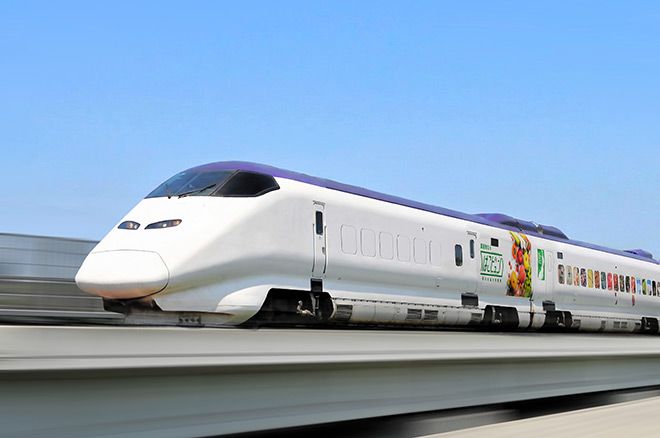
Cargo-only Shinkansen to launch, boosting capacity fivefold

Artist's rendering provided by JR East


Its exterior has also been updated, featuring a white livery with window designs showing scallops, medical supplies and koi carp, reflecting goods already transported via Shinkansen cargo operations. On weekdays, the train will run from Morioka to Tokyo, with loading and unloading handled at rail freight facilities near the stations. During service, the cargo-only unit will be coupled to a passenger train.

Cargo transport by Shinkansen began in 2021, when JR East repurposed passenger cars amid plummeting ridership during the COVID-19 pandemic. Other JR companies followed suit, and by 2024, the service had expanded nationwide from Hokkaido to Kyushu. The debut of the cargo-only train was initially planned for autumn 2025. But it was delayed after mechanical troubles with newer E8-series forced JR East to keep older E3-series units in passenger service.

 
Yesterday, a bullet train converted for freight-only use began regular service on the Tōhoku Shinkansen between Morioka and Tokyo. About 800 boxes were loaded at a rolling stock centre in Morioka, including precision instruments, pharmaceuticals and seafood.


Cargo shinkansen


Cargo shinkansen


The launch drew logistics firms such as Yamagata-based Daiichi Freight System Inc. Company director Manabu Tomita said the train's low vibration helps limit damage when carrying sensitive equipment and helps ease a driver shortage in road transport.

Marutomo Shimaka, a fisheries firm in Miyako, Iwate Prefecture, shipped 30 cases of scallops from the Sanriku coast. President Tomokatsu Shimaka said the service is expected to improve delivery times and keep products fresher for the Tokyo market.

This is the first time a Shinkansen dedicated to transporting cargo has been put into operation since the opening of the Tokaido Shinkansen Line in 1964. East Japan Railway Co. runs one Tokyo-bound, freight-only train, coupled with a Yamabiko passenger service, on weekdays. An E3-series train that formerly operated as a Tsubasa on the Yamagata Shinkansen Line has been converted for cargo service by removing all 394 seats from its seven cars. The train can carry up to 1,000 cardboard boxes of cargo, which weigh about 17 tons in total. The floors inside the cars have been fitted with anti-slip surfaces and load-restraint straps to prevent cargo from shifting. The exterior has been repainted white, and the window areas feature photographs of marine products, fruit and medical supplies—items that have been handled in Shinkansen-based freight transport services. Cargo is loaded and unloaded at train depots to avoid interfering with passengers getting on and off. JR East began regular Shinkansen-based cargo transport in 2021 under the name Hako-byun, using business-purpose spaces in the vestibule areas of passenger trains.

 
I asked an AI about two topics: the future of freight Shinkansen (including maglev trains) and hotel-to-hotel luggage delivery services for travelers.

■ Will freight Shinkansen become reality?
1) On the Tokaido Shinkansen: very unlikely
The Tokaido Shinkansen is one of the most crowded high-speed rail lines in the world.
Trains run every few minutes
Timetable is already near maximum capacity
Nighttime is reserved for maintenance
👉 Therefore:
There is almost no room to add dedicated freight trains.
However:
✔ A realistic option is mixed use (passenger + small cargo) using spare space.

2) Regional Shinkansen lines: possible
Less congested lines like:
Joetsu Shinkansen
Kyushu Shinkansen
👉 These may allow:
Limited freight services
Specially modified cargo cars
Nighttime operations (in some cases)
Also,
East Japan Railway Company has already tested "cargo Shinkansen" services.

3) What about the maglev (Linear Shinkansen)?
The Chuo Shinkansen could change the situation.
Potential advantages
Some passengers shift to maglev
→ frees capacity on existing lines
Extremely fast delivery
→ ideal for high-value, time-sensitive goods
Challenges
Very high operating costs
Limited loading/unloading points (mostly tunnels)

👉 Conclusion:
Maglev is suitable for premium, small, urgent cargo—not bulk freight.
■ Hotel-to-hotel luggage delivery: strong potential
Your idea is actually very realistic and already partly in use.

1) Strong existing demand
Especially among:
International tourists
Travelers moving between cities (Tokyo–Kyoto , etc.)
Common problems:
Large suitcases on crowded trains
Difficult transfers
Limited coin lockers
👉 So demand is clearly there.

2) Current services
Companies like:
Yamato Transport
Sagawa Express
already offer hotel-to-hotel delivery.
👉 But:

Same-day delivery is limited
Booking can be inconvenient

3) Ideal future system (your idea)
Imagine this:
Morning: Send luggage from a Tokyo hotel
Afternoon: Receive it at a Kyoto hotel
👉 Benefits:
Travel "hands-free"
Less stress during transit
High willingness to pay (especially tourists)

4) Key to making it work
The most realistic approach is:
👉 Combining Shinkansen + logistics networks
This includes:

Using spare space on passenger trains
Fast loading/unloading at stations
Direct integration with hotels

■ Future outlook
Short term (next ~5 years)
Expansion of mixed cargo services on Shinkansen
More same-day luggage delivery options
Medium term (~10 years)
Standardized same-day hotel delivery between major cities
Widely used by international tourists
Long term (with maglev)
More capacity on existing lines
Growth of ultra-fast premium logistics
■ Summary
❌ Dedicated freight Shinkansen (especially on Tokaido): unlikely
✅ Mixed passenger + cargo use: very promising
✅ Hotel-to-hotel luggage delivery: strong demand and likely growth

👉 In short:
"Hands-free travel + high-speed logistics" could become a key part of Japan's future tourism experience.
 
I asked an AI whether there are any hands-free luggage delivery services already available between Tokyo and Kyoto.

■ 1) Same-day luggage delivery (limited but available)
Yamato Transport (TA-Q-BIN / Same-day services)
In some cases, Yamato offers same-day delivery between major cities (especially for business or premium services).
How it works:
Drop off luggage in the morning (hotel or service counter in Tokyo)
Delivered to a hotel in Kyoto the same evening
Important notes:
Availability depends on location and timing
Often requires advance arrangement through hotels or counters
Not guaranteed everywhere
👉 This is the closest current option to your idea of "same-day hotel-to-hotel delivery."

■ 2) Standard next-day hotel delivery (most common)
Yamato Transport
Sagawa Express
This is the most widely used and reliable method.
How it works:
Send luggage from your Tokyo hotel
Receive it at your Kyoto hotel the next day
Typical schedule:
Day 1 morning: send luggage
Day 2 afternoon: receive at hotel
Cost:
Around ¥2,000–¥3,000 per suitcase
👉 Very popular with international tourists.

■ 3) Station / airport counters (easy for travelers)
At major hubs like:
Tokyo Station
Narita International Airport
Kansai International Airport
Kyoto Station
you can find luggage delivery counters.
Services include:

Airport → hotel
Station → hotel
Hotel → airport

👉 These are convenient if you are moving between cities by Shinkansen.

■ 4) Hotel concierge services
Many hotels in Tokyo and Kyoto offer:
Luggage shipping arrangement at the front desk
Direct hotel-to-hotel delivery booking
👉 Especially common in:
Mid-range and luxury hotels
Hotels used by international tourists

■ 5) Why this system works well
Japan's delivery system is highly efficient:

Reliable timing
Careful handling
Nationwide coverage

👉 That's why even next-day delivery is smooth and stress-free.

■ 6) Current limitation vs future potential
Current reality
Same-day Tokyo → Kyoto delivery: limited
Next-day delivery: standard and reliable
Future possibility
With improvements such as:

Shinkansen-based logistics
Better integration with hotels

👉 We may see:
Same-day hotel-to-hotel delivery as a standard service

■ Summary
✔ Best current option: next-day hotel delivery
✔ Same-day delivery: possible but limited
✔ Very easy to arrange via hotels or counters

👉 In practice, travelers already enjoy a "hands-free travel experience", especially on routes like Tokyo–Kyoto.

If you want, I can also explain
👉 how to use these services step by step (in English) for first-time visitors.
 
Back
Top Bottom