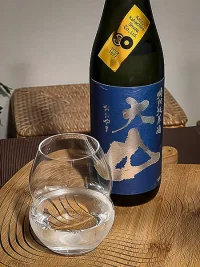
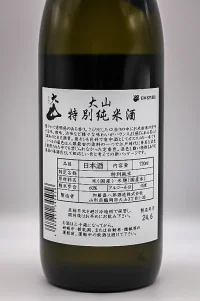
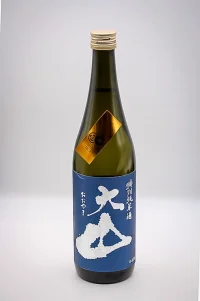
Sake specs
- Prefecture
- Yamagata (山形)
- Rice type
- Hitomebore (ひとめぼれ)
- Polishing rate (semaibuai)
- 60%
- Alcohol content
- 15%
- SMV
- +3.0~4.0
- Acidity
- 1.5~1.6
- Amino acid level
- 0.95~1.05
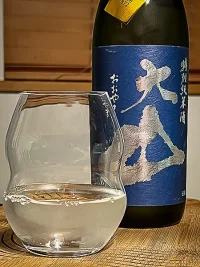
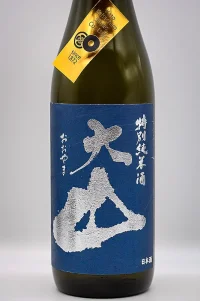
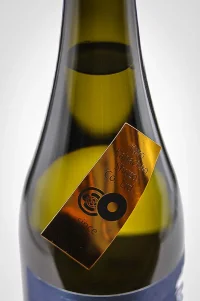
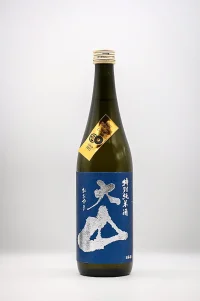
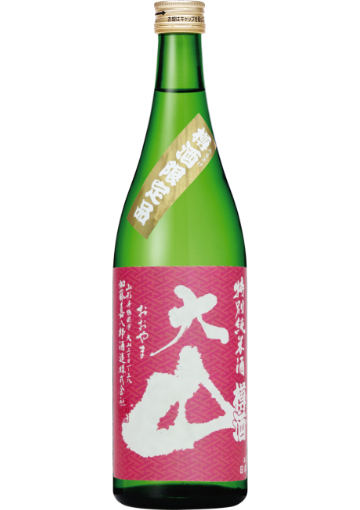
Katō Kahachirō Ōyama Tokubetsu Junmai (大山 特別純米酒 藍色ラベル) is made of Hitomebore and Dewanosato rice milled to 60%. Light and smooth on the palate, this is a soft, well-balanced, and harmonious sake. Since ancient times, Indigo is a traditional colour familiar in Japan and will never fade away. It was chosen as the base colour of the standard sake. Indigo also refers to the word 'love' in the brewery's catchphrase, 'Sake is Oyama Ai no Sake'. The packaging was created hoping the sake would continue to be popular for many years.





About the brewery
- Brewery
- Katō Kahachirō Shuzō
- Name in Japanese
- 加藤嘉八郎酒造
- Address
- 3-1-38 Ōyama, Tsuruoka, Yamagata 997-1124
- Phone
- 0235-33-2008
- Website


The brewery was founded in 1872 in the Ōyama area. Only a few breweries remain, and the old days have faded, but the sake was named 'Ōyama' as a region representative. The company is descended from Katō Kiyomasa, a feudal lord patronised by Toyotomi and the lord of Kumamoto Castle in Kyushu, with 530,000 koku of rice. In the early Edo period, Kiyomasa and other powerful foreign lords were obstacles to the newly established shogunate. After his death, his eldest son, Tadahiro, was relieved of his lands and placed under the custody of the Sakai family in Tsuruoka for his involvement in the heir disputes of the third Tokugawa shogun . Subsequently, some of Tadahiro's sons and daughters started their sake breweries.
Shonai, a rice-producing region surrounded by Chōkaisan (鳥海山) and Dewasan (出羽三山) and blessed with abundant subsoil water and the Mogami River (最上川), has been famous since the Edo period as one of the country's leading rice-producing regions, both in terms of quality and quantity. Many sake brewers in the Tōhoku region are said to have learnt from 'Ōyama' (e.g. Akita's Yamauchi Tōji). In 1973, the company developed its own 'OS tank', with which temperatures can be controlled with an accuracy of 0.2°C. In 1978, the KOS Kōji Making Machine was also developed in-house.