Need a Kanji Translated? Just ask!

The first one means "long time" and the second means "different". They don't mean anything together... in Japanese. Luckily, though, this is a greeting term used among friends in Chinese that means something like "long time no see" or just that it's been a while since something happened. On Baidu they offer explanations and example sentences; of the ones that involve greeting friends not seen in a while, two are from the Qing Dynasty (1636-1912), and the third was written by a guy who died in 1957. The one for a feeling is more modern:

这里一切都是那么陌生,又是那么的亲切,那种久违的快乐、久违的轻松又回到了我的身边。
"Everything about this place is so strange, yet so familiar. That old joy and relaxation have come back to me."
 
I was reading a manga today and it said 着替え? And the official translation said "Do you want to change?", and it makes perfect sense on the context.
So when intonated correctly this means "want to~" ?

見え? = Want to look then?
 
着替え is the noun usage of the -masu stem of 着替える. It can refer to both the action "changing clothes" and "extra clothes".
 
好きでいってるわけじゃない!僕ら中の人たちを見捨てた!目的を果たすために

How would you translate the first line? suki de itteru wake ja nai, no clue what it means

official translate : When I say we can't I mean it! We already had to abandon the people inside! We had to get out!

I had a similar translation but no clue where they got the first line from

edit: Could it mean "Don't say things as you like"
 
Literally, it means "I say it, not because I want to say it". (= I don't want to say it, but it's the fact.)
 
yeah thats what I was kind of thinking, but where does the "want" come from ? Or is it rather "I say it, not because I like(好き) to say it". But you reworded it otherwise ?

Also is this like a set phrase or something I thought wake ja nai negated 言ってる.
 
じゃない negates わけ, and the rest of the clause describes わけ.
Simliarly and perhaps easier to see, そういうわけじゃない means "It's not for that reason."

You can't really express the meaning naturally in English and still use the word 'like', although 'It is not out of liking that I say it' is reasonably close and reasonably literal. Of course, that sounds like a dusty phrase from Victorian times or earlier. Toritoribeさん's translations are both natural modern English with similar meaning.
 
Yes, that's right. Here's an alternative literal translation.

"I'm not saying it because I like to."

If you want to split the sentence further, 好きでいってる here means "to say as one pleases" and わけじゃない means "is not the case"
So the whole means "It is not the case that I'm saying whatever I like", or more generally, the above sample.

It's just that in english, 'want' is more commonly used in such a situation. So "I'm not saying it because I want to", or Toritoribe's translation is also correct.
 
Yes that makes more sense now. Thanks guys. I actually like the official translation one , I first thought what you guys said but when I look at the translation it looks trippy as hell. I have come to realize though alot of the translations aren't made for someone studying japanese rather so it sounds better in english , so I think thats why im getting confused
'It is not out of liking that I say it'
bahahah sounds like shakespeare indeed 😊
I think "It is not out of liking that I say such" is even more archaic :D
 
Help with some kanjis

Hello everyone!

Could someone help me with some kanjis? I have them in a image and I need convert them to text (shift-jis). Is it possible to decipher them only seeing them isolated (not inside a phrase) or it could be easier if I give a phrase where them appear?
For example, in the image below there are 11 kanjis.

k1.webp

I have converted them to (from the left to the right):

武 ? ? ? 生 早 正 ? 移 動 力

So, did I make some mistakes? What are the text representation of the others?

Thanks
 
器 ki machine撃 geki attack攻 kou attack/criticize etc 精sei as in pure
These are the remaining kanji as far as I can tell.
 
器攻撃生早正移動力

武器, 攻撃, 移動 or 移動力 can be compound words.
 
Hi again everyone!

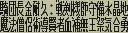
I have some more kanji to be converted to text. I don't need the translation or the meaning, I only need the text. And please, tell me if I made mistakes. I colored in blue the ones that I have more doubts about if I chose the right representation. Here we go:

k2.webp

?団?金?久:戦剣??守備水?
??者血?無王?気合勇

Thanks again! :-)
 
久:戦剣桟師守備水晶地
魔法僧侶術導賢者血無王気合勇
 
Thank You Very Much Toritoribe :-)

I have a lot more to be converted, the tougher ones 😌

I will post them later.
 
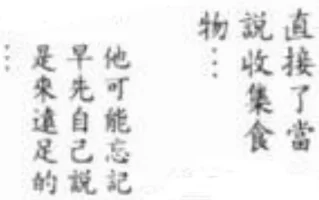
Hey! In the following picture the text is so blurry and small that I can't make out what some of the kanji are.

dpqo.webp

Can someone tell me what these kanji are? No translation is needed. Thanks!
 
直接了當(=当)
説收(=収)集食
物…

他可能忘記
早先自己説
是來(=来)遠足的
 
Hey guys,

Back in 2010 my wife and I went on a trip to Japan. During our travels we stopped at a monastery in Mt Koya. While attending a Buddhist ceremony we were given a gift that you can see below. It has been hanging at the entrance of our house ever since. However, I have no idea what it says. If someone could help with the translation I would be exceptionally thankful.

Dan

image03.webp
 
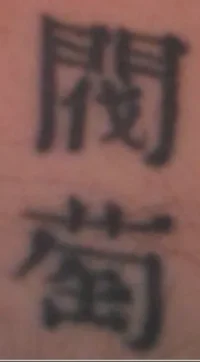
The tattoo: 閥萄

Makes no sense. My best guess is that it is supposed to be some sort of phonetic representation, in kanji, of somebody's name.
 
They say it means

They are claiming that it means Clan Vineyard or Vineyard Family. Does that seem plausible
The tattoo: 窶敖エ窶慊ク

Makes no sense. My best guess is that it is supposed to be some sort of phonetic representation, in kanji, of somebody's name.
 
Well, 閥 is more clique/faction but could be clan in some contexts, and 萄 is from 葡萄 which means "grape" (there isn't actually a single kanji that means vineyard, and at least in Japanese that kanji is not used by itself) but you can't just stick two kanji together like that, in the same order as the word order would be in English, and expect them to make sense.

家 (ke) would be more appropriate for "clan/family". It goes as a suffix after the name (i.e. 佐藤家 for the 佐藤 family). Vineyard would be something like 葡萄園 if you really must have a translation but direct translation of surnames tends to come out weird (like Mr Tanaka introducing himself as Mr Fieldmiddle).
 
(like Mr Tanaka introducing himself as Mr Fieldmiddle).
A bit of a tangent, but, the name Middlefield does exist in English and would be a better translation. Of course, it still doesn't make sense to actually translate your name, except maybe if you're permanently immigrating and want to actually change your name to something more natural to the new country.
 
Back
Top Bottom