Jericho Desu
七転八起
- 23 Feb 2008
- 1,105
- 28
Isn't it ずうずうしい or "impudent"?
Ah, yes that would be it! Thank you

Follow along with the video below to see how to install our site as a web app on your home screen.
Note: This feature may not be available in some browsers.

Isn't it ずうずうしい or "impudent"?

1)
少なからず
少なからず(すくなからず)の意味 - goo国語辞書
2)
the adjectival form of the negative of らしい = らしくない
3)
さることながら
「さることながら」の検索結果 - Yahoo!辞書
さる is not a verb but considered a 連体詞(attributive/adnominal adjective or unconjugated adjective).
#1/#2 and #3 originated from a conjugation of classical adjectives and verbs, respectively.

~たところでもともと勉強する気がないのなら、大学を受けてみたところで何の意味があるのか。
I don't understand the meaning of ところ in this sentence- is there some English equivalent of this?
よろしくお願いします!

I think たところで is always replaceable with ~て/~でも (but not the reverse) if that helps with the yahoo explanation.Thanks for your detailed response!
もともと勉強する気がないのなら、大学を受けてみたところで何の意味があるのか。
I don't understand the meaning of ところ in this sentence- is there some English equivalent of this?
よろしくお願いします!

It's rather ~しても/~たとしても as in the explanation.;-)I think たところで is always replaceable with て/でも (but not the reverse) if that helps with the yahoo explanation.
Oh, yes. And ta tokoro de may well be more replaceable with something like Tatoe ~te mo than ~te/demo. I used what I thought would be clearest to the OP. :emoji_flushed:It's rather ~しても/~たとしても as in the explanation.;-)

It's asking about the countries of the people in your college.Doing a Genki exercise and I have no idea what it is asking...
あなたの大学には、どこの国の人がいますか。
I just learned 危ない means "dangerous"
but I saw at the online dictionary that it also means "in danger" and "insecure"/"doubtful"
so if I say: "Kare wa abunai desu"
it can mean "he is dangerous", "he is in danger" or "he is insecure" ?
Yes, it's common to use 自分 in that way. It's considered that the writer wrote it in the person's position.I have a question about "jibun", I know it means "myself." But recently I was
reading where a man started telling a story about someone else, and said:
"彼は美しい 自分の母親をこよなく愛していたのだ"
Here I'm not sure whether he meant his own mother in the story, because
of the way the person he was talking to reacted, and since the story was
supposed to have happened 300 years ago. So, can 'jibun' when being
used in that manner be meant as the person he's talking about's mother?
魅惑の森 literally means "a fascinating woods/forest".Hi, I'm aquariumist. It is my first post
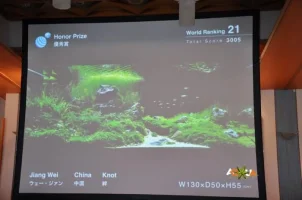
The best Aquarium contest is IAPLC organized by Takashi Amano.
I need to translate titles of top prize works. Titles are in English and Japanese.
魅惑の森 is blue or green wind in may? What does it mean 魅惑 ? Young wind fresh?
It's 絆[kizuna], and exactly refers to "knot" as in "a lover's knot".Now I stacked with this knot .In English it called "Knot". However if I translate it in Japanese or Chinese these translations do not correspond to title in Japanese and I cannot find this kanji.
Thank you in advance!
魅惑の森 literally means "a fascinating woods/forest".
Yes, it's literally "Blue wind in May". 青 also has a nuance of "young/immature" in Japanese.五月の青い風 is blue or green wind in may? What does it mean 青い風 ? Young wind fresh?
(Have made mistake.)


読書感想文 would work for "book report" as an assignment of homework.I often hear something that sounds like "wakatta", the meaning attached to it is "yes, understood" but I can't find it in the online dictionary, does anyone know what word I'm looking for?
:emoji_thinking:
EDIT
second question:
Ik want to write all the things I have to do in kanji in my agenda
and I need two words, Book Report and Homework
Homework was written as 宿題 if I'm right, romaji: Shukudai
But I can't find Book Report anywhere, can someone give me the kanji and romaji please?