


mad pierrot
I jump to conclusions
- 22 Nov 2003
- 1,453
- 85
窶「ツカ窶ーツサ窶堙娯?愿コツ Bunka no Hi
The 3rd of November is a national holiday in Japan. It celebrates the completion of Japan's current constitution, first put into effect in 1946. What most people don't know is before the U.S. occupation, November 3rd was already a national holiday. It's the birthday of the Meiji Emperor, the man who saw Japan rise from a backwards feudal country to a modern, industrialized nation on the verge of conquering Asia.
All this in mind, I figured this would be a good day to visit his tomb. Afterall, in a nation of 27+ million people, you would imagine there would be some people there paying respects on the holiday created in his honor. I was wrong.
First of all, most of my friends didn't even know that "culture" day was the emperor's birthday. Second of all, none of them knew where he was buried. Some thought he was buried in Tokyo. It turns out he's buried right here in Kansai, half-way between Osaka and Kyoto .
When I got on the train today, it was packed. Perhaps there'll be a crowd afterall, I thought. Wrong again. Everyone one got off in Hirakata City, home to one of the biggest theme parks in Osaka. I was left alone on the train.
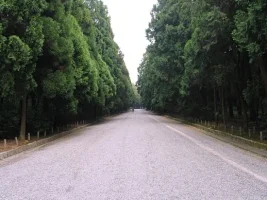
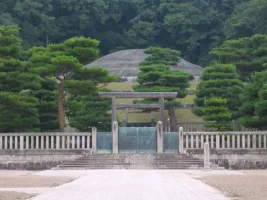
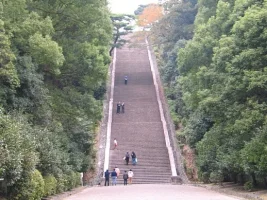
The area around the train station was equally deserted. I quietly walked up the broad gravel path to the tomb, undisturbed except by a jogger. The Meiji Emperor is buried on Momoyama, just off the Keihan line near Chushojima. The burial mound is located at the top of an impressive rise of steps, and commands a good view of the surrounding town and mountains. Just at the foot of the hill is the shrine dedicated to General Nogi. Nogi and his wife both committed suicide upon hearing of the Emperor's death. Natsume Soseki glorifies their passing as an end of an era in his novel, Kokoro.
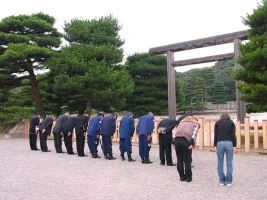
There was practically no one there. While I waited, a small group of soldiers paid respects, but that was about it. (Although some students were practicing running up and down the stairs.) I sat there thinking about how the man enshrined here was once revered as a living god, a symbol for all of his nation's hopes, and a figurehead of fear for others. It seemed odd that he should be so forgotten.
(F.Y.I., thanks to my professor for telling where to find his tomb. On a side note "Green" day, (窶氾寂?堙娯?愿コ) was the traditional celebration of the Showa Emperor's birthday. It will revert to it's original title in a few years.)
The 3rd of November is a national holiday in Japan. It celebrates the completion of Japan's current constitution, first put into effect in 1946. What most people don't know is before the U.S. occupation, November 3rd was already a national holiday. It's the birthday of the Meiji Emperor, the man who saw Japan rise from a backwards feudal country to a modern, industrialized nation on the verge of conquering Asia.
All this in mind, I figured this would be a good day to visit his tomb. Afterall, in a nation of 27+ million people, you would imagine there would be some people there paying respects on the holiday created in his honor. I was wrong.
First of all, most of my friends didn't even know that "culture" day was the emperor's birthday. Second of all, none of them knew where he was buried. Some thought he was buried in Tokyo. It turns out he's buried right here in Kansai, half-way between Osaka and Kyoto .
When I got on the train today, it was packed. Perhaps there'll be a crowd afterall, I thought. Wrong again. Everyone one got off in Hirakata City, home to one of the biggest theme parks in Osaka. I was left alone on the train.
The area around the train station was equally deserted. I quietly walked up the broad gravel path to the tomb, undisturbed except by a jogger. The Meiji Emperor is buried on Momoyama, just off the Keihan line near Chushojima. The burial mound is located at the top of an impressive rise of steps, and commands a good view of the surrounding town and mountains. Just at the foot of the hill is the shrine dedicated to General Nogi. Nogi and his wife both committed suicide upon hearing of the Emperor's death. Natsume Soseki glorifies their passing as an end of an era in his novel, Kokoro.
There was practically no one there. While I waited, a small group of soldiers paid respects, but that was about it. (Although some students were practicing running up and down the stairs.) I sat there thinking about how the man enshrined here was once revered as a living god, a symbol for all of his nation's hopes, and a figurehead of fear for others. It seemed odd that he should be so forgotten.
(F.Y.I., thanks to my professor for telling where to find his tomb. On a side note "Green" day, (窶氾寂?堙娯?愿コ) was the traditional celebration of the Showa Emperor's birthday. It will revert to it's original title in a few years.)


 )
)


