


- 14 Mar 2002
- 21,050
- 18,903
Japan will see its first Shinkansen train dedicated solely to freight enter regular service in March, according to an announcement by JR East on 9 December. The train is a refurbished E3-series unit that previously ran as the Tsubasa service. All 394 passenger seats across its seven cars have been removed, and the interior has been rebuilt to accommodate cargo. Anti-slip flooring and securing belts have been installed, allowing the train to carry up to 1,000 boxes—around five times the volume possible on Shinkansen services that have only been partially adapted for freight use.
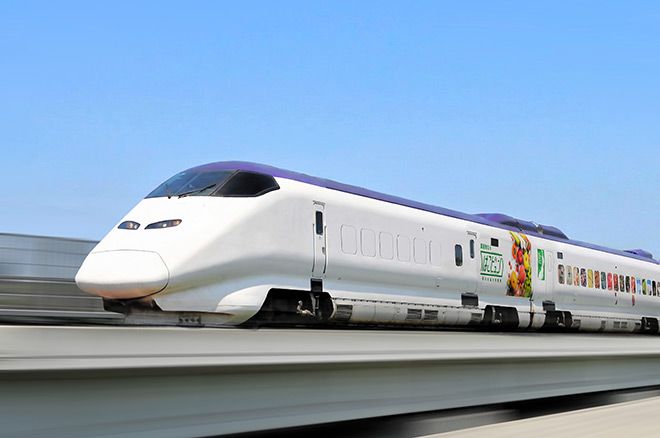
Artist's rendering provided by JR East
Its exterior has also been updated, featuring a white livery with window designs showing scallops, medical supplies and koi carp, reflecting goods already transported via Shinkansen cargo operations. On weekdays, the train will run from Morioka to Tokyo, with loading and unloading handled at rail freight facilities near the stations. During service, the cargo-only unit will be coupled to a passenger train.
Artist's rendering provided by JR East
Its exterior has also been updated, featuring a white livery with window designs showing scallops, medical supplies and koi carp, reflecting goods already transported via Shinkansen cargo operations. On weekdays, the train will run from Morioka to Tokyo, with loading and unloading handled at rail freight facilities near the stations. During service, the cargo-only unit will be coupled to a passenger train.
Cargo transport by Shinkansen began in 2021, when JR East repurposed passenger cars amid plummeting ridership during the COVID-19 pandemic. Other JR companies followed suit, and by 2024, the service had expanded nationwide from Hokkaido to Kyushu. The debut of the cargo-only train was initially planned for autumn 2025. But it was delayed after mechanical troubles with newer E8-series forced JR East to keep older E3-series units in passenger service.


 Therefore:
 Dedicated freight Shinkansen (especially on Tokaido): unlikely
 Mixed passenger + cargo use: very promising


