Art Ukiyo-e: Japanese woodblock prints and paintings

Topics, threadsm and news related to Japanese art and artists
Utagawa Hirokage (歌川広景), No. 9, Terrace of the Yushima Tenjin Shrine (江戸名所道化尽 九 湯島天神の臺 Yushima Tenjin no dai), from the series Comical Views of Famous Places in Edo (Edo meisho dôke zukushi), 1859. Woodblock print (nishiki-e); ink and colour on paper, vertical ōban; 36 x 23 cm.

full.jpeg.webp


Hirokage light-heartedly portrayed Edokko (江戸っ子), or townspeople of Edo, enjoying themselves and engaging in playful antics during the late Edo period. His woodblock prints sought to introduce humour and absurdity into the otherwise refined world of traditional ukiyo-e. This particular example is print number 9 from the series titled Terrace of the Yushima Tenjin Shrine. It captures a moment of comic chaos as several men laugh at a confused samurai who has just had a bowl of soba noodles dumped unceremoniously onto his head. The mishap occurs when a noodle shop worker, seen on the left, is bitten by a stray dog, causing him to lose control of his delivery trays and inadvertently spill the contents onto the unsuspecting warrior.
 
Keisai Eisen (渓斎英泉, 1790–1848), Beauty and Nihonbashi Bridge, from the series "Bijin Tōkaidō" (美人東海道, Beauties and the Tōkaidō Highway). Nihonbashi Bridge, the starting point of Tōkaidō, and Mt. Fuji.

Bijin Tōkaidō (美人東海道)
 
Utagawa Hiroshige (1797-1858), Naruto Whirlpool, Awa Province, from the series Views of Famous Places in the Sixty-Odd Provinces (六十余州名所図会 阿波 鳴門の風波), Woodblock print; ink and colour on paper, vertical ōban, 35.6 × 24.4 cm; ca. 1835.

full.jpeg.webp
 
Not sure whether to slide these in here or Japan Photos--went to an exhibit today, 墨汁画. These are a few I liked (my preference is for things more abstract):


y.webp


z.webp


I'm not sure what this one is, but it's fantastic:
x.webp


There were also some 'modern' wood block prints, but no photography signs all over, and I was the only one in the room with a staff member watching, so I didn't challenge the system.

I like this kind of thing, since to my mind it's so similar to B&W photography.
 
Last edited:
Tsukioka Yoshitoshi (月岡芳年, 1839-1892), Wakan Hyaku Monogatari: Shirafuji Genta (和漢百物語 白藤源太).

full.jpeg.webp

The series Wakan Hyaku Monogatari (和漢百物語) is a collection of eerie tales and legendary figures from both Japan and China. This particular piece, titled Shirafuji Genta (白藤源太), is one of the 26 illustrations in the set. Shirafuji Genta is a legendary sumo wrestler renowned as the mightiest of his kind, and his story has become the subject of both kabuki plays and chants. At first glance, the image appears rather charming—it shows Genta cooling himself on a summer riverbank while kappas (mythical water creatures) engage in a sumo match before him. However, the explanatory text in the upper right corner adds a chilling twist: "When a kappa challenged Genta to a contest of strength, Genta immediately threw and killed it." Upon closer inspection, Genta's expression doesn't seem that cheerful.
 
Two woodblock prints by Tsukioka Yoshitoshi (月岡 芳年, 1839-1892) depicting Minamoto no Yorimitsu.

full.jpeg.webp

Minamoto no Yorimitsu and Kintarō, 1886, Warriors Trembling with Courage. 芳年武者无類 阪田公時・源頼光 (芳年武者无類).


full.jpeg.webp

Minamoto no Yorimitsu's retainers, Watanabe no Tsuna, Urabe no Suetake, Usui Sadamitsu, and Sakata no Kintoki and the aristocrat Fujiwara no Yasumasa fighting Shuten-dōji on Ōeyama.


Minamoto no Yorimitsu (948-1021)

Bio  Minamoto no Yorimitsu (948-1021)

Minamoto no Yorimitsu (源頼光, 948-1021), also widely known by the name Minamoto no Raikō (頼光), was a prominent military commander during the mid-Heian period (平安時代, 794-1185). He was the eldest son of Minamoto no Mitsunaka (源満仲, 912-997), the powerful patriarch of the Seiwa Genji (清和源氏), a...
 
If anything, the original was based on an ōban nishiki-e by Tsukioka Yoshitoshi:

浮世絵 月岡芳年「近世侠義傅 夏目新助」無残絵 魁斎芳年画 小川煙村編 UKIYOE 木版画 歴史資料 風俗絵巻図画刊行会錦絵部 挿絵.

Natsume Shinsuke


In 1865, the renowned ukiyo-e artist Tsukioka Yoshitoshi (月岡芳年, 1839‑1892) created a striking woodblock print titled "Kinsei Kyōgiden: Natsume Shinsuke" (近世侠義伝 夏目信助), which forms part of his series Biographies of Modern Heroes. This work portrays Natsume Shinsuke, a legendary figure from Edo-period chivalric lore, embodying the virtues of bravery and righteousness that fascinated late-Edo and early-Meiji audiences. Carved during the first year of the Keiō era (1865), the print continues the tradition of warrior hero portraits popularised since the 14th century, yet introduces a fresh realism and emotional intensity characteristic of Yoshitoshi's mature style. This striking ōban nishiki-e (large-format colour print) captures its subject mid-gesture, reflecting both personal heroism and the era's collective yearning for honour amidst societal change.
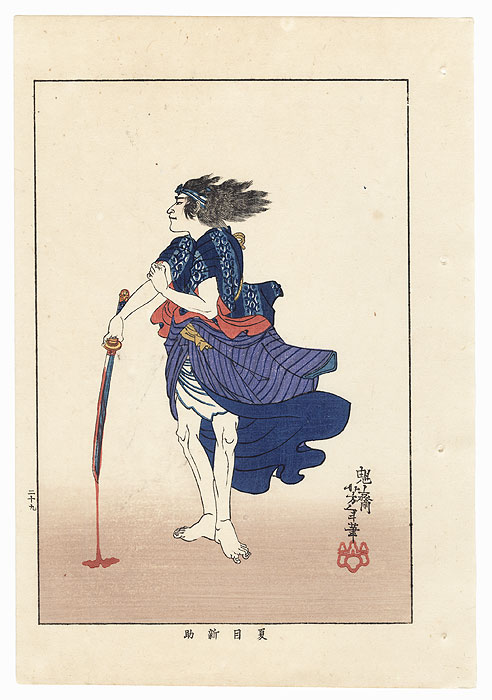
 
On the bottom it says 夏目新助 (read from right to left in the original). It's read Natsume (no) Shinsuke. He was active at the end of the Edo period in what is now Chiba Prefecture. It looks like he might have been a professional gambler. He was executed at Kozuppara in modern-day Tokyo. His age was unknown.

Sources:
 
Well I don't agree with gambling in any form. I shall burn the print immediately!😑
Ah, so I take it you agreed with the Taliban when they destroyed the giant Bamiyan Buddha statues? (Just in case it's not clear, I'm being sarcastic.)

 
Utagawa Kuniyoshi (歌川国芳, 1798-1861), Yoshioki's Death in Battle at Yanokuchi-watashi (矢ノ口渡合戦にて義興戦死図), ukiyo-e.

Yoshioki's Death in Battle at Yanokuchi-watashi


Nitta Yoshioki (新田義興, d. 1358), second son of Yoshisada, was active in the Southern Court's campaigns following the death of Kitabatake Akiie (北畠顕家, 1318-1338), assisting in the siege and brief occupation of Kamakura in 1337. Alongside Akiie's younger brother Akinobu, Yoshioki fortified Otokoyama Castle (男山城), but was forced to retreat to Yoshino, the seat of the Southern Court. In 1352, together with his brother Yoshimune and cousin Yoshiharu, he drove Ashikaga Motouji (足利基氏, 1340-1367), shōgunal deputy in Kamakura, out of the city. However, Ashikaga Takauji (足利尊氏, 1305–1358) soon returned with reinforcements and expelled the Nitta once more. Yoshioki fled north and attempted to regain control of Kōzuke and Musashi provinces, but was eventually captured by Takezawa Nagahiro and sentenced to death by Hatakeyama Kunikiyo, a retainer of Motouji. He was drowned in the Rokugō River at Yaguchi no Watari (矢口渡, Musashi Province). In later generations, Yoshioki came to be venerated as Nitta Daimyōjin (新田大明神), a deified warrior.


Yaguchi Ferry

The Yaguchi Ferry, known as Yaguchino-watashi (矢口渡) in Japanese, was a historical ferry crossing on the Tama River in Musashi Province. It is particularly known for the legend of Nitta Yoshioki's death by drowning there in 1358. The "Yaguchino-watashiato" (Yaguchi Ferry Ruins) are located near 146-0093-3 Yaguchi, Ota-ku, Tōkyō.
 
Yoshitoshi Tsukioka (月岡芳年), Nitta Yoshisada, "One Hundred Views of the Moon: Half-Moon over Inamuragasaki"「月百姿 稲むらか崎の明ぼのの月」

One Hundred Views of the Moon: Half-Moon over Inamuragasaki

This warrior-themed ukiyo-e print is one of the 100 works from Tsuki Hyakushi (月百姿, One Hundred Aspects of the Moon). It depicts a scene from the Taiheiki (太平記), in which Nitta Yoshisada advances toward Inamuragasaki (稲村ガ崎) during his campaign to attack Kamakura.

At the time, the tide was at its highest, and he could not proceed further. However, Nitta Yoshisada offered his golden-hilted sword, which he had worn at his waist, to the sea as an offering to the dragon god (龍神 Ryūjin). Upon doing so, the tide miraculously receded before his very eyes. A path appeared leading to Kamakura, enabling Yoshisada to proceed and ultimately bring about the downfall of the Kamakura shogunate.

In the woodblock print, Yoshisada prays reverently, showing a deep sense of devotion. The light from the "twentieth day moon" ( 二十日月 hatsukazuki), a half-moon, shines down upon the scene, reflecting across the waves of the sea and heightening the sacred atmosphere. Tsuki Hyakushi was a series of one hundred colour woodblock prints (nishiki-e) based on scenes involving the moon, drawn from Japanese and Chinese legends, literature, and poetry.

The artist who created this warrior-themed print, Tsukioka Yoshitoshi (月岡芳年, 1839-1892), was the adopted son of Tsukioka Sesshū (月岡雪舟) and a pupil of Utagawa Kuniyoshi (歌川国芳, 1797-1861), who was celebrated as the master of musha-e (武者絵, warrior pictures). Although ukiyo-e gradually declined with the onset of the bunmei kaika (文明開化, "civilisation and enlightenment") movement during the Meiji period, Yoshitoshi defied this trend. He continued to produce striking and imaginative work, earning the title "the last ukiyo-e master" (最後の浮世絵師).
 
An interactive exhibition in Fukuoka is bringing Edo-period ukiyo-e into the present day by combining traditional woodblock prints with modern digital technology. Taking place in Hakata Ward, the "Moving Ukiyo-e Exhibition" showcases more than 300 works by celebrated artists, including Katsushika Hokusai and Utagawa Hiroshige, enhanced with projection mapping and other digital displays.


Over the three-day holiday weekend beginning on 19 July, visitors can rent an easy-to-wear, separate-type kimono designed to be worn over everyday clothes, allowing them to take photos in the digitally reimagined ukiyo-e space. "It inspired me to feel a deeper connection with Japanese culture," one attendee remarked. The exhibition is being held on the 9th floor of JR Hakata City and will run until 17 August. The kimono rental service will remain available until 21 July.


Tsukioka Yoshitoshi (月岡 芳年, 1839-1892), Ashikaga Yoshimitsu Admiring the Temple of the Golden Pavilion, 1879. Series; Mirror of Famous Generals of Japan: Lord Yoshimitsu Ashikaga (大日本名将鑑 足利義満公 Dainihon Meishō Akira Ashikaga Yoshimitsukō).

Ashikaga Yoshimitsu Admiring the Temple of the Golden Pavilion
 
Today's topic: Kubi Jikken (首実検), the inspection of enemy heads after the battle.

Tsukioka Yoshitoshi (月岡芳年), "Illustration of the Inspection of the Heads by Mashiba Hisayoshi (Toyotomi Hideyoshi) and his Lord and Servant Takechi," 1866 「真柴久吉武智主従之首実検之図」慶応二.

Illustration of the Inspection of the Heads by Mashiba Hisayoshi (Toyotomi Hideyoshi)


Tsukioka Yoshitoshi (1839-1892), Tokugawa Ieyasu Examining the Head of Kimura Shigenari at the Battle of Osaka Castle, Series: Brief Account of the Rulers of the Tokugawa Clan, colour woodblock print, 1875. 大蘇芳年筆「徳川十五代記略」より『神君大坂御勝利 首実検之図』

Tokugawa Ieyasu Examining the Head of Kimura Shigenari at the Battle of Osaka Castle

Totoya Hokkei (魚屋 北渓, 1780–1850), Samurai Carrying a Kubi-oke, a "head basket."

Samurai Carrying a Kubi-oke

More on kubi jikken:
View item 185
 
Utagawa Hirokage (歌川広景), Ryōgoku Yonezawa-machi (両国米沢町), from the series "Joyful Events in Famous Places in Edo" (江戸名所道戯盡 Edo meisho dōke zukushi), 1861.

full.jpeg.webp

It was another lively afternoon in Ryōgoku, the energetic heart of Tokyo nestled beside the Sumida River—a place known as much for sumō as for its food markets, galleries, and backstreet eateries. The streets were buzzing, full of tourists soaking up the sights and smells, the clatter of geta sandals mixing with the chatter of shoppers and stallholders. At one corner of a local fish market, a slightly harried fishmonger was doing his best to keep up with the pace when, in a sudden flurry of bad luck, two live unagi (鰻)—long, slippery eels—slipped from his grasp and flopped unceremoniously onto the ground. One immediately made a break for it, wriggling toward a nearby woman who had been minding her own business. She let out a yelp and half-hopped, half-danced backwards, nearly losing one of her wooden sandals in the process. The eel, undeterred, continued its undignified advance. The fishmonger, mortified, lunged forward in a panic to catch it. At the same time, the woman stood frozen in horrified disbelief, caught somewhere between disgust and self-preservation. It was over in a flash, but not before half the market had turned to watch. Eyes followed the two of them—one flushed red from embarrassment, the other apologising profusely as he finally scooped up the fugitive eel. For the woman, the ordeal had left its mark: she was rattled, but not defeated. Gathering what composure she could, she glanced coolly at the two eels now safely behind the counter, gave the fishmonger a look that said, "Why not?" and bought them both on the spot. Sometimes, dignity is best restored with a firm grip and a hot grill. That night, she made unagi no kabayaki—grilled eel glazed with sweet soy sauce. After all, if life hands you eels, you might as well make dinner.
 
Utagawa Hiroshige I (1797–1858), View of the Shiba Coast (芝うらの風景 Shibaura no fūkei), from the series One Hundred Famous Views of Edo (名所江戸百景 Meisho Edo hyakkei); 1856 (Ansei 3), nishiki-e, ink and colour on paper, vertical ōban; 35.4 x 24.4 cm.

Utagawa Hiroshige I (1797–1858), View of the Shiba Coast (芝うらの風景 Shibaura no fūkei)
 
Back
Top Bottom