Nobunaga/Hideyoshi/Tokugawa

Ukigumo

後輩
Joined
15 Mar 2025
Messages
1,382
Reaction score
2,684
Hello everyone, this is my first post on this forum - yorishiku onegaishimasu 🙏🏽

I've been reading Pre-Modern Japan by Hane & Perez and enjoying it very much. What has struck me is how truly awful the unifiers of Japan behaved today's their subjects. They were exploitative, suppressive, murderous, nepotistic, fratricidic, uxocidic, jealous, mercurial, duplicitous etc! Although these were different times with their own, unique values they were, without doubt, pretty unpleasant. They were the antithesis of the idea of the 'virtuous samurai ', steeped in Confucian ethics and ideals.

So why are they so idolised in Japan today? Why do people buy everyday items emblazoned with Nobunaha/Hideyoshi/Tokugawa mon? There are parallels with the British/English Kings and Queens some of whom were also pretty awful, Henry VIII for example, but most Brits will talk about Henry VIII and add that he was a 'bit of a b*****d'!

Does anyone have any ideas? Is it just the passage of time that has sanitised the acts of N/H/T? Has their unification of Japan (for their own benefits, I might add), superseded the methods they employed to do so?

Thank you in advance.
 
Welcome to the forum! :)

They were exploitative, suppressive, murderous, nepotistic, fratricidic, uxocidic, jealous, mercurial, duplicitous etc! Although these were different times with their own, unique values they were, without doubt, pretty unpleasant. They were the antithesis of the idea of the 'virtuous samurai', steeped in Confucian ethics and ideals.

So they weren't so much different from their medieval European counterparts who allegedly followed the sacred principles of chivalry, were they?

I have been living in Japan for some time now, and I have never had the impression that any of the three hegemons was idolised. No matter how ruthless and controversial they were, they were accepted as part of a historical process that led to the unification of Japan. Historical documentaries often portray them with a mix of admiration and criticism, devoid of reverence or idolisation.


Why do people buy everyday items emblazoned with Nobunaha/Hideyoshi/Tokugawa mon?

They don't. I have seen local souvenirs emblazoned with the triple hollyhock of the Tokugawa, but that's for tourists (foreign and domestic).
 
Thank you 🙏🏽

Western chivalry has never really been emphasised except in romantic fiction and books on etiquette! Bushido, on the other hand appears to be the very basis of the Japanese people (if you believe Inazo Nitobe's book…many no longer do).

I see, this stuff is for tourists! I'd better get rid of my Oda Clan motifed underpants lest i look like a tourist 😳
 
I think Kurosawa's depiction of the samurai was closer to reality than any of the idealisations of Bushido. Most of their lower ranks were mere ragtag scallywags permanently short of cash. :LOL:
 
It's a shame really. We need our heroes and the bushi of 'Seven Samurai' protecting the peasants against marauding bandits, outwardly for just their meals, but inwardly as it was the 'right thing to do' is extremely attractive. It's a good job we still have cowboys, eh? 😉
 
I would also ask where you're getting the impression that these figures are idolized. It wouldn't surprise me if their history was sanitized in schools though.
 
Like I said in my original post, the emblazoning of their family mon on everything from wallets, Kendo do, stickers etc. It seems like a celebration, associating yourself with their mon. If they were in a red circle with a red line across them, then I'd consider that a criticism of them 😆

Also the accounts of their exploits rarely contain adjectives like awful, horrid, megalomaniaclly psychotics;ly murderous.

And don't get me started on the shinsengumi ! 😉
 
Like I said in my original post, the emblazoning of their family mon on everything from wallets, Kendo do, stickers etc. It seems like a celebration, associating yourself with their mon.
Where have you seen this? I've only seen these kinds of items at tourist areas and I've never seen a Japanese person with such goods.
 
I think Thomas established that it was a touristy thing. Although not belonging to the 'three monsters', a cursory look around my house turned up three items with mon upon them, but then I'd be a tourist in Japan!
D34A9E24-5FF9-4008-8DAE-E3EC7FC15B30.webp


31C11FDA-19E3-4B50-B75B-0C1690D9DDCE.webp


2C38636E-E37D-4D6A-A81D-06D45485D9E4.webp
 
I just remembered we had these sake cups featuring the etched kamon of prominent samurai clans. I'm unsure what happened to the rest of them, but only the Sanada have survived the onslaught in our kitchen cabinet.

sanada-sake-cup.webp
 
I assume for the initial capital for materials and tooling up.

I generally avoid Kickstarter except on rare occasions when I've found the ideas inspiring. I've had my fingers burned three times once for a replica of the Apollo 11 flight manual, once for a Japanese language grammar and expressions book (Alex Adler, you owe me £90 😡) and a 'Zen photography' book. In each case they never turned up and they ignored my messages for updates on my rewards. So I no longer back books.
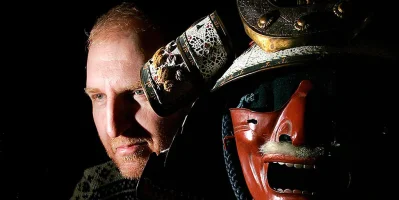
Currently I'm awaiting a mobile phone camera microscope (posted) and a 1/2 sized, wooden carving of Miyamoto Musashi's Fudo Myoō statue (not due until May).
 
I have only supported one Kickstarter project: Terje Solum's "Saga of the Samurai" series. Sadly, the last issue, the second part of the Gamō clan, never materialised due to a lack of funds.

We interviewed him in 2017. Being hopelessly optimistic, I still hope he'll continue his series.

 
I think people don't realise how much work is involved in writing, checking the details, proof reading, editing and time-consuming, a book. It just becomes too much for them. I translated a book on Iaido for a friend (with no charge) and it nearly killed me. My PhD thesis wasn't as bad since I was getting something out of it, but that translation…? 🤢
 
Back
Top Bottom