Japan's whaling industry going under

thomas

Unswerving cyclist
Admin
Joined
14 Mar 2002
Messages
21,050
Reaction score
18,903
With dwindling government subsidies and decreasing demand for whale meat, the future of Japan's whaling industry looks bleak.

Mariko Abe, from the Nature Conservation Society of Japan, told DW that whale used to be a "traditional food" for millions of Japanese, but "that time has gone and young people just do not look at it that way any more. Most of them have never eaten whale and are not interested in trying it. It makes absolutely no economic sense to build this new whaling ship and to set out to catch more whales because no one wants to buy it," she said.

Japan's whaling fleet is operated by Kyodo Senpaku Co., the sole offshore whaling company in Japan, which has an annual quota of 52 Minke whales, 150 Bryde's and 25 Sei whales within the nation's exclusive economic zone. Kyodo Senpaku employs 170 people. It operates four ships, consisting of three hunting vessels and the world's only whaling factory ship, Nisshin Maru, which processes the carcasses.

If state support is completely phased out, the financial conditions for Japan's whaling industry would appear unsustainable. The break-even price for 1 kilogram (2.2 pounds) of whale meat is 1,200 yen. However, the 2,000 tons brought to market in 2020 was sold at an average of just 1,100 yen, according to the Fisheries Agency. "What we are witnessing is a dying industry sinking of its own weight," Patrick Ramage, the senior director of the International Fund for Animal Welfare, said. Japan's withdrawal from high-seas whaling was a "death blow," and an acknowledgment that "even massive government subsidies could not keep the industry afloat. Thirty-six months later, even the most ardent advocates for commercial whaling see it as a charity case, completely reliant on taxpayers' support. Consumer demand continues to plummet while costs continue to soar," he said.

The solution: as commercial whaling moves through the stages of death, coastal communities from Hokkaido to Okinawa are migrating to whale and dolphin watching, a profitable ecotourism activity in Japan and worldwide. Saving the whales costs less and delivers more than continuing to subsidise whaling.
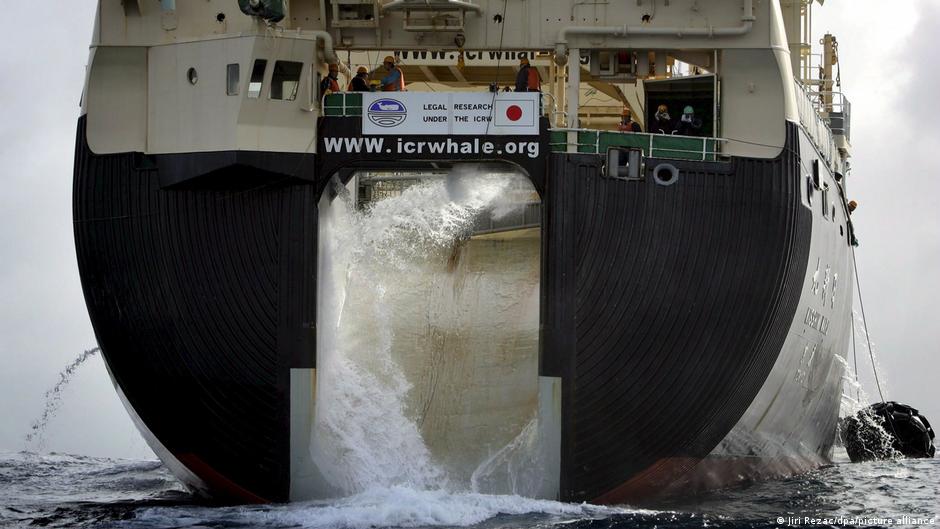

 
Asahi with an interesting piece on the decommissioning of Japan's "whaling flagship," the Nisshin Maru:

After over three decades of serving as Japan's whaling flagship, the Nisshin Maru, a symbol of the country's whaling tradition, has finally retired. It will be replaced by a new vessel next year, but the industry's future, which faced global criticism, is unclear due to low demand for whale meat. The ship arrived at its home port here for the last time on Nov. 4, where a large crowd of crew members' families and others greeted it with cheers and waves. "Its age caused many difficulties, but it endured until the end," said the captain, Akihiro Kitajima. The factory ship, originally a nautical trawl boat, led its first whaling expedition from 1991 to 1992. It was known as a "moving processing factory" because it could flense and freeze the whales caught by catcher boats on board. Seventeen thousand seventy-two whales, such as sei and Antarctic minke whales, were processed in the Antarctic Sea, the Northwest Pacific Ocean and waters around Japan.

9d46b83712477ce86521593b9a5593d1.webp


Japan withdrew from the IWC in 2019 and resumed commercial whaling in its exclusive economic zone. But since then, the whaling industry has remained stagnant. In addition to Kyodo Senpaku Co., the whaling company that owns the Nisshin Maru, four organizations are engaged in commercial whaling. Those entities are based in Abashiri, Hokkaido; Ishinomaki in Miyagi Prefecture; Minami-Boso in Chiba Prefecture; and Taiji in Wakayama Prefecture. They are all struggling to survive in an increasingly challenging business environment. The Fisheries Agency permits the hunting of three large whale species: minke, Bryde's and sei whales. But minke whales have become hard to find, and the catches last year were half the maximum limit.


Despite shrinking demand, the Fisheries Agency plans to add one species next year to the list of whale species that can be caught if its ocean stocks are plentiful. Fin whales are considered the most likely candidate, but an official decision will be made at the agency's deliberative council. The Kangei Maru, the successor to the Nisshin Maru, has improved freezing and storage technology and sanitation features, such as processing whale carcasses indoors. The company has already started to bolster demand for whale meat with the opening of five Kujira (whale) Store outlets this year that feature whale meat vending machines in and around Tokyo and Osaka.


The Kangei Maru, a newly constructed whaling mother ship, has replaced the retired Nisshin Maru. The ship's handover was celebrated on 29 March at the Kyokuyo Shipyard Corporation in Shimonoseki, Yamaguchi Prefecture. A ritual to bless the vessel was conducted on the Kangei Maru's bridge earlier that day, wishing for safe travels and operations. The Kangei Maru's maiden whaling voyage is planned for May in the waters of the Tohoku region. The ship, built for 7.5 billion yen (equivalent to $50 million), is powered by electricity. It measures 112.6 meters in length, 21 meters at its broadest point, and has a gross tonnage of 9,299 tons, per the details provided by Kyodo Senpaku and Kyokuyo Shipyard.

RYYhmRWpDPZpMmV84Xe67VBrAX03ZFQRab35X824.png

The vessel can accommodate 100 crew members and boasts a cruising range of 13,000 kilometres, sufficient for reaching the Antarctic Ocean. The slipway of the Kangei Maru features a gentler incline of 18 degrees compared to its predecessor, facilitating the easy loading of large cetaceans that weigh approximately 70 tons. Additionally, the ship has a deck designed for a sizable drone capable of locating whales.


To coincide with the launch, Shimonoseki City is promoting restaurants and hotels where people can enjoy whale dishes and raising awareness about different cuts and their nutritional content. Restaurant owners are also trying to expand their repertoires. [...] Local enthusiasm is matched only by distaste in other parts of the world. A recent report by Japan's Fisheries Agency noted that out of the 88 member countries on the International Whaling Commission, 50 oppose whaling. The IWC banned commercial hunts in 1986 but allowed Japan to continue catching a small number of whales each year for research purposes. The local industry said this would allow them to monitor populations of different species and compile data that would eventually justify ending the moratorium.

 
Labor and resource-intensive industry to harvest and process a kind of meat/protein for which there is virtually no demand. It's almost an adolescent kind of opposition to world trends (including trends from within Japan). It's not even a major part of Japanese culture. It's one thing that Japan could switch off, and the lives of ordinary Japanese wouldn't be affected at all. So the effort that goes into saving the whaling industry is always surprising to me.

If there was a demand for the meat I could understand. I'm not even opposed to whaling those species that are off the endangered list. Take your quota of 100 Minke whales and let the public have a feast if they want. They seem to be abundant enough. It feels a lot less problematic that slicing off shark's fins, for example. But if the public is indifferent, this effort feels like it should be directed elsewhere. More sustainable tuna farming, or crab farming, or something.
 
As probably mentioned here before, when I lived in Yamaguchi Prefecture, I heard stories of when a whale washed up ashore once and people would bring wheelbarrows to grab some of the meat. That apparently happened when Japan (or at least that area) was much poorer, because people were so happy to have the cheap meat.

There was some frozen whale meat in at least one convenience store, and I had some whale meat at a restaurant once. As someone who's actually eaten some, I can say that at least for me there was nothing particularly special about it. There's nothing inherent about it's taste or texture that makes you crave for more. You eat it, and you're done. That could explain the lack of demand, at least in part. With so many other better options, there's just no reason to go out of your way for it.
 
To my wife's generation, whale meat means school lunch. She has fond memories of it.

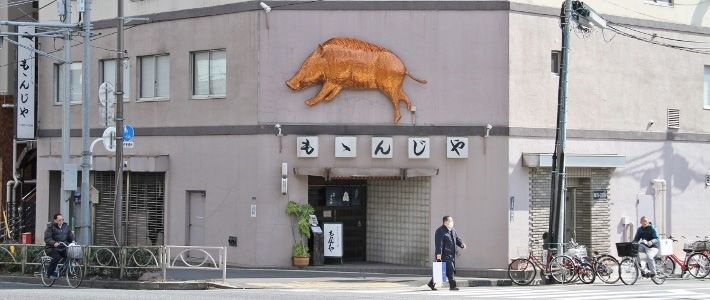
I've had whale meat twice. Once a whale burger at Lucky Pierrot in Hakodate:


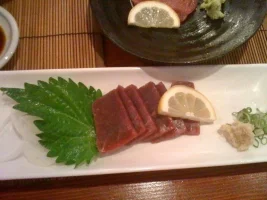
And once kujira sashimi in Wakayama:

kujira_sashimi.jpg

I perfectly agree with @Mikawa Ossan's assessment.
 
Living on the Maine coast , I have access to a lot of different fresh items from the ocean. The best flavor I've ever tasted was fresh king crab while in Alaska. They sure are big and ugly looking , but the leg meat was great , better than fresh Maine lobster.
 
I think the main question -- aside from sustainability -- is whether or the government is subsidizing this industry or not. I'm guessing they probably are but if not it doesn't really matter what the public opinion is or level of demand. If that was a consideration we should eliminate all the restaurants serving game meat too.
 
I think the main question -- aside from sustainability -- is whether or the government is subsidizing this industry or not. I'm guessing they probably are but if not it doesn't really matter what the public opinion is or level of demand. If that was a consideration we should eliminate all the restaurants serving game meat too.

It would make more sense to support the consumption of game meat. Feral animals (deer, wild boars, bears) are kept in check because they cause environmental damage or pose threats to the (human) population. According to NHK, over 90% of game meat in Japan is discarded. Whales cause no harm and aren't dangerous; most people are not interested in eating them. Regardless of sustainability and conservation, subsidising a dying industry makes no commercial sense.
 
I was never into whale meat (I had it just a couple times) but my father in law loved it so my mother in law and wife at it a lot and even eat it when we visit like when we spent last summer in Japan. Whale is readily available in Nagasaki prefecture. Wild boar I had in a beppu ryokan with my wife. One of my military (half Japanese) now retired friends who was stationed in Iwakuni get licenses and still does to hunt wild boar in that area. I had deer in the US but I don't remember eating it in Japan. I had no idea so much game meat was discarded, the Iwakuni guys loved it including the rural Japanese there. I would like to see some encouragement not to discard that meat as well, I had no idea. On whale I agree the big question is if the government is subsidising it, I don't feel they should be doing that. If the market supports it for non endangered species I have no problem. I also never had craving for any more whale meat it just wasn't that good. I have also had raw horse in Japan and while not a huge fan I found it better than whale.
 
Last Thursday, Japan's "whaling mothership" was presented to the public, with Tokoro Hideki, president of Kyodo Senpaku, speaking to the media:

"Whales eat up marine creatures that should feed other fish. They also compete against humans. So, we need to cull some whales and keep the balance of the ecosystem... It's our job, our mission, to protect the rich ocean for the future."


Whaling knives

Japan has a quota this year of around 350 Bryde's, minke and sei whales, species the government says are "abundant". The Bryde's and common minke are listed as "least concern" on the International Union for the Conservation of Nature's Red List, but globally the sei is "endangered". Japan also wants to resume hunting fin whales, the world's second-biggest animal after the blue whale. Fin whales are listed as "vulnerable" by the IUCN. Tokyo argues that eating whales is part of Japanese culture and an issue of "food security" in the resource-poor country which imports large amounts of animal meat. But consumption of whales has fallen to around 1,000 or 2,000 tonnes per year compared to around 200 times that in the 1960s.


Source: Wi-Fi, drones and sharp blades on Japan's whaling mothership


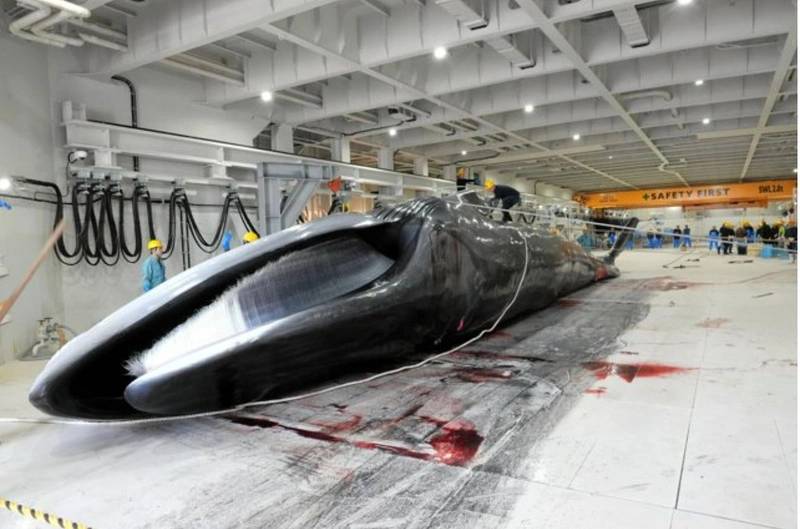
The Kangei Maru, the 9,300-ton pride of what's left of Japan's national whaling industry, has killed a fin whale off Iwate Prefecture. The 19.6 meter, 55-tonne male was caught using Kyodo Senpaku's new whaling ship, which entered operation in March. Japan's Ministry of Agriculture has added 59 fin whales to its existing quotas for minke whales, Bryde's whales and sei whales. Fin whales are the second largest and are considered vulnerable to extinction by the International Union for Conservation of Nature. These giant mammals can live up to 90 years.


The Kangei Maru, the new pride of what's left of Japan's national whaling industry, has killed a fin whale off Iwate Prefecture.

Photo credit: Paul Watson Foundation


OceanCare and Humane Society International (HSI), among others, have condemned this expansion of whaling by Japan. Nicola Beynon, head of campaigns at HSI Australia, said: "Killing whales causes significant suffering due to the size of the animals, not to mention the fact that considerable time often passes between the first harpoon strike and death." Adam Peyman, HSI's director of wildlife programs, said: "All whale species are battling a range of threats in their marine environment including climate change, noise pollution, ship strikes and fisheries bycatch. There is no nutritional, scientific or moral justification for killing these magnificent ocean giants, so the launch of the Kangei Maru is a chilling sight at a time when the imperative to conserve rather than kill whales is so urgent." Australia has also announced that it is deeply disappointed by Japan's decision. Australia is opposed to all commercial whaling and urges all countries to end this practice. The slaughter of the whale occurred less than 10 days after the arrest of anti-whaling activist Paul Watson by Denmark in Greenland.

 
Back
Top Bottom