New Japanese banknotes in 2024

thomas

Unswerving cyclist
Admin
Joined
14 Mar 2002
Messages
21,053
Reaction score
18,907
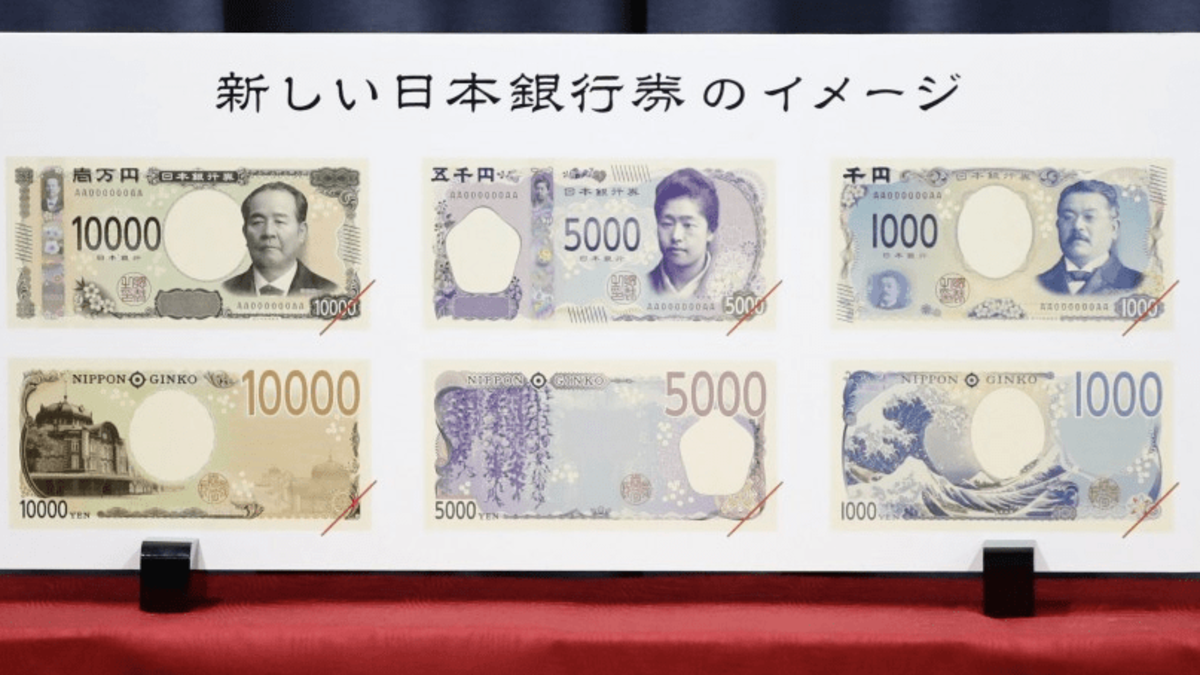
Although this was announced over half a year ago, I thought it would be interesting to take a look at the new Japanese bills that will be issued in 2024 and the 500-yen coin (to be issued in 2021).

The new notes will be issued in the first half of fiscal 2024 and will be the first new bills since 2004. To combat counterfeiters, the Japanese government releases new notes every twenty years. The new bills will incorporate the latest anti-counterfeiting features. According to Asahi News, as many, as 1,698 forged notes were found in Japan in 2018.

Five-hundred-yen coins were first issued in 1982 to replace the old 500-yen notes. The first series, however, was too similar in weight and size to Korean 500-won coins (back then equivalent to about 50 yen), so they were replaced with the current 500-yen coins minted since 2000.

The new 10,000-yen banknote will feature Shibusawa Eichii (渋沢 栄一 , 1840-1931), the "father of Japanese capitalism" and an illustration of the Marunouchi facade of Tokyo Station on the reverse.
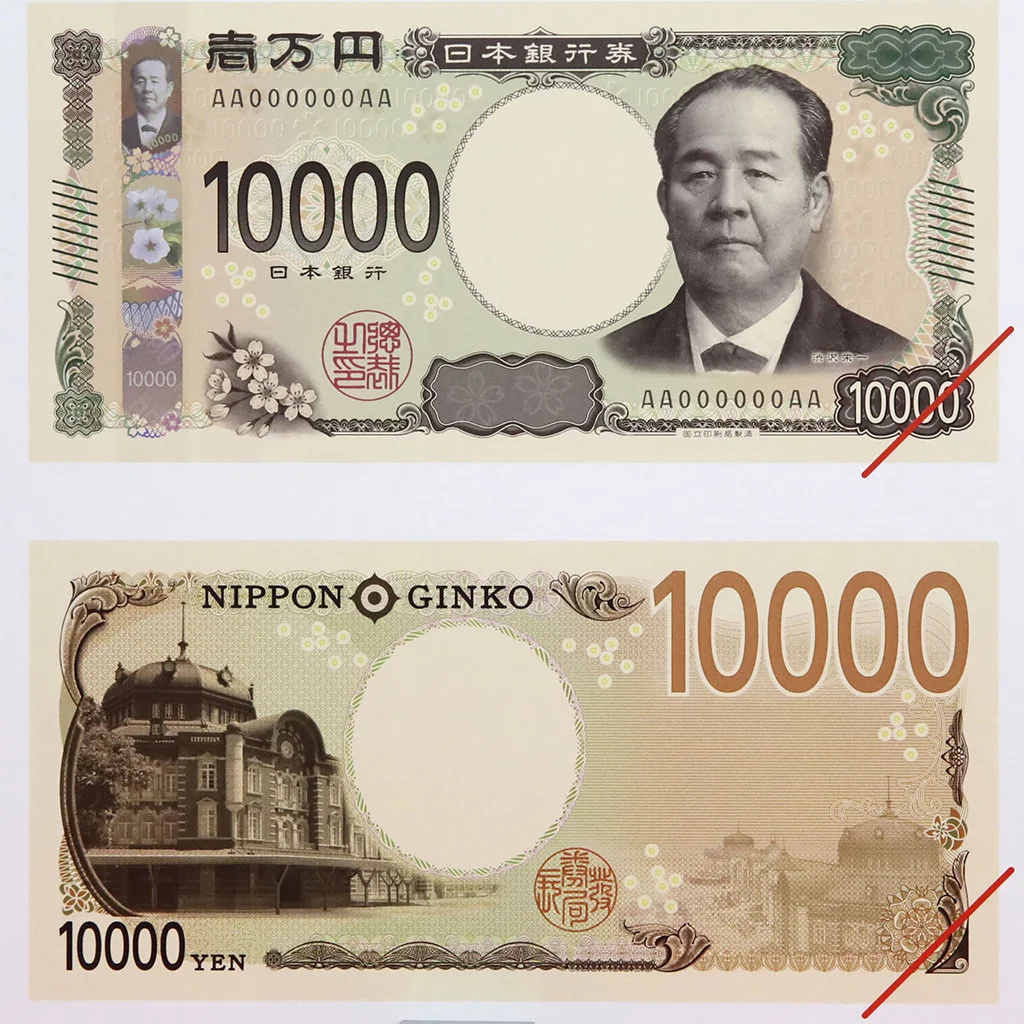
new-ten-thousand-yen-bill.jpg


Five-thousand-yen notes seem to be reserved for famous female personalities. The new 5000-yen note displays Tsuda Umeko (津田梅子, 1864-1929), one of the first Japanese women to study abroad. She was the youngest of five girls who accompanied the Iwakura Mission to the United States in 1871. In Washington DC she studied at private girls' schools and was later baptised. In 1900, she founded Joshi Eigaku Juku (女子英学塾 Women's Institute for English Studies) in Tōkyō, later renamed to Tsuda College. The reverse shows an illustration of wisteria flowers.
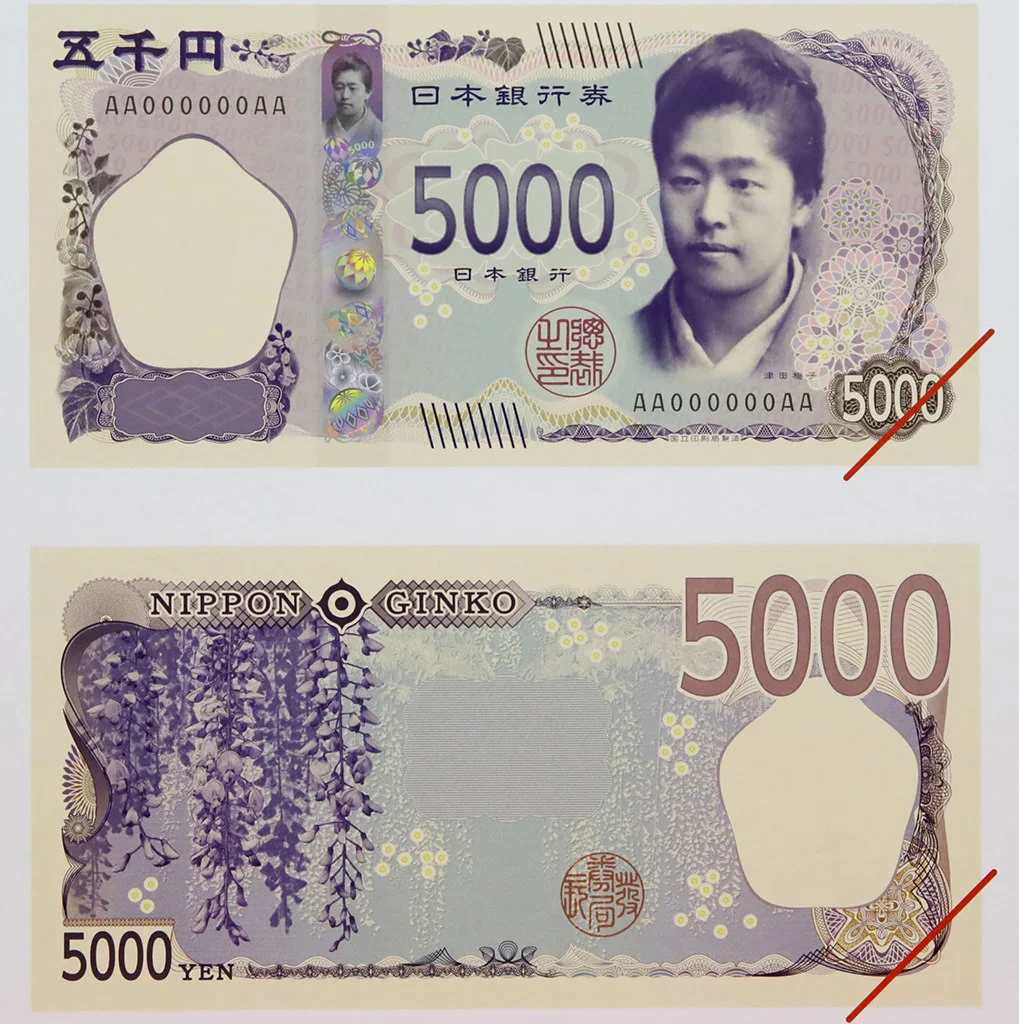
new-five-thousand-yen-bill.jpg


The relatively rare 2,000-yen bill will not be redesigned,

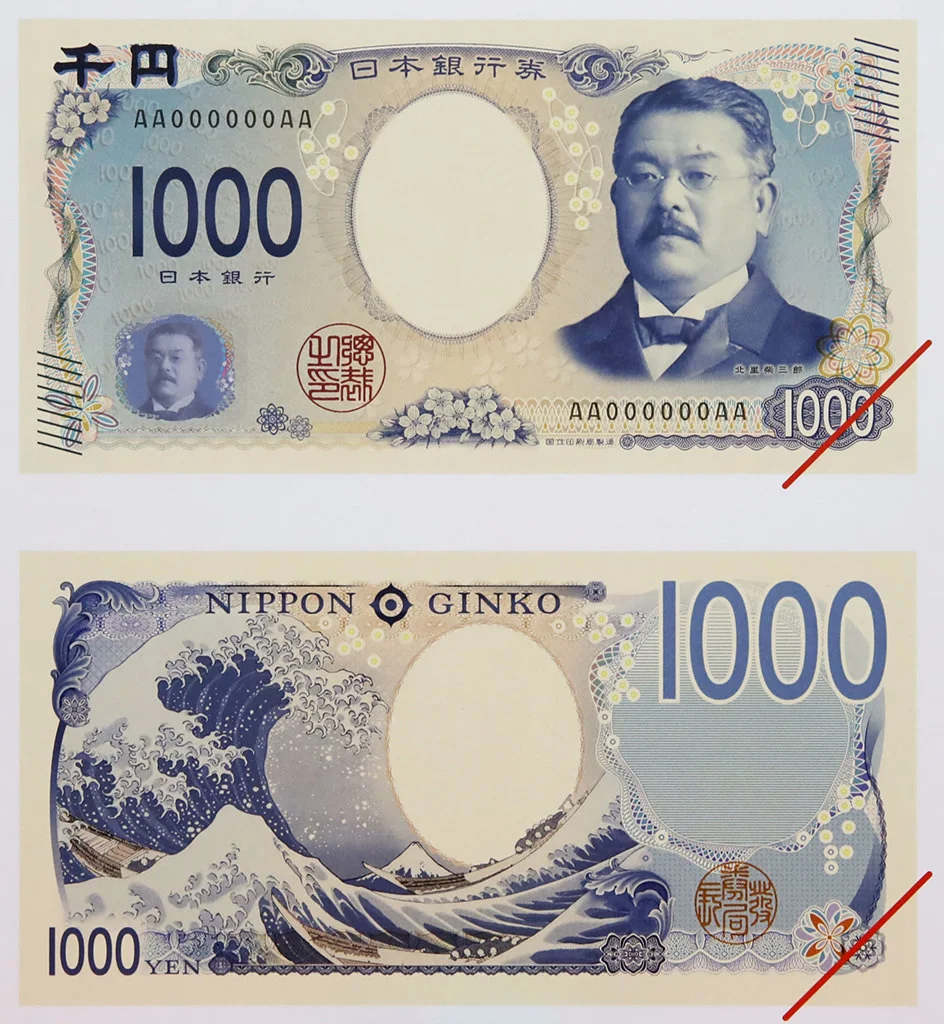
The obverse of the new 1000-yen bill features Kitasato Shibasaburō (北里 柴三郎, 1853-1931) who studied under Robert Koch in Germany. Later, he became a famous bacteriologist and co-discovered the infectious agent of bubonic plague in Hongkong in 1894. He was also the first dean of the Faculty of Medicine of Keiō University as well as the first president of the Japan Medical Association. The reverse features "The Great Wave off Kanagawa," the famous woodblock print by ukiyo-e artist Katsushika Hokusai (葛飾北斎).

new-one-thousand-yen-bill.jpg


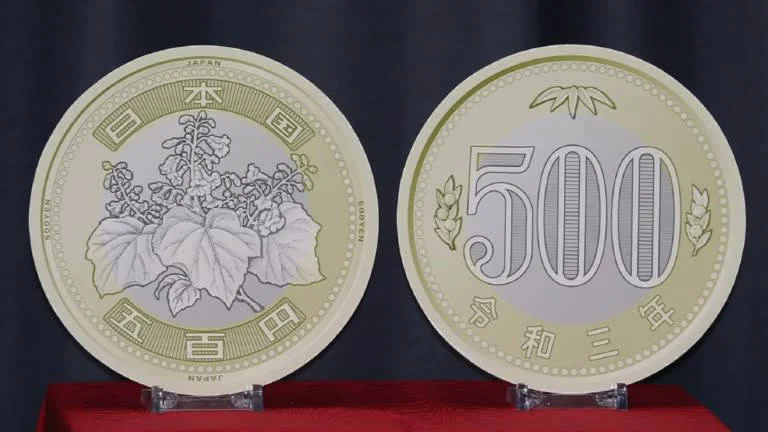
The new 500-yen coin will be issued in the first half of 2021. The new coin will feature a two-coloured, three-layered structure. The current 500 yen coin has grooves of the same size while the new one has differently-sized grooves on its side.
new-500-yen-coin.jpg


Last edited:
I feel bad that Fukuzawa Yukichi is disappearing from the bank notes. I think he was a true visionary, and unique, and more-or-less uncoopted by various political ideologies. He's an inspiring figure. The new group of faces are completely unknown to me. Putting "the father of Japanese capitalism" on the 10000 note is, somehow appropriate, but also seems a big step down from Fukuzawa Yukichi. I do like the designs on the revers sides, though.
 
I see that the new (3rd generation) 500 yen coin has "Japan" written twice along the edge on the obverse side, and also hidden inside of the large 0's on the reverse--visible when viewed at an angle. I wonder if this marks the first time that the English word "Japan" has appeared on Japanese currency. Did the Prime Minister sign off on this??

Five-hundred yen coins were first issued in 1982 to replace the old 500-yen notes but were too similar in weight and size to Korean 500-won coins (with only one-tenth of their value).
The way this is worded suggests that the Japanese coins were one-tenth the value of the Korean ones, when the opposite is true.
 
Its just all paper to me. Worthless, just worthless. Don't you all just agree with me.
What I'm saying, if in the event of a disaster and the banks are all closed, its worthless unless it remains its true value, which in most cases it doesn't.
Just bought a 58 gram bag of chips for 100 yen. Unbelievable 20 years ago.
 
The way this is worded suggests that the Japanese coins were one-tenth the value of the Korean ones when the opposite is true.

Thank you, I have corrected this.

I feel bad that Fukuzawa Yukichi is disappearing from the banknotes. I think he was a true visionary, and unique, and more-or-less uncoopted by various political ideologies. He's an inspiring figure. The new group of faces are completely unknown to me. Putting "the father of Japanese capitalism" on the 10000 note is, somehow appropriate, but also seems a big step down from Fukuzawa Yukichi. I do like the designs on the reverse sides, though.

What impressed me in Shibusawa (and I'd never heard of him before his "nomination" in April) wasn't his pioneering role in introducing Western capitalism to Japan but his philanthropism and moral principles. However, I agree with you that he isn't of Fukuzawa's calibre.

Hard to say who else might qualify for the 10,000-yen note. Scientists, artists, and poets are the least controversial, but they only seem to be featured on 1000-yen bills. A few faces I'd like to see on any future banknote would be Sugihara Chiune, Miyazawa Kenji, Kurosawa Akira, and Yosano Akiko.
 
I remember those 500won/500yen coin problems. That really was a rather bad problem back then.

I also seem to remember a friend told me that it was such an easy slide for some bad folks not getting too carried away with tricks, as they could just use a great smooth, straight face and claim they really hadn't noticed they used the wrong coin. That made the problem even worse.

But the number one question is how could it have been that some smart government worker didn't figure out in the very beginning a problem would exist?
 
Japan will start issuing new ¥10,000, ¥5,000, and ¥1,000 banknotes on 3 July 2024, marking the first redesign in about two decades, the Finance Ministry and the Bank of Japan said on Tuesday. Even after the new bills begin circulating, the current banknotes will remain legal tender.

Quite amazing:

At the end of December last year, 18.59 billion banknotes were in circulation, which is equivalent to about eight times the distance between the Earth and the moon if they were lined up horizontally, according to the BOJ.


Two signs you are getting old

1. What? They are changing the banknotes ALREADY?? Didn't they just change them?
2. These new notes suck.

Keep the current ones (the "new" old ones...the ones with Higuchi Ichiyo on them)! ..... he says as he shakes his fist at the screen.

And, what about the unloved, but still charming 2,000 yen notes? No mention of these. I guess they will be quietly killing these off. The resistance to these is funny. Not unlike Americans' resistance to using a dollar coin, even though it would make an enormous amount of sense.

I still find it funny that Japan's smallest note is, even with the weak yen, still more valuable than the US's two smallest notes.* And Japan's highest denomination coin in normal circulation, the 500 yen coin, has way more value than US's hated $1 coin, and the equally hated 50c coin. America sure loves its quarters and dollar bills.

Actually, to be honest, I can't remember when the last time I used any cash was. America is almost entirely cashless. I have a pile of loose change in a coin purse that is slowly oxidizing from lack of use.

*I am not including the US's own version of the unloved note; the rarely seen (and never used) $2 bill.
 
And I still think Fukuzawa Yukichi is a much more dignified person to have on your largest-denomination note.
 
And, what about the unloved, but still charming 2,000 yen notes? No mention of these. I guess they will be quietly killing these off. The resistance to these is funny. Not unlike Americans' resistance to using a dollar coin, even though it would make an enormous amount of sense.

The other day, I saw this on Twitter: the poster exchanged money in Lithuania, and all her change came in 2,000-yen bills. :LOL:

 
Japanese banknotes used to be made of mitsumata (三椏, Japanese paperbush, Edgeworthia chrysantha). The paper required for the notes starts with woody pulp from plants of the Thymelaeaceae family. These plants grow at high altitudes with moderate sunshine and good drainage—ideal tea-growing terrain.

However, Japan's supply of mitsumata was running low: shrinking rural populations and climate change drove Japan's farmers to abandon their labour-intensive plots.

Argeli


An Osaka-based company, Kanpou Incorporated, discovered that a plant called argeli, an evergreen, yellow-flowering shrub found wild in the Himalayas, was also well-suited to print banknotes and started tutoring Nepalese farmers. The bark stripped from argeli would one day turn into pure money - and a lucrative business for Nepal.


The BOJ's head office and branches will not exchange old notes for the new designs that will go into circulation on 3 July.

To obtain the new notes, one must go to a counter or an ATM of a private financial institution. While the BOJ is scheduled to deliver the new bills to each financial institution from on the morning of 3 July, megabanks are still "considering" specific measures to be taken. Even after the new notes are issued, the current ones can still be used. The BOJ will gradually collect old bills deposited by financial institutions and switch them for the new designs. They are calling on people to be on guard against scams urging people to deposit funds with claims that "the current bills will become unusable, so we'll exchange them for new banknotes."

 
They are here! :cool: And does this BOJ guy ever smile❓


BOJ chief Kazuo Ueda

Photo credit: Kyodo


New 10,000 yen ($62), 5,000 yen and 1,000 yen banknotes featuring cutting-edge anti-counterfeit technology went into circulation in Japan on Wednesday, in the first design change in two decades just as the cash-loving nation slowly goes cashless. The first batches of the new bills, featuring three-dimensional holograms of historical figures, were transported from the Bank of Japan's head office by truck to financial institutions, and some consumers may be able to obtain them Wednesday at banks and automated teller machines. The previous banknotes will remain valid. The BOJ plans to ship 1.6 trillion yen worth of the newly printed bills on Wednesday, with its chief Kazuo Ueda underscoring the importance of banknotes as a "critical settlement method" even in the age of increasing cashless payments.


Paywall alert:
 
So, has anyone laid hands on the new bills yet? I haven't.

Cup Noodles introduced them in a video:


Asahi reported on the mitsumata plant from Nepal:


Since 1879, "mitsumata" (Oriental paperbush) has been used to print banknotes, according to the National Printing Bureau (NPB). The deciduous shrub native to the Himalayan region also grows in Okayama and Tokushima prefectures, and elsewhere in Japan, and is used in the production of traditional "washi" paper. However, domestic output is declining. The plant also flourishes in the Nepal and is used as a raw material for paper production. Feeding Japan's appetite for banknotes requires around 100 tons of mitsumata each year, but Nepal's maximum annual production capacity stood at approximately 30 tons.

 
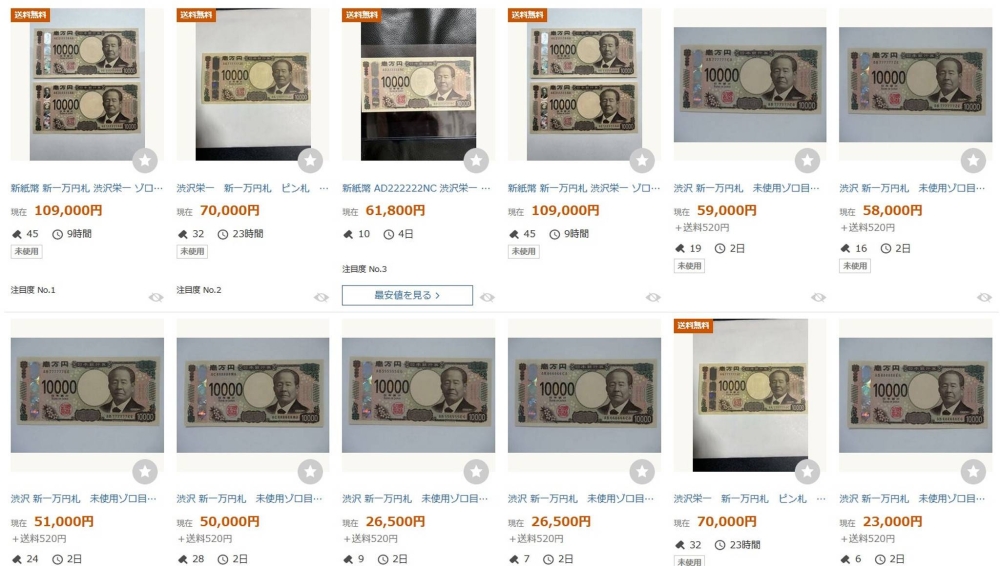
New Japanese banknotes are fetching premium prices on online auction sites. Just a month after their release, some bills, particularly those with matching serial numbers, have sold for ten times their face value. While auction platforms like Yahoo! Japan allow listings of banknotes with collectable value, they also reserve the right to remove items lacking such appeal. In contrast, the famous flea market app Mercari has outright banned the sale of banknotes due to concerns over money laundering.


Photo credit: Jiji


[...] a new ¥10,000 note with the same numbers in its serial number sold for as high as ¥70,000. Bids surpassing a banknotes face value have also been observed for new ¥1,000 notes. Circulated notes can be listed on Yahoo Auction as long as their collectible or scarcity appeal is recognized.


Contact me privately if anyone overseas needs a cheap Shibusawa ¥10,000 banknote. Bids start at double face value. 😆
 
I've seen and used some of these now, and they work just as you'd expect money to work. Much ado about nothing.
 
Back
Top Bottom