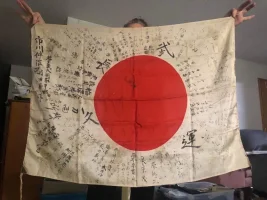
New to this forum so I hope I am doing this correctly. I have this flag that as family history goes belonged to my grandfather who was in WW2 stationed in the Philippines. Any information would be greatly appreciated.
Hello Allmom
This is the correct orientation for the flag.
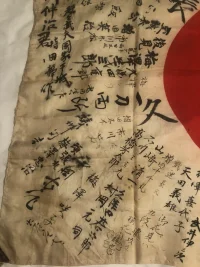
The big letters vertically down the right around the red disk are 武運長久 (bu-un chōkyū). It means "good luck in war". Vertically down the left side of the flag is the recipient's name, Ichikawa Nakaharu (last bit could be wrong). The writing next to that looks like it is from the people who presented the flag to Mr. Ichikawa. It looks like several family names, but I am unsure. A close up of that area might make easier to read. Most of the the rest of the writing on the flag are names.
The big letters vertically down the right around the red disk are 武運長久 (bu-un chōkyū). It means "good luck in war". Vertically down the left side of the flag is the recipient's name, Ichikawa Nakaharu (last bit could be wrong). The writing next to that looks like it is from the people who presented the flag to Mr. Ichikawa. It looks like several family names, but I am unsure. A close up of that area might make easier to read. Most of the the rest of the writing on the flag are names.
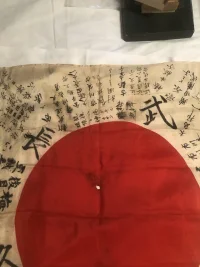
What do you mean by "orientation? Also, could you tell me a little more about the history behind flags like this and how my grandfather may have gotten position of it? I have been told the hole close to the middle is a gunshot hole. Not 100% on that but it is a "burned" looking hole.
Thank you for responding and any other information you can give me.
The big letters vertically down the right around the red disk are 武運長久 (bu-un chōkyū). It means "good luck in war". Vertically down the left side of the flag is the recipient's name, Ichikawa Nakaharu (last bit could be wrong). The writing next to that looks like it is from the people who presented the flag to Mr. Ichikawa. It looks like several family names, but I am unsure. A close up of that area might make easier to read. Most of the the rest of the writing on the flag are names
If you are, for example, mounting the flag in a frame, or if you want to post pictures of it on social media, you will want to orient it like I have in my post above. Often people who don't speak Japanese will put it upside-down, or back-to-front. In other words, they don't know that the flag has a proper direction vis-a-vis the writing on it.
Flags like these were presented to young men as they joined the army, or if they were sent off to the front lines. Usually they were presented by coworkers, colleagues, friends, fellow classmates, etc... The recipient's name is often written in large letters down one side of the flag, and the people who presented the flag would write their organization's name next to the recipient's name. So it isn't unusual to see a flag with large letters that say something like, "To Mr. Sato, from all of us at Tanaka Electronics". Then the fellow coworkers and friends would all sign the flag with their own individual names. It would be carried off to the front lines in the soldier's kit as a remembrance.
How your grandfather came into possession of it will be something of a mystery, I'm afraid. It is possible he took it off a Japanese soldier. It is possible he bought it off a Japanese soldier after the war, as the value of these items as souvenirs was instantly recognized after the war. If he was stationed in the Philippines for a while, he might have bought it off of a fellow US soldier. In fact, they became such sought-after souvenirs that many GIs started making their own fake flags to sell to other soldiers, and we see a lot of fake flags here on JREF. Your flag looks authentic. If you were considering repatriating the flag (trying to find the descendants of the soldier mentioned in the flag), there are organization that can help. The Obon Society is one. The Japanese Embassy is another.
This site uses cookies to help personalise content, tailor your experience and to keep you logged in if you register.
By continuing to use this site, you are consenting to our use of cookies.