

Hello everyone, today I thought I'd work on the following excerpt:
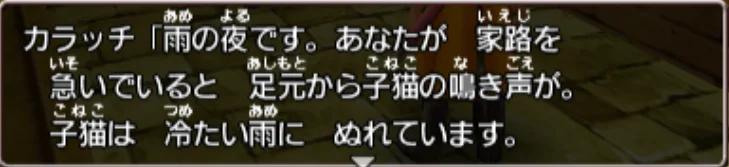
Step 1:
As usual, I first type in the actual text from the picture:
雨の夜です。あなたが 家路を
急いでいると 足元から子猫の鳴き声が。
子猫は 冷たい雨に ぬれています。
Step 2:
And as usual, I'll identify the vocabulary I can at a glance. I like to identify what part of speech each element is to practice using Japanese grammar terminology. I also try to rewrite the kanji in kana if possible in order to learn them at the same time or at the very least become familiarized with it. I also try to remain structured by following the same pattern:
雨 (kanji): 普通名詞 (part of speech); あめ (kana); rain (meaning).
夜: 普通名詞; よる; evening
家路: 普通名詞; えいじ; way home
急: 五段; いそぐ; to hurry
足元: 普通名詞; あしもと; at one's feet
子猫: 普通名詞; こねこ:kitten
鳴き声: 普通名詞; なきごえ: animal cry
冷たい: 形容詞; つめたい: cold to the touch
Step 3:
Refining. What I mean by that is modify what I already have identified with the extra information the text provides. This is more of less what I've done for 「冷たい」 and
「鳴き声」in the sense that I didn't stick to each individual kanji alone as that'd be losing sight of some crucial information.
急いでいる is one such element which requires extra attention.
Step 4:
And so 「急いでいる」is the excerpt I wish to focus on this time because it's a recurring grammatical construction.
First off, the ~て construction. In order to obtain the ~て form, we must follow a two-step process. First conjugate the verb (急ぐ) in the past.
For 五段 verbs ending with ぐ, we change the ぐ to いだ, like so:
急いだ
The second step of the two-step process is to change the だ to で like so:
急いで
All that's left would be to add 「いる」like we already have:
急いでいる
This construction means the enduring state of 急ぐ, which it this case: ''hurrying''. Depending on the verb in the ~て form, it can either express the ''enduring state of being'' or ''enduring state of action''.
As for a partial translation, I would say:
雨の夜です。
It's a rainy evening.
あなたが 家路を
急いでいると 足元から子猫の鳴き声が。
As you are hurrying home, at your feet is a mewing kitten.
...or something along those lines. At this point in time, a general idea is good enough.
Thank you for reading!
Step 1:
As usual, I first type in the actual text from the picture:
雨の夜です。あなたが 家路を
急いでいると 足元から子猫の鳴き声が。
子猫は 冷たい雨に ぬれています。
Step 2:
And as usual, I'll identify the vocabulary I can at a glance. I like to identify what part of speech each element is to practice using Japanese grammar terminology. I also try to rewrite the kanji in kana if possible in order to learn them at the same time or at the very least become familiarized with it. I also try to remain structured by following the same pattern:
雨 (kanji): 普通名詞 (part of speech); あめ (kana); rain (meaning).
夜: 普通名詞; よる; evening
家路: 普通名詞; えいじ; way home
急: 五段; いそぐ; to hurry
足元: 普通名詞; あしもと; at one's feet
子猫: 普通名詞; こねこ:kitten
鳴き声: 普通名詞; なきごえ: animal cry
冷たい: 形容詞; つめたい: cold to the touch
Step 3:
Refining. What I mean by that is modify what I already have identified with the extra information the text provides. This is more of less what I've done for 「冷たい」 and
「鳴き声」in the sense that I didn't stick to each individual kanji alone as that'd be losing sight of some crucial information.
急いでいる is one such element which requires extra attention.
Step 4:
And so 「急いでいる」is the excerpt I wish to focus on this time because it's a recurring grammatical construction.
First off, the ~て construction. In order to obtain the ~て form, we must follow a two-step process. First conjugate the verb (急ぐ) in the past.
For 五段 verbs ending with ぐ, we change the ぐ to いだ, like so:
急いだ
The second step of the two-step process is to change the だ to で like so:
急いで
All that's left would be to add 「いる」like we already have:
急いでいる
This construction means the enduring state of 急ぐ, which it this case: ''hurrying''. Depending on the verb in the ~て form, it can either express the ''enduring state of being'' or ''enduring state of action''.
As for a partial translation, I would say:
雨の夜です。
It's a rainy evening.
あなたが 家路を
急いでいると 足元から子猫の鳴き声が。
As you are hurrying home, at your feet is a mewing kitten.
...or something along those lines. At this point in time, a general idea is good enough.
Thank you for reading!


