After further review and several meetings on the subject, here is a revision of Shimazu's journal without the Japanese writing of the 18th century. Thanks to Mike-san and Toritoribe for their alerts to my mistakes concerning the language in the novel. I would appreciate any feedback on this revision. I will also post the revision regarding Tsunako's book at some point in the future. Thank you again for the help. The suggestions and comments are critical to getting everything correct, which is what I strive to do.
----------------
The tall bookcases set against the walls contained hundreds of books and documents. He spent nearly twenty minutes searching for the journal when he noticed the faded spine of a brownish cover. Henry gently pulled the old, scratched-up book from the shelf and smiled.
He had found the journal of Shimazu Masahiro, who lived in the eighteenth century and served in the British army during Braddock's expedition to Fort Duquesne. The inscription on the front read—旅行記—translated to Ryokōki in the language of Japan at that time, or roughly, "My Journey" in English. The document's inside pages contained a Pro Patria watermark and British crest. The pages were somewhat faded and brownish-colored, but all penned in English by a careful hand. It also included many hand-drawn sketches that impressed Henry.
"Let's see what Shimazu says about this coin," Henry said, seated at his desk and eager to learn about Shimazu's life in colonial America.
Though Shimazu's journal was written in English, the vernacular of the eighteenth century was much different than Henry anticipated. What he expected to take a couple of hours to complete instead turned into an all-night struggle. Some pages flowed nicely, but others describing eighteenth-century phrases and situations frustrated him as he transcribed the accounts onto his computer.
"Shimazu's descriptions are challenging to understand in some instances—the words of the English in the eighteenth century were . . . difficult because of the multiple meanings, different spellings, unusual phonetics in that period of time," Henry said, typing notes on his computer. "But he was very detailed in his writing, and his penmanship is magnificent."
Henry's task began before midnight and did not end until after 8 a.m. the next day. Only when Noriko interrupted him did he move away from the desk.
"Have you been down here all night?" Noriko asked, already knowing the answer.
Unlike sentences such like 私は家に帰る vs. 我家へ帰らん, there is not much difference between modern and classical Japanese titles of those kind of journals. In fact, 旅行記 (lit. record of (my) journey) is quite commonly used even now. If you want to add "classical" nuance to the title, 旅行記 is not a good choice. Is Shimazu's journal only about his serving in the army there, or his entire journey after leaving Japan?
Unlike sentences such like 私は家に帰る vs. 我家へ帰らん, there is not much difference between modern and classical Japanese titles of those kind of journals. In fact, 旅行記 (lit. record of (my) journey) is quite commonly used even now. If you want to add "classical" nuance to the title, 旅行記 is not a good choice. Is Shimazu's journal only about his serving in the army there, or his entire journey after leaving Japan?
Shimazu began this journal while aboard the HMS Syren during the British army's voyage across the ocean to North America. The contents of the journal are his day-to-day observations of serving as a military physician for the Braddock expedition. To answer your question, the journal would include entries from late 1754 until his death, which I can't divulge without giving away too much. I would appreciate your advice on whether a "classical" title would apply in this case. Also, I am including a bit more information on Shimazu's past below from the novel, how he left Japan and arrived in Europe during a time in which Japan had chosen isolation from the western world. Thank you again for your suggestions and comments!
-------------
Born and raised in Satsuma of the samurai class, Shimazu displayed physical attributes at an early age that portended a warrior. Shimazu's prodigious skills with the daishō—the matched pair of traditionally made Japanese swords worn by Samurai—impressed the daimyo, but the youth's self-discipline and wisdom secured unreserved favor with his feudal lord. With Japan flourishing in peace and the samurai having been reduced to bureaucrats, the daimyo instructed sixteen-year-old Shimazu to instead learn the ways of medicine. The daimyo, acutely aware of the youth's vast intelligence and looking to reduce the number of soldiers, arranged for Shimazu to begin training as a doctor.
Shimazu embraced the opportunity, traveled to Kyoto for his education and became a notable student of medicine. He also impressed many doctors with his hand-drawn illustrations of the human anatomy. The physicians in Kyoto admired Shimazu's artistic talent with the lead pencils and ink quills, something that enabled him to sketch accurate medical diagrams. He ascended into a prominent role as a doctor in the Imperial House shortly after his twenty-second birthday in 1734. By this time Shimazu stood five-foot-eleven (extremely tall for a Japanese man) and his powerful build prompted many to call him the oushi—the bull. But his vocation was that of a healer, not a warrior.
Having barely escaped death for violating a royal mandate in Kyoto, Shimazu and his future bride, Tsunako, fled Japan in 1738. They traveled by ship to India, where he found employment in the Dutch East India Company. He later served as a field doctor and soldier at the beginning of the Travancore-Dutch War in southern India.
Shimazu and Tsunako eventually journeyed to Great Britain, where they produced a daughter, Yoshino, in 1740. Tsunako died in 1744 from complications of dysentery, leaving Shimazu to raise Yoshino on his own in London. Though not a naturalized citizen of Great Britain, Shimazu joined the British army in 1749. His background in medicine allowed him to be assigned as a surgeon's mate on the recommendation of Sir John Pringle, who marveled at Shimazu's unique methods for treating sick patients. Pringle later informed David Middleton, the British surgeon general, of the Japanese doctor's advanced abilities in medicine, noting Shimazu would be an ideal physician in challenging locations.
Shimazu was subsequently reassigned to serve under Sir James Napier, Braddock's chief surgeon, when the British made the voyage to North America in 1755. Napier's medical staff consisted of surgeons and mates exclusively, with no doctor of primary care and medicine listed among the personnel. Shimazu would be the de facto physician to treat illness and normal medical concerns during the expedition. To avoid political bickering in choosing the Japanese man instead of an expensive English physician, Pringle and Middleton clandestinely enlisted Shimazu as an apothecary under the nom de guerre of William Couch.
Once they reached North America, Napier instructed Shimazu to discard the William Couch alias and begin work as a physician. The Japanese man also shouldered the responsibility of protecting his daughter in the wilderness of the New World.
Then, 従軍行記 Jūgunkōki (record of journey of army) or 従軍雑記 Jūgunzakki (record including observation of daily life) might be more appropriate. These titles sound somewhat classical.
He also impressed many doctors with his hand-drawn illustrations of the human anatomy. The physicians in Kyoto admired Shimazu's artistic talent with the lead pencils and ink quills, something that enabled him to sketch accurate medical diagrams.
This might be nitpicking, but the first act of dissecting was done in 1750 in Japan (it's forbidden).
Pencils were not used as a writing implement in that era.
Then, 従軍行記 Jūgunkōki (record of journey of army) or 従軍雑記 Jūgunzakki (record including observation of daily life) might be more appropriate. These titles sound somewhat classical.
This might be nitpicking, but the first act of dissecting was done in 1750 in Japan (it's forbidden).
Pencils were not used as a writing implement in that era.
There is no such thing as nitpicking when a reader notices an inconsistency! That is very interesting about the dissecting, and I will address it in the novel. While still living in Japan, Shimazu had in fact studied diagrams provided by doctors/surgeons working with the Dutch East India Company, but I can see where that could be confusing. Thank you!
It was also an eye-opener about lead pencils not being used in Japan in the 18th century! I knew the brushes and ink quills were used. I even remember seeing the mini-series called "Shogun " years ago and the character Blackthorne being given pencils by Lord Toranaga to draw maps, and that was in 1598 or so! I will address that point in that section as well. As always, I appreciate the comments!
Graphite sticks and pastels were used in parts of Europe during the 1750s, not lead pencils. The quill pens were the most commonly used writing utensil of that era, but I found this note of interest online to confirm Toritoribe's note:
---Graphite came into widespread use following the discovery of a large graphite deposit in Borrowdale, England in 1564. Appreciated for leaving a darker mark than lead, the mineral proved so soft and brittle that it required a holder. Originally, graphite sticks were wrapped in string. Later, the graphite was inserted into hollowed-out wooden sticks and, thus, the wood-cased pencil was born. In 1795, the first pencil was invented by French scientist Nicholas-Jacques Conte.
Thanks again to Toritoribe for a great catch! I assume what I saw in the Shogun mini-series was a graphite writing instrument, though I thought it was a pencil.
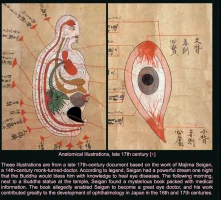
I am attaching an illustration from 17th-century Japan that was produced by documents based on Majima Seigan's work from the 14th century. It depicts the human anatomy on the left side. Not as detailed as what I envisioned Shimazu's illustrations in the novel, but according to the file from the 17th century in Japan.
Yes, I know those kind of pictures were used in medical books in that era (mostly originally from Chinese books, if my memory is correct). I had an impression as if Shimazu painted realistic pictures while looking at real organs from your description.
He also impressed many doctors with his hand-drawn illustrations of the human anatomy. The physicians in Kyoto admired Shimazu's artistic talent with the lead pencils and ink quills, something that enabled him to sketch accurate medical diagrams.
Here are some of the revisions to correct/strengthen some of the items we discussed in this forum last week. I talked with a professor of Japanese language and she informed me Henry would be Nisei, and as Mike-san pointed out, very unlikely to be able to translate much of the old language of Japan. She said depending on his background, possibly some, but not an entire book or journal. Thanks again to everyone for their comments and suggestions. Revised passages below:
---------------
She then started asking questions pertaining to the language of Japan and Tsunako's book. "Is the lettering consistent with what you learned while working in Japan?"
Henry shook his head and smiled. "No, it is in kanbun, a style used for Japanese writing in that period of the eighteenth century," he said, noting the calligraphy and its relationship to Chinese writing. "I have some very basic knowledge, but I'll need assistance to translate this book into modern Japanese, then to English."
"Sounds more complicated than I would have expected," Elsie replied. "Do you have anyone in mind?"
"Tatsumi Ando. He's a good friend who was born in Japan, and an expert in Japanese language," Henry said. "I met him when I worked in Tokyo years ago. He lived in Japan for almost forty years, then moved to America in the late 1980s. Tatsumi has since taught modern Japanese in California for years, but he is an expert in the old language of Japan."
"Sounds like an outstanding contact for such an ambitious project, Mister Yamaguchi."
"Yes, but the problem could be deeper with this type of document," Henry replied, shaking his head. "It's more complex than just translation to English. And there seems to be traces of symbolism in what little I could decipher. I could only get through one page, all of like three small sentences, but I am far from an expert. The first page is just an epigraph, a poem that translated appears to say something to the effect of 'Our beginning forgotten. Our ending unrecognized. Only he observes both.' Took me about forty-five minutes just to translate those three sentences. And I am still not sure my interpretation is completely accurate."
"That book is awfully thick, Mister Yamaguchi," Elsie quipped, sipping at a cup of coffee. "It took you that long just to translate three sentences? There must be more than a hundred pages in that book. Is it legible?"
"Yes, the calligraphy is artistic, visually clear," Henry said, "but it's going to take time and assistance from an expert like Tatsumi to accurately translate this document."
-------(from later in the novel)
Tui turned her head at an angle that prevented Henry from noticing the bruise up close. "That's OK," she said with a chuckle. "We're all too busy. Any luck in translating the book?"
"Yes and no," Henry said, sitting next to Noriko on the sofa. "Tatsumi is doing fine with translating the language . . . most of it, anyway. Just very slow, but he's much faster than me with the old language. It's much more difficult than I anticipated."
"Tatsumi is older than you, Dad, so I'm ashamed you're that slow," Tui quipped. "What is he? Eighty at least?"
"Eighty-six, to be exact, sharper than most thirty-year-olds I know, and twice as dedicated to his work," Henry wisecracked. "No, the stories, or whatever they are, seem to be very odd. I think Tsunako's family might have been of either Hindu or Buddhist beliefs as she grew up in Japan, but that just doesn't add up with . . . I'm not sure where this document is going at the moment."
"What doesn't add up?"
"One of the stories describes Shimazu Masahiro and his daughter riding in a wagon, protected by soldiers wearing red uniforms," Henry answered.
"What's so problematic with that, Dad? She's writing about the expedition to Fort Duquesne, right? British soldiers, Shimazu, his daughter. What would you expect her to write about?"
Henry removed his reading glasses, folded his arms, and looked at the ceiling. "Tsunako died in 1744. Yet in this book she is describing something that would have happened in 1755. Seem a bit odd to you?"
Tui frowned, tugged at her ponytail, and slapped Henry playfully on the knee. "That's creepy, Dad. Really creepy. You and Tatsumi probably translated it incorrectly. Is the lettering hard to read?"
Henry chuckled and leaned forward. "The calligraphy is astonishingly artistic. It's an incredibly well-written . . . story, but we just haven't connected the pieces yet. But I will. Tatsumi emails me his translations to modern Japanese, and I convert those into English. Slow, but sure."
"Mom said you were bringing Tatsumi over here to the house twice a week to help you with the project," Tui said, who unwittingly turned her head at an angle that allowed Henry to see her entire face.
"Yes, but we seem to work faster and more effectively with him doing his part over at his home in Reseda," Henry said, momentarily staring at his daughter. "He doesn't drive, and his wife is busy tending to all the grandkids and great grandkids. So I drove over there and picked him up a few times. Now he just emails me the translations. It saves me from wasting gas on the drive to Reseda."
No, it is in kanbun, a style used for Japanese writing in that period of the eighteenth century," he said, noting the calligraphy and its relationship to Chinese writing.
Maybe I'm misunderstanding, but that reads to me as though you have the idea that kanbun refers to the calligraphy or to the visual appearance of the writing. Kanbun could as well be as clearly printed as today's newspaper and still be kanbun. Sort of like how Shakespearean English is still Shakespearean English whether it is in the handwritten style common to that era or printed crystal clear in a modern book. Kanbun was a style of rendering the language into written form using Chinese characters and some conventions borrowed from Chinese composition....not a font style.
Maybe I'm misunderstanding, but that reads to me as though you have the idea that kanbun refers to the calligraphy or to the visual appearance of the writing. Kanbun could as well be as clearly printed as today's newspaper and still be kanbun. Sort of like how Shakespearean English is still Shakespearean English whether it is in the handwritten style common to that era or printed crystal clear in a modern book. Kanbun was a style of rendering the language into written form using Chinese characters and some conventions borrowed from Chinese composition....not a font style.
I see your point and understand why that part needs to be cleaned up. In your opinion, would it be best to totally eliminate the mention of kanbun? Or maybe eliminate the mention of visuals and calligraphy? I'm thinking the latter. Henry is explaining he is not capable of translating the book without an expert because of the challenges in the complexities of reading kanbun. Grouping the references to calligraphy and visuals is a bad idea on my part! I see where confusion would arise. Thank you for the comments as always!
The biggest problem is that women didn't write kanbun diary. It could be possible that quite few women might use kanbun, but it must be in official documents, and not a personal diary. Kanbun was sort of an official language, just like Latin in Europe.
The biggest problem is that women didn't write kanbun diary. It could be possible that quite few women might use kanbun, but it must be in official documents, and not a personal diary. Kanbun was sort of an official language, just like Latin in Europe.
I think the mere visually impenetrable nature of the text is enough to serve the plot purpose of requiring outside help to read/decipher the diary without needing to bring kanbun into it, whether she would have written in kanbun or not. Adding the kanbun is just 錦上添花, if I may be allowed to misuse a phrase.
Yeah, I, too, think so. Henry wouldn't be able to decipher even a sentence, though. (All he could get would be just a few kanji/words/phrases from the diary.)
Thanks for the comments and help! Any mention of kanbun is being deleted from the novel. In case you were wondering where all this is going, here is a brief summary:
-----------
Retired businessman Henry Yamaguchi is obsessed by the tale of an eighteenth-century woodland girl described as "beyond understanding" in a journal written by a British army physician during Edward Braddock's expedition to Fort Duquesne in 1755.
Claiming a "deity of the forest" intervened repeatedly during that British military campaign in North America, the journal of physician Shimazu Masahiro also reveals a young aide-de-camp named George Washington died while fighting the French and Indians. And what begins as a hobby to satisfy his curiosity instead turns into a life-changing crusade for Yamaguchi, the patriarch of a Japanese American family in present-day Granada Hills, California.
Yamaguchi's pursuit leads to the diary of a colonial scout (Luther Smith) who also encountered the woodland girl during Braddock's expedition, and a peculiar old book—Kikyōki—written by Shimazu Masahiro's wife. The scout's diary includes an entry confirming George Washington's death in the forest near the Monongahela River. The diary also connects Yamaguchi with Dr. Russell Smith, a descendant of the scout and a history professor who is haunted by bizarre nightmares of Indian torture.
The translation of Kikyōki produces an equally disturbing revelation, setting in motion a stirring sequence of events for both Yamaguchi and Smith.
---------
Thanks again for the guidance and answers to my questions! I'm sure I will more before the final manuscript is ready for publication.
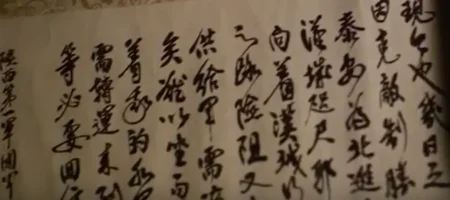
This has nothing to do with my novel, but I'm hoping either @Toritoribe or @Mike Cash can clarify with a response. We have discussed pre-modern Japanese writing and the differences with today's language. I watched a Korean movie last night called "The Admiral: Roaring Currents" that is about Japan's 1597 invasion of Joseon. The film included a scroll being read by the Japanese naval commander, and I wondered if this was actual pre-modern Japanese writing, or if the movie just used today's language. No need for translation. I just wanted to know if the movie producers actually used pre-modern Japanese. The scroll is attached from a screenshot I made. Thank you.
Yes, they are all kanji. It seems to be too much Chinese-like, though.
Note that the kanbun style is written language and rather different from spoken language even in that era. This kanbun style used to be used partially even in Meiji period or until WW2, but these new documents can be read relatively easily since hiragana were standardized and they were basically written in regular script or printed.
This site uses cookies to help personalise content, tailor your experience and to keep you logged in if you register.
By continuing to use this site, you are consenting to our use of cookies.