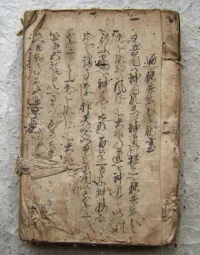
Is Henry supposed to be reading directly from the manuscript here or from something someone else has already input into a computer?
The trouble he would have reading this isn't simply a matter of a difference in grammar, style, or vocabulary and therefore analogous to the trouble speakers of modern English would have reading Chaucer, for example....tough, but doable with a little coaching and determination. As I mentioned earlier, most Japanese-Americans would do well to read modern clearly printed material written in modern Japanese. I don't think you appreciate the amount of trouble they would have reading even modern Japanese handwritten. Handwritten Japanese is a whole 'nuther beast unto itself. If he is supposed to be reading this straight from the manuscript, in the words of the immortal Del Griffith, he would have better luck playing pick-up-sticks with his butt cheeks. "Implausible" doesn't begin to describe it.
Henry is actually reading Shimazu's journal, which is written in both English and Japanese. Shimazu was fluent in both languages in 1755, and his journal includes entries in both languages. The reasons are explained later in the novel, as is Henry's background.
Now, Shimazu's wife's book is written
entirely in the 18th-century Japanese. Henry is able to translate some of the material, but he must turn to an expert in the language to get the exact translations and interpretations, many of which seem to be symbolic. You are correct about the reading straight from the manuscript. Born in California, Henry is well-educated and spent many years in Japan after turning 20. He does know 18th-century Japanese to an extent (explained later in the novel), but the abstract nature of Tsunako's document forces him to ask for help in the translation. It begins to make sense as the novel progresses and is not implausible at all once you see what has transpired in the plot. In fact, it will make total sense and tie up some of the loose ends to which you allude. Thank you for your comments and suggestions!
Shimazu translated English words/phrases into Japanese and wrote it in kanbun, and Henry is reading it now?
Shimazu (aka as William Couch, based on a character from the Braddock expedition) wrote entries in his journal during the march to Fort Duquesne in both Japanese and English. He is a physician in the British army (his backstory is told in the novel) and fluent in both languages. By the end of the story, it all makes sense.
Keep in mind that many words in the English language used in the 18th century and even 19th century also had vastly different meanings and uses than they do today. While I enjoy James Fenimore Cooper's collection of the "Leatherstocking Tales," many people complain his use of English is confusing and unreadable. I disagree with them, but I also understand his descriptions and sentence structures are from the early 19th century. English is in no way, shape, or form as complex as Japanese, though.
A quote I found on the impossible. The impossible or implausible simply do not exist.
---Nothing is impossible in this world. Firm determination, it is said, can move heaven and earth. Things appear far beyond one's power, because one cannot set his heart on any arduous project due to want of strong will. Yamamoto Tsunetomo---
Read more at:
Nothing Is Impossible Quotes - BrainyQuote
I found this on the kanbun subject, and the complex nature of the Japanese language. These observations from a pair of English professors....
----
William C. Hannas points out the linguistic hurdles involved in
kanbun transformation.
Kambun, literally "Chinese writing," refers to a genre of techniques for making Chinese texts read like Japanese, or for writing in a way imitative of Chinese. For a Japanese, neither of these tasks could be accomplished easily because of the two languages' different structures. As I have mentioned, Chinese is an
isolating language. Its grammatical relations are identified in
subject–verb–object (SVO) order and through the use of
particles similar to
English prepositions. Inflection plays no role in the grammar. Morphemes are typically one syllable in length and combine to form words without modification to their phonetic structures (tone excepted). Conversely, the basic structure of a transitive Japanese sentence is
SOV, with the usual syntactic features associated with languages of this typology, including
post positions, that is, grammar particles that appear
after the words and phrases to which they apply. (1997:32)
He lists four major Japanese problems:
word order, parsing which Chinese characters should be read together, deciding how to pronounce the characters, and finding suitable equivalents for Chinese
function words.
According to John Timothy Wixted, scholars have disregarded
kanbun.
In terms of its size, often its quality, and certainly its importance both at the time it was written and cumulatively in the cultural tradition,
kanbunis arguably the biggest and most important area of Japanese literary study that has been ignored in recent times, and the one least properly represented as part of the canon. (1998:23)