Need a word or phrase translated?

Thank you for the tip. In other words, it's like saying "so you do level up" in English, isn't it?
It's more likely "Hmm, (I don't know) your level can be up by that", I think.

My guess is that if the moment in the story was exactly 8PM, it'd be more convenient for her. I guess this has something to do with religious belief of souls, but I'm not really sure. Maybe that's when souls go to the other world?
That's a joke from a well-known old pop song. The name of the animal(kid?) "あずさ2号" is the title of the song, and at the same time, the name of a train running between Tokyo and Matsumoto City. There is a phrase "8時ちょうどあずさ2号で 私は私はあなたから旅立ちます" in the lyrics. The girl's words are taken from this verse.

See 1:46 ~ 2:02
 
Last edited by a moderator:
It's more likely "Hmm, (I don't know) your level can be up by that", I think.


That's a joke from a well-known old pop song. The name of the animal(kid?) "あずさ2号" is the title of the song, and at the same time, the name of a train running between Tokyo and Matsumoto City. There is a phrase "8時ちょうどあずさ2号で 私は私はあなたから旅立ちます" in the lyrics. The girl's words are taken from this verse.

See 1:46 ~ 2:02
Wow, this is awesome! I never imagined that it would be a reference to a pop song O_O Thank you so much Toritoribe :D
 
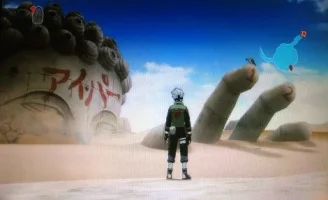
アイパー
This is written on the head of what seems like a buddha statue mostly buried under a desert. I have no idea what it means. I searched it but anything I could find or understand didn't seem relevant to it being in the place it is. The meaning? (This comes from a game in case that changes anything...). TYIA.
 
アイパー is an abbreviation of アイアンパーマ "(hair) iron permanent (wave)". Probably the author would be used it as パンチパーマ, since these two words are sometimes confused (they are actually different, though). Thus, if it's really the head of a Buddha's statue, it seems to me to be a joke that Buddha's hair style 螺髪[らほつ] is similar to a hair style アイパー/パンチパーマ.

螺髪
2us9wlv-1.webp


パンチパーマ
16h5l49-1.webp
 
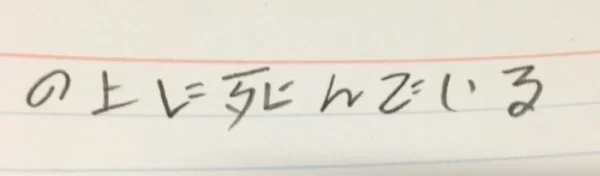
Growing up I often heard the phrase: "Death Before Dishonor". As such, I felt that it was simply saying that in death (posthumously) honor/dishonor are no longer relevant. This seemed very silly to me. So I began to teach my children that it should be a mentality "beyond the grave". In highschool I had began to study the grammar, and I think a very highschool me got it very wrong.
IMG_2421.webp
I am thinking that I put: "no ue ni"... in the wrong place. Any help would be appreciated.
 
Oh right, I see, a perfect explanation, thanks again Toritoribe :). I found an image of what I was talking about.IMG_3230s-.webp
The joke seems to be the case xD
 
Last edited:
@xjmtx
I think "Death Before Dishonor" means that one would rather die than dishonor one's family/friends/comrades etc.
Also, I think it's unclear what you want. Do you want to say "beyond the grave" in Japanese? You're right that the particle の cannot come at the start of a sentence.
My Japanese is bad, but I think on your image it says "is dead on ___"


Can anyone help me coming up with a translation for this one please?

復讐されるは我にあり

It's the title of a chapter where the main character is getting punished by his Yakuza boss.
I'm having trouble coming up with a translation. "His vengeance is upon me", does that sound about right?
Thank you as usual. :)
 
Yes, your interpretation is correct. That's a parody of a well-know movie/novel 復讐するは我にあり, whose title is quoted from the Japanese translation of "Vengeance is mine; I will repay, saith the Lord." --Romans 12:19.
 
@xjmtx
I think "Death Before Dishonor" means that one would rather die than dishonor one's family/friends/comrades etc.
Also, I think it's unclear what you want. Do you want to say "beyond the grave" in Japanese? You're right that the particle の cannot come at the start of a sentence.
My Japanese is bad, but I think on your image it says "is dead on ___"

I understand what death before dishonor is meant to mean. I am only saying that it seems a bit short sighted. I would like to say "beyond the grave" in japanese yes. Or furthermore, I'd like to know the correct version of that sentence, and know what is wrong with my grammar and vocabulary in general.

Thanks!
 
ツ考えていないとすれば- Please tell me how to translate this into English - I can not find any translation. :emoji_confused:
 
@easychan
You can't really translate simple phrases like that without any context, because they are very ambiguous.
考えていない ~ isn't thinking / haven't been thinking
とすれば (conj) if it happens that; if we make ...; if we take ...; if we assume ...; (P)
So I think it means something along the lines of "If isn't thinking".


Can someone please help me on this one?

ワシの自宅の警備ようやってくれとるみたいやんけ!?

I don't really get the bold part. The context is that a boss is asking one of his security guards this, and the guard replies to this: "Yes, sir! We're protecting your family 24/7!" I'm assuming he's asking something like "How's securing my home going along?"
Also I can tell that the boss has a dialect.
 
That's よくやってくれているみたいだな in Standard Japanese, thus it's not question but more likely confirmation or praise.
 
What exactly does "作業用" mean? Dictionary just says, "for manufacturing; for work." I always see it on videos of music, like, "作業用BGM." So what does "for work/manufacturing Background Music" mean?
 
"Music to have on in the background while you're working".

~用 (as a suffix) generally means "for the purpose of/use of". It can go with the person/group who is supposed to use it (子供用 for things that are for children), or the situation where something is used (調理用、勉強用、etc).
 
What exactly does "作業用" mean? Dictionary just says, "for manufacturing; for work." I always see it on videos of music, like, "作業用BGM." So what does "for work/manufacturing Background Music" mean?
You saw 作業用BGM on ニコニコ動画 or somewhere maybe? If so, it specifically refers to "BGM for homework", "(a list of/a series of) songs someone selected for BGM while doing homework".
 
Need help with these

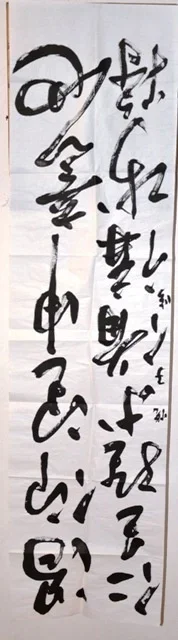
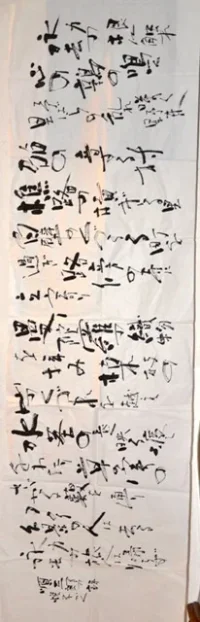
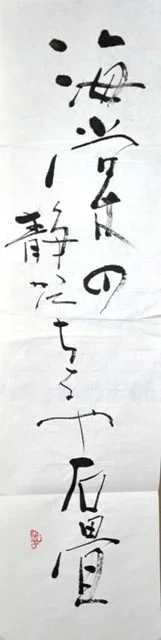
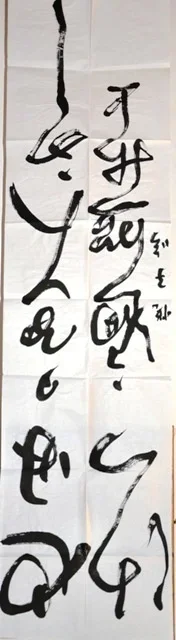
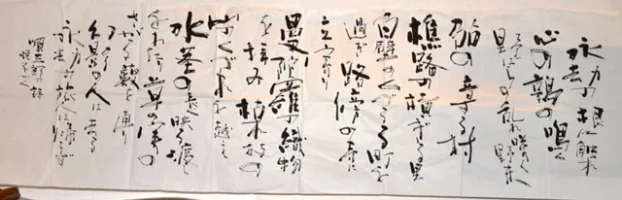
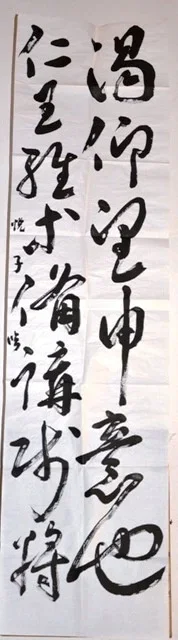
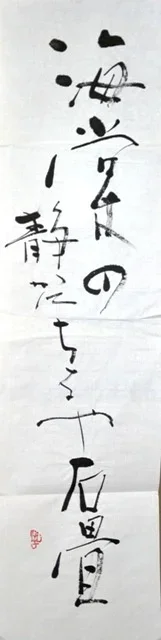
Hello everybody. I've been presented with these four pieces of linen, presumably containing Japanese poetry.

Since I can't even tell the correct orientation (top-bottom, left-right), you can easily imagine what I can understand of the text inside!

Can anyone have a look at them and thell me exactly what are these texts about?
Thanks in advance.

geppo2.webpgeppo1.webpgeppo3.webpgeppo4.webp
 
#1 and #4 are upside-down. #2 should be rotated clockwise 90 degrees. I can only read parts of them.
 
"Music to have on in the background while you're working".

~用 (as a suffix) generally means "for the purpose of/use of". It can go with the person/group who is supposed to use it (子供用 for things that are for children), or the situation where something is used (調理用、勉強用、etc).

Thanks. I was unaware of that. It makes sense now.

You saw 作業用BGM on ニコニコ動画 or somewhere maybe? If so, it specifically refers to "BGM for homework", "(a list of/a series of) songs someone selected for BGM while doing homework".

Yeah I saw it there. That's interesting, next time I have to do anything I'll find one of these. A nice selection of Japanese music will be perfect.

Thanks nekojita, Toritoribe :)
 
Note that if you see a tag on a video on niconico and there is a red icon attached to it, it will link to an entry on nicodic which can be helpful in attempting to decipher obscure slang.
 
I asked before and merely got a response of that my grammar was bad (which I am thankful to know). Is there any possible way to get help to translate from English to Japanese: "Beyond the Grave". My previous highschool days had very flawed grammar. Help not only with katakana/hiragana but phonetic would be of great use.
 
Can anyone please help me with this one?

ホンマやのぅ~!

I think it's a dialect and I'm guessing the ホンマや part is 本当だ in standard Japanese.
But what is the のぅ~ part in standard Japanese?

As usual, thanks a lot in advance. :-)
 
Back
Top Bottom