Need a word or phrase translated?

始めまして、アニメをロシア語に翻訳しているものです。
現在は、「アクセル・ワールド」を訳しています。
現時点では、放送されているのは18話までですが、
サイトには16話までにしかないです。
本アニメのプライオリティはあげられるものでしょうか
できるようでしたら、ぜひ日本語の字幕をアップ
お願いしたく思います

Hey guys, I need help with the bolded parts.
Thanks.
 
Is it possible to increase the priority of (uploading) this anime(Accel World)?

Can I ask you (to upload the Japanese subtitles?)
 
一般的に、若い患者ほど病気の進行も早い。

In general, the younger patient the earlier the illness progress to he (she).

So what is the role of ほど here?
 
Is it possible to increase the priority of (uploading) this anime(Accel World)?

Can I ask you (to upload the Japanese subtitles?)

What does the word 本 mean in the sentence?

あげられる= potential form of 上げる? I'm assuming this means uploading.

Thanks for your help.
 
"Hayai" can also mean "fast", so "In general, the younger a patient is, the faster the disease progresses".

"hodo" means "to the degree that". So literally "to the degree that it is a young patient, the disease's progress is fast(er)."
 
一般的に、若い患者ほど病気の進行も早い。

In general, the younger patient the earlier the illness progress to he (she).

So what is the role of ほど here?
ほど literally means "the more~, the more..." You can think it as 若い患者であればあるほど/患者が若ければ若いほど.

[4] (多く「…するほどに」「…ば…ほど」の形で用いられて)一方の程度が高まるに比例して、他方も高まるという意を表す。…するにつれてますます。

火事は、発見が早ければ早い―、消しとめられる

見れば見る―美人だ

地位が高い―、腰が低いものだ
「ほど」の検索結果 - Yahoo!辞書
(*多く, i.e., "often" means "not always".)


What does the word 本 mean in the sentence?
本 is a prefix, meaning "the one I'm talking about", "the one in the topic". "This" in my translation is the one.

[接頭]名詞に付く。
1 今、現に問題にしているもの、当面のものであることを表す。この。「―議案」「―大会」
2 それがいま話している自分にかかわるものであることを表す。「―大臣としては」
本(ほん)の意味 - goo国語辞書

あげられる= potential form of 上げる? I'm assuming this means uploading.
Yes and no. あげられる is indeed the potential form of あげる, but the object of it is プライオリティ. "To be possible to increase" is the part.
 
Thank you so much for your help. I will review it and see if I have any more questions.

EDIT: It is pronounced もと or ほん? (本)
 
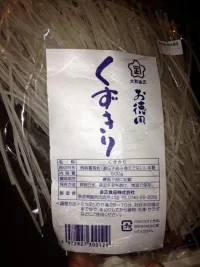
Hi! I just shopped and I was looking for shirataki noodles. I came across this bag and the lady said it was but i cannot understand the labels. Can i ask for help if these are indeed shirataki/ konayaku noodles?
Thank you!!!!

472660_10151575692517715_1203798402_o.webp
 
It's kuzukiri according to the packaging. It's made by dissolving kuzuko in water then heating it and cooling it into a board-type shape, then cutting it into long strips like udon.

Source: 葛切り
 
There are many similar white noodles. Shirataki, Ito konnyaku, Malony, Harusame, Kuzukiri and so on. Sharataki and Ito Konnyaku are made of Konnyaku. Shirataki is littele bit thinner than Ito konnyaku. Shirataki means white waterfall that inspire thinner noodle. Malony, Harusame and Kuzukiri are made of starch, and some other ingredients are diferent.
 
Hello
First let me thank Toritoribe-san for his translation a few weeks ago.

Now, I once again need somebody's help.

What is the Japanese text of this haiku from Yamaguchi Seishi:

Grasses wilt:
the braking locomotive
grinds to a halt


Many thanks in advance.
Uimanabi
 
Seems like this one.

夏草に汽罐車の車輪来て止る

*罐 is the traditional form of 缶.
 
You can check it by yourself just by clicking the link to the dictionary page in my previous post.

I did click on it, but I was overwhelmed by the amount of Japanese.


I need another translation guys.

"俺がここに来た理由とも 被らないでもないから"

I need help with this sentence.
Char A comes out of nowhere and helps a woman.
The woman is grateful for his help. He plans to accompany her on her next errand/mission.
She seems like she's going to pay him money, and says something like, "I don't think this will be enough".

He replies, "Don't worry" and then follows with the sentence above.

I don't understand the usage of 被る in this phrase.
I would like a direct translation please.

Thank you.
 
被る is the same as 重なる, meaning "to overlap" here.
 
と + も(too/also)

What part of the sentence can't you understand?
 
今寝られるならいいな

It'd be good if I can sleep now.
Is it correct?

2
 
Last edited by a moderator:
It can be correct. I don't know the context exactly, but there might be a reason why 寝られるなら is used instead of 寝られたらいい(のに)な or 寝られたらなあ.
 
Back
Top Bottom