Meaning of ずっくり

nonezumi

先輩
Joined
28 Aug 2010
Messages
208
Reaction score
1
Hello,

Please kindly help me with correct translation for the sentence below:

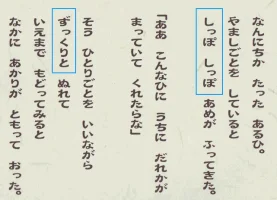
そう ひとりごとを いいながら ずっくりぬれて いえまで もどってみると なかに あかり ともって おった。

Maybe I could translate it as
"While speaking that to him, he slowly got wet and when he tried to come home, inside the lamp light went on."

But I am not sure about ずっくり, I could find it in the dictionary, so I assumed maybe it is a variation of ゆっくり, that may mean "slowly"

And the second difficulty is あかり. I am little bit unclear why it comes without any particle. For example can I use あかりが in this sentence.

If my translation is wrong, please kindly correct me.

I am sorry, maybe I asking too many simple questions…

Thank you very much! :sorry:
 
Last edited:
Are there any typos, for instance, いいながら ずっくりと ぬれて?
 
Oh, I am so sorry. I've made type mistakes. I amended message...

Thank you very much for your kind help. :sorry:
 
I think ずっくりと is also the author's coined word probably meaning "(wet) thoroughly", and yes, it's あかりが ともって おった.

"When he came home wet thoroughly with speaking that to himself, the light was on inside."
 
I think ずっくりと is also the author's coined word probably meaning "(wet) thoroughly", and yes, it's あかりが ともって おった.
"When he came home wet thoroughly with speaking that to himself, the light was on inside."

If possible, can I ask about もどってみると, I have read before, Verbてみる it could mean "try to do Verb". But in the correct translation he came come without any tries.
If possible, can you please kindly explain this detail.

Thank you very much!
 
When used as a conditional clause like ~てみると, ~てみたら, ~てみれば, it doesn't have the meaning of "to try to do".

(イ) (無意志動詞にも付いて、「…てみると」「…てみれば 」「…てみろ」などの形で用いられる)その運動がなさ れることを条件として、結果として新しい事態や認識が 起こることを表す。
なるほど、そう言われてみれば、本当にそうだ
気がついてみると、すっかり人通りがとだえていた
「みる」の検索結果 - Yahoo!辞書
 
If possible, can I ask about もどってみると, I have read before, Verbてみる it could mean "try to do Verb". But in the correct translation he came come without any tries.

~てみる is rather tricky.
It can express "try to do something", and it also means "to do something to see if it works, if it is OK, etc" i.e. to do something for a try, do something tentatively, etc.

In this particular sentence the sense of "tentativeness/for a try" is not strong, so the person returned home (without much expecting something - perhaps someone waiting for him)".
 
Again, are there any other typos, すっかり ぬれて or like that?
 
Again, are there any other typos, すっかり ぬれて or like that?

Like Toritoribe-san, I find ずっくり very strange. I have lived in the Kanto region (Tokyo area, where the Japanese spoken is the basis of the "standard" Japanese language) all my life, but never heard of it.

Googling got only one instance of it:
http://www.weblio.jp/content/びったらこ
ずっくり is used there to describe a word in the Yokkaichi dialect. I have a feeling that the person who contributed the definition is him/herself a dialect speaker.

At any rate, the word is used to mean "thoroughly (wet)" which is びっしょり in ordinary Japanese speech.

Considering that you asked about 「しっぽ しっぽ」 in another thread, aren't you by any chance reading an old folk tale from some region in Japan, and the writer is using the local dialect?
 
Thank you so much for all your kind help.

Indeed, this story is an old folk tale. But, unfortunately, my Japanese is so bad that I can not recognize region of origin or distinguish any dialect nuances. I feel it so hard to translate and asking almost about every sentence. Since my messages are full of mistakes, and there is no guarantee of mistake-free typing, maybe it is better to show small part of the story with problematic words outlined as image attachment.

Thank you very much again :sorry:
 

Attachments

  • zukkuri.webp
    zukkuri.webp
    34.2 KB · Views: 148
No, no, you don't need to apologize, and you misread nothing.:) They are exactly しっぽ しっぽ and ずっくりと. So they would be the author's coined words, or dialect as epigene-san wrote.
 
In total agreement with Toritoribe-san, no need to apologize.

This is something that happens quite a number of times with folk tales, which are very often written in very plain Japanese (offering a great learning opportunity for Japanese language learners). However, there are times when the writer uses a dialect or exercises creative liberty (which probably applies in this case) to give the story a distinctive flavor.

Otherwise, the story seems a very good one to learn basic Japanese. Have fun reading and don't hesitate to ask questions here! :-)
 
Thank you very much for so kind words.

Reading fairy tales is hard but so exciting. Maybe, because it is little bit close to real language, comparing to the dry textbooks. Besides, every folk tale is a wonderful mix of language, moral and history events no textbook can offer.

Thank you all so much again :sorry:
 
Back
Top Bottom