

Navigation
Install the app
How to install the app on iOS
Follow along with the video below to see how to install our site as a web app on your home screen.
Note: This feature may not be available in some browsers.
More options
Style variation
System
Light
Dark
You are using an out of date browser. It may not display this or other websites correctly.
You should upgrade or use an alternative browser.
You should upgrade or use an alternative browser.
Imperial Japanese Army Academy
- Thread starter Astroboy
- Start date

- 8 Aug 2005
- 7,316
- 3,727

scorpion da black
a friend
- 17 May 2007
- 646
- 16
i wish japan would re establish the Imperial army academy...
then they wont need any ones help any more and they can be as stron as they once were
then they wont need any ones help any more and they can be as stron as they once were
scorpion da black
a friend
- 17 May 2007
- 646
- 16
but as sad as it sounds , japan is dependent on USA's military power to protect its land from threats ike north korea..
if japan would strengthen its army it wouldnt have to keep okinawa under US control and it wouldnt have to be dependent on any other nation.
not that i'm saying it should be a hostile military based nation...i am just saying it would protect its soverienty better
if japan would strengthen its army it wouldnt have to keep okinawa under US control and it wouldnt have to be dependent on any other nation.
not that i'm saying it should be a hostile military based nation...i am just saying it would protect its soverienty better

Astroboy
先輩
- 5 Dec 2007
- 1,307
- 26
- Thread starter
- #6
...i am just saying it would protect its soverienty better
Although I am not military geek, as far as I know, JDSF (Japanese Self-Defense Force) is already one of the most powerful military in the world. Defense of Japan is not primary objective of US army in Japan, but JDSF is primarily responsible, and US army is to support defense of Japan.
Ministry of Defense, formerly Japan Defense Agency / Self-Defense Force
Then why US army stays in Japan? My answer is:
1. US army in Japan is a kind of "insurance" for Japan's defense
2. USA plays a key role as powerful third party in the region to judge who cause problems in the region. As you know, Korea and China are untrustable.
3. As a premium of insurance, Japan bears approx. half of cost of US army.
4. It is always good to share the costs.
In addition, although all believes that Japan forms military alliance with USA, but it is not correct. Japan-USA security treaty tells that USA must support Japan but Japan must not support USA. So it's very good treay for Japan.

Japan 日本 ญี่ปุ่น
Japan 日本 ญี่ปุ่น: May 2006
Japan 日本 ญี่ปุ่น: July 2006
nashara
Most Korean army's generals were graduated from it
大韓民国国軍 - Wikipedia
btw
Paik Sun-yup - Wikipedia
he was a Korean hero at Korean war
now he is on the pro-japan list in Korea
He said "Korean War was Japan VS Russia" lol
another interesting story
Japanese soldiers made a Chinese air force academy??
『人民中国』
Japan 日本 ญี่ปุ่น: May 2006
Japan 日本 ญี่ปุ่น: July 2006
nashara
Most Korean army's generals were graduated from it
大韓民国国軍 - Wikipedia
btw
Paik Sun-yup - Wikipedia
he was a Korean hero at Korean war
now he is on the pro-japan list in Korea
He said "Korean War was Japan VS Russia" lol
another interesting story
Japanese soldiers made a Chinese air force academy??
『人民中国』
米国空軍参謀長・バンテンバーグ将軍は、「レッドチャイナは、一夜のうちに世界の主要な空軍強国の一つになったようだ」と驚いた。
新中国の空軍は、日本の友人たちの支援のもとで誕生した。「帝国軍人」だった日本人たちは、中国共産党が初の航空学校を創設するのに協力し、初代のパイロットを育成した。王海上将も日本人の教官から教えを受けた戦闘の英雄である。
Last edited:
scorpion da black
a friend
- 17 May 2007
- 646
- 16
well, i have debated on wether the american military should stay in japan or not on another thread.
i said out of respect to the japanese people i choose to leave the answer for the japanese people! if they feel the US is an allie well the US army gets to stay..if they belive it is a liability that should be discarded then as so.
i said out of respect to the japanese people i choose to leave the answer for the japanese people! if they feel the US is an allie well the US army gets to stay..if they belive it is a liability that should be discarded then as so.
Chiang Kai-shek and Iwane matsui's relation
Iwane Matsui - Wikipedia
Matsui took care of Chiang Kai-shek like a family during his staying..
in 1927, Chiang Kai-shek came to Japan again by Matsui's invitation.
then ,Japan and KMT took a agreement that if KMT unites the china and eliminates the CCP commies, Japan would approve KMT's china.
and KMT will accept to approve Manchuko.
However, this plan was ruind by this
Mukden Incident - Wikipedia.
in 1961, Chiang Kai-shek commented about Matsui to Japanese delegation.
when I was in nanking in 1937,I announced I declared the do-or-die resistance to a Japanese army. However indeed, I never heard such Nanking incident. then he crid and said " I am very sorry for Matsui. he really loved China and helped Sun Yat-sen's revolution with Attention of regret"
"
Iwane Matsui - Wikipedia
Matsui took care of Chiang Kai-shek like a family during his staying..
in 1927, Chiang Kai-shek came to Japan again by Matsui's invitation.
then ,Japan and KMT took a agreement that if KMT unites the china and eliminates the CCP commies, Japan would approve KMT's china.
and KMT will accept to approve Manchuko.
However, this plan was ruind by this
Mukden Incident - Wikipedia.
in 1961, Chiang Kai-shek commented about Matsui to Japanese delegation.
when I was in nanking in 1937,I announced I declared the do-or-die resistance to a Japanese army. However indeed, I never heard such Nanking incident. then he crid and said " I am very sorry for Matsui. he really loved China and helped Sun Yat-sen's revolution with Attention of regret"
"

nash99
後輩
- 7 Jul 2004
- 7
- 0
Hi, I just found out through a site meter report that somebody posted my great grandfather's profile here in the link above. Yes, he was the first and only Thai graduated from Rikugun Daigakkou. He led a Siamese troop to WWI and got a Croix de Guerre medal. He did not participate in WWII. He spent his retirement dedicating his time teaching Japanese language, martial arts, and helping the Japanese community in Thailand in general. Obviously, having been to Japan since 8 years old, accompanying his father who was then the Siamese Ambassador, he always had a special bond to the her.
For history buffs here, yes, at that time, the Royal Thai Government thought it was good for my great grandfather to try to get into this prestigious school, with Japan basking in many of her military glory at that time (before WWI).
And according to the historical documents we have here in Thailand, it was not easy to get in the school. The prospective applicants had to have experience in all the regiments before (infantry, artillery, etc.), not just having good grades, recommendations and physical and mental fitness. I think the idea still prevails nowadays in Japanese corporation when the top person should have had their training in all the departments before?
Anyway, my great-grandfather graduated from the Officers' War College in 1928.
Thank you.
For history buffs here, yes, at that time, the Royal Thai Government thought it was good for my great grandfather to try to get into this prestigious school, with Japan basking in many of her military glory at that time (before WWI).
And according to the historical documents we have here in Thailand, it was not easy to get in the school. The prospective applicants had to have experience in all the regiments before (infantry, artillery, etc.), not just having good grades, recommendations and physical and mental fitness. I think the idea still prevails nowadays in Japanese corporation when the top person should have had their training in all the departments before?
Anyway, my great-grandfather graduated from the Officers' War College in 1928.
Thank you.
Hey nash99, your blog is great
I thought your previous life was related to them.
welcome back to japan

 jref.com
I thought your previous life was related to them.
welcome back to japan
Yamada Nagamasa
Yamada Nagamasa (山田長政, 1590–1630) was a Japanese adventurer who engaged in trade between Japan and the Thai kingdom of Ayutthaya. He rose to a prominent position in Ayutthaya and eventually became the governor of the Nakhon Si Thammarat in...
jref.com
This is a Korean name; the family name is Hong.
Hong Sa-ik (4 March 1889 – 26 September 1946)[1] was a lieutenant general in the Imperial Japanese Army, and the highest-ranking ethnic Korean in Japan to be charged with war crimes relating to the conduct of the Empire of Japan in World War
Biography
A graduate of the Imperial Japanese Army Academy, Hong was placed in command of the Japanese camps holding Allied (primarily U.S. and Filipino) prisoners of war in the Philippines during the latter part of World War II, where many of the camp guards were of Korean ethnicity. Unfortunately for Hong, some of his Korean guards committed atrocities against the POWs. [2]
Early career
Hong, a member of the Namyang Hong clan, was born in 1889 to a yangban family in Anseong, Gyeonggi-do. In 1905, as the Eulsa Treaty was being signed, he entered into the military academy of the Korean Empire. With the abolishment of the academy in 1909, he transferred to Japan's Central Military Preparatory School (陸軍中央幼年学校, Rikugun Chūō Yōnen Gakkō?) as a government-financed student along with Crown Prince Yi Eun on the orders of dethroned Emperor Gojong.
Soon after, he advanced to the Imperial Japanese Army Academy. At that time, there were several students from the Empire of Korea enrolled at the military academy, and with the shock of the 1910 annexation of Korea by Japan, a few left the Academy to join in the movements for Korean independence, but most followed the lead of Ji Cheong-cheon, who argued that they should leave to fight only after having studied and developed their skills. A few, such as Hong, attempted to stay aloof from either movement, and largely parted ways with his classmates.[1]
In 1914, Hong graduated in the 26th class of the Academy and was commissioned as a lieutenant into the Imperial Japanese Army, and in 1923 graduated from the Army War College.
Around this time, he was contacted by Ji Cheong-cheon, who had now defected to become the commander of the Korean Liberation Army; Ji invited him to join the Provisional Government of the Republic of Korea, based in Shanghai, but Hong felt that the time was not right and that other ethnic Korean officers serving in the Japanese Army would suffer if he defected, and thus refused his old friend's invitation. However, in spite of this, he secretly maintained his friendship with Yi and other anti-Japanese activists in the Korean Liberation Army, and even supported Yi's family with his own funds, an action which could have put Hong himself in danger if he made even a small mistake.[1]
Rising through the ranks
With the implementation of the sōshi-kaimei policy, Hong was under strong pressure change his Korean name to a Japanese-style name, but he ignored the pressure and in the end did not change his name and kept his surname as Hong.
Hong continued to demonstrate exceptional ability and was rapidly promoted through the ranks, eventually rising to the rank of lieutenant general. From 1939-1940, he was with the China Expeditionary Army. From 1940-1941, he was assigned to the 1st Depot Division, and in 1941, he became the commander of the IJA 108th Infantry Brigade as a major general. In March 1944, he went to the Philippines to command all prisoner-of-war camps. He was promoted to lieutenant general in October of the same year, and remained in the Philippines under the 14th Area Army until the cessation of hostilities.
[edit] Trial and execution
After the war, Hong was tried in Manila before a military tribunal by the Allies over the conduct of his prison guards while he was commandant. [3]The Manila tribunal sentenced Hong to death as a war criminal on 18 April [1946]]. [4]
While in prison, Hong was reported to have converted to Christianity.[2] He was executed by hanging on 26 September 1946. Before he was executed, he requested the presiding minister to read Psalm 51, a plea by King David for God to wash away the sin of his adultery with Bathsheba.[1]
[edit] Later views
After Korea regained its independence, Hong's family became the target of blame and ostracism by various factions in Korea. His eldest son Hong Guk-seon graduated from Japan's Waseda University and afterwards worked in the Bank of Chōsen , but was removed from his position on the orders of Syngman Rhee. He and his mother, Hong's widow, later emigrated to the United States to escape the persecution.[5]

Hong Sa-ik - Wikipedia
The reason why he succeeded was unrelated to the position and the standing of a family and was single-mindedly individual abilities.
After that, the Economic world, Eisaku sato and many Japanese helped his family
辞世の句
「昔より冤死せしものあまたあり われもまた これに加わらんのみ」
There are a lot of people executed by the false charge for a long time.
I also only join them.
Although I am not military geek, as far as I know, JDSF (Japanese Self-Defense Force) is already one of the most powerful military in the world. Defense of Japan is not primary objective of US army in Japan, but JDSF is primarily responsible, and US army is to support defense of Japan.
Then why US army stays in Japan? My answer is:
1. US army in Japan is a kind of "insurance" for Japan's defense
2. USA plays a key role as powerful third party in the region to judge who cause problems in the region. As you know, Korea and China are untrustable.
3. As a premium of insurance, Japan bears approx. half of cost of US army.
4. It is always good to share the costs.
In addition, although all believes that Japan forms military alliance with USA, but it is not correct. Japan-USA security treaty tells that USA must support Japan but Japan must not support USA. So it's very good treay for Japan.
I think it was a good deal for Japan. Being under the American security umbrella let Japan concentrate on their economy after the war. It let America have a strategic bulwark against the Soviet Union during the Cold War.
Initially they drew up the constitution and article 9 to prevent Japan from going to war again and be overseen by the United Nations. Unfortunately Chiang Kai Shek(America's ally) was defeated by the communists and fled to Taiwan. The Soviet Union came to be seen as a threat.
In 1952 they concluded the peace treaty with Japan to end the occupation and urged Japan to re-arm. They ratified the US-Japan security treaty. Then negotiated a new treaty in 1960 that would benefit both sides equally.
I think though eventally Japan will have to take more responsibilty for security. Politically that will be difficult because it does not seem the majority of Japanese want it or they have more important domestic concerns(which I think are more important also). Also because of the conservatives in government who just don't do a very good job convincing the world of Japan's hansei for the war. You know if they just got it over with(compensation etc) they could probably re-arm.
I hope you mean North Korea. South Korea is fine, and should be an ally of Japan.
Astroboy
先輩
- 5 Dec 2007
- 1,307
- 26
- Thread starter
- #14
I think though eventally Japan will have to take more responsibilty for security. Politically that will be difficult because it does not seem the majority of Japanese want it or they have more important domestic concerns(which I think are more important also).
I think that Japan is already well equipped for its own security, but Japan is not interested in showing militaristic strength. It is a waste of money and human lives. Thanking to Article-9, Japan self-regulates overseas deployment of military.
Go USA! Ganbatte-ne!


tokapi
後輩
- 8 Sep 2007
- 850
- 5
Chiang Kai-shek and Iwane matsui's relation ....
Iwane Matsui - Wikipedia
Matsui took care of Chiang Kai-shek like a family during his staying..
Chiang Kai-Shek adopted a half-Japanese,he named him 蔣緯國 Chiang Wei-Kuo.Actually,an illegitimate son of Chiang's crony 戴季陶 Tai Chi-Tao
Dai Jitao - Wikipedia
Born in Tokyo when Chiang Kai-shek and the KMT was exiled to Japan by the Beiyang Government, Chiang Wei-Kuo has long been speculated to be an illegitimate child of Tai Chi-Tao and a Japanese woman, Shigematsu Kaneko ( 重松金子 ).
According to popular speculation, Tai believed knowledge of his extramarital affairs would destroy his marriage and his career, so he entrusted Wei-kuo to Chiang Kai-shek, after the Japanese Yamada Juntaro (山田純太郎) brought the infant to Shanghai. Yao Yecheng (姚冶誠), Chiang's wife at the time, raised Wei-Kuo as her own.The boy called Tai his "Dear Uncle" (親伯).
Chiang Wei-kuo - Wikipedia
* Chiang's KMT regime have been in bed with the Japanese on & off and KMT's propagenda machine feeds anti-Japan or anti-Japanese sentiments to ignorant Chi-nee population.

Aisin-Gioro Pujie
Pujie - Wikipedia
17th Aug ,1945
邱錦春, a Taiwanese memory: he went to Pyongyang to rescue Puji and Puyi as a secret mission impossible...
http://ysptclub.rithosts.net/ktftw/fugi.html
Pujie - Wikipedia
17th Aug ,1945
邱錦春, a Taiwanese memory: he went to Pyongyang to rescue Puji and Puyi as a secret mission impossible...
http://ysptclub.rithosts.net/ktftw/fugi.html
tokapi
後輩
- 8 Sep 2007
- 850
- 5
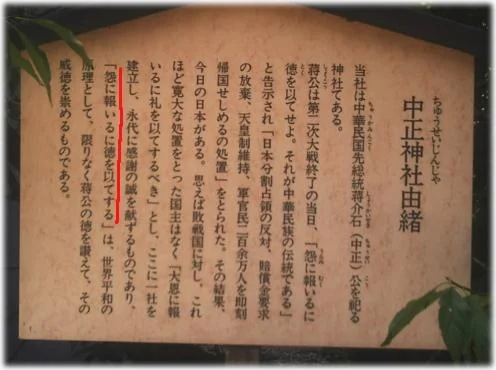
Btw,there is Chiang Kai-shek shinto shrine in Japan. lol
Wow ... that's interesting
tokapi
後輩
- 8 Sep 2007
- 850
- 5
I now recall one old world news magazine article revealed Chiang Kai-Shek retained a few talent Taiwan-stationed former Japanese Army officials to train his KMT police forces in the 1950's.Maybe,you can dig up some reliable online Japanese sources on your end.
Astroboy
先輩
- 5 Dec 2007
- 1,307
- 26
- Thread starter
- #20
I now recall one old-world news magazine article revealed Chiang Kai-Shek retained a few talented Taiwan-stationed former Japanese Army officials to train his KMT police forces in the 1950s. Maybe, you can dig up some reliable online Japanese sources on your end.
"Bai Dan": Voluntary Military Advisory Group of ex-Imperial Japan Army Officers worked for the Taiwanese Army from 1950 - 1968.
Chiang Kai-Shek needed a Japanese-styled army for an offensive to the mainland.
From his experience in a Japanese military academy, he knew that a US-styled military force would not fit with Taiwan because the US military is based on unlimited resources and supplies.
Bai Dan is not an official military assistance for Taiwan and Japan, but it is voluntary. It is reported that 83 ex-officers of the Imperial J-army went to Taiwan and helped establish the training system of the Taiwanese Army.
中村祐悦 『白団』
Amazon product ASIN 4829503831

elliliong
後輩
- 7 Feb 2011
- 1
- 0
Information
Hello! I noticed that a lot of people were able to find a lot of information on the people that attended the Imperial Japanese Army Academy who were not of Japanese descent. I'm trying to find more information about a specific person, but I'm not sure how to get to it. I was wondering if those people could point me in the right direction to try and find the information I'm looking for. Thanks!
Hello! I noticed that a lot of people were able to find a lot of information on the people that attended the Imperial Japanese Army Academy who were not of Japanese descent. I'm trying to find more information about a specific person, but I'm not sure how to get to it. I was wondering if those people could point me in the right direction to try and find the information I'm looking for. Thanks!
Similar threads

- Replies
- 43
- Views
- 176K

- Replies
- 43
- Views
- 166K

- Replies
- 66
- Views
- 112K


