I need help Identifying a Kanji character

Beach_Bouy

後輩
Joined
12 Mar 2007
Messages
5
Reaction score
0
Hi everyone,

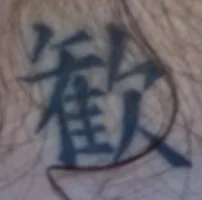
I'm trying to identify a certain kanji character for a friend. Its a tattoo, which the artist said was "joy", but all the characters I've seen on the net to represent "joy" are completely different. I'll try attaching a pic of the tattoo for anyone who'd like a challenge.

Thanks heaps for your help, I'm stumped for now. I didn't learn too many kanji in Japanese class at school. If there really are more than 2000, then I learned only just about 1/10th of them. :-)

Take care
 

Attachments

  • tattoo.webp
    tattoo.webp
    20.1 KB · Views: 229
It is the "kan" of "kangei" (歓迎). I can't recall ever having seen it used in isolation like that.
 
Thank you!

Hi,

Thank you both for your help. Thats such a quick response:-) .

This will be a great forum to help me learn more Japanese. I'm studying it on my own as a kind of hobby, but I also want to learn conversational Japanese to help my minstry work.

Take care
 
It's listed in the dictionary, but I guess it isn't used all that often. It's defined as よろこび。楽しみ。

yukio_michael said:
Hey! It's an ideograph.

I don't think it is. Quoted from danger + opportunity ≠ crisis

...Among the most egregious of the radical errors in this statement is the use of the exotic term "Ideogram" to refer to Chinese characters. Linguists and writing theorists avoid "ideogram" as a descriptive referent for hanzi (Mandarin) / kanji (Japanese) / hanja (Korean) because only an exceedingly small proportion of them actually convey ideas directly through their shapes. (For similar reasons, the same caveat holds for another frequently encountered label, pictogram.) It is far better to refer to the hanzi / kanji / hanja as logographs, sinographs, hanograms, tetragraphs (from their square shapes [i.e., as fangkuaizi]), morphosyllabographs, etc., or -- since most of those renditions may strike the average reader as unduly arcane or clunky -- simply as characters.
 
Question

Hi,
I just looked up the meaning of よろこび in my Kodansha's Furigana Japanese-English dictionary. There is a strange thing though. It uses a different Kanji character - 喜. Thats the one that comes up whenever you search for joy or happiness. Maybe there's more than one way to write it?
Anyway, thanks for your help everyone :-)

p.s.
I just looked up on j-talk.com and it shows that they both have similar meanings, but are both translated よろこび or よろこぶ. So I answered my own question :-)

Japanese is such an interesting language, much easier than english with its lack of exact words.
 
喜ぶ is the verb and 喜び is the stem form, which can also be treated as a noun. While the character itself has meaning, it's kind of nonsensical when it's by itself, similar to 歓
 
Just to mention. Have any of you got a Nintendo DS? I bought a Japanese-English dictionary for it that lets you use the touch sceen to draw into. For example, any unknown kanji, input it in via the touch screen an it comes up in the dictionary in seconds. I've been using it for my study for months now and it saves so much time, instead of using a traditional dictionary.
It's called Kanji sono mama raku biki ji ten.
 
So that's the actual name of the dictionary, then? I thought that it must be 漢字源 or some other dictionary. Do you know how many characters it contains? They didn't seem to have that listed on the official Nintendo site.
 
I know over a dozen exchange students that bought their DSes mainly for that dictionary.
 
I know a few as well. I don't play games often enough to warrant purchasing it though, I think. Although there's also that 金田一先生の日本語レッスン game, I think it's called, that looks pretty hard judging from the samples they have on the site. Still, that's another ¥4900 or so, which is what the dictionary costs, on top of the DS itself, which is around ¥21,000, I believe.
 
I just started learning Japanese(I have memorized about 12 animals and numbers 1-10--so happy!!). Well anyway I need to know if watashi means I…and if it doesn't I would like to know what I is. Oh, and how would you write I in Kanji.
 
watashi reply

Hi,
Good to hear you're learning Japanese.
Watashi does mean I, its usually used by adult men, women and girls, while Boku is used by boys. The explanation I received was that it lets the other person know you're a boy, I guess there may be some confusion otherwise sometimes. But if you're an adult then usually they can tell you're a man. Some people just use watashi though, especially foreigners.
You write watashi in kanji as 私 and in Hiragana its わたし.
You write boku in kanji as 僕 and in Hiragana its ぼく.
Hope this helps.
 
Hi, me again. This time i need to know if あなた means you...and if it doesn't want does? Oh, and does ひっこう mean sunlight?
 
(1) Yes, あなた means "you".
(2) I think you mean 日光(にっこう), it means sunshine, also it is a name of a place in Japan famous for its temples.
 
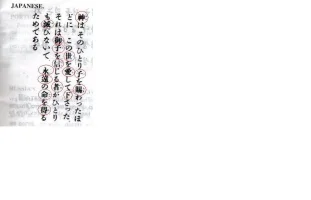
I found the translation in this mini pocket Bible and to my surprise I actually have memorized so many hiragana characters that I knew 40 of the 59 characters in the translation. There are these 15 that I have never seen before so I was wondering if anyone can tell me the meaning of the circled ones and the romaji of each. If you can't see or read the picture, just don't worry about it
 

Attachments

  • lastscanjaspbib3.webp
    lastscanjaspbib3.webp
    29.2 KB · Views: 214
Last edited:
They are kanji, if you take a close look, it has small kana on their right to show how to pronounce it.

神(かみ)God
子(こ)child ひとり子 only child
賜った←賜る(たまわる) to give
世(よ)the world
愛(あい)love
下さった←下さる(くださる)to give
御子(みこ)God's son (in Christianity)
信じる(しんじる)to believe
者(もの)person
滅びない←滅びる(ほろびる)to perish
永遠(えいえん)eternity 永遠の(えいえんの) eternal
命(いのち)life

To look up words
WWWJDIC
To look up each kanji
WWWJDIC
得る(える)to gain
 
Could ひと(human i think) also mean person?

Yes, 人(ひと) also mean person.
者(もの) is not used so often on its own nowadays, mind that this translation of the Bible is in a very classic style, I think it is written about 100 years ago.
While it might be helpful to learn Japanese because you know the original (in English) but may not be so useful if you want to learn daily conversation and words commonly used today.
 
A good japanese translation of the bible

Hi,

I have found a very good translation of the bible in the modern language. Its actually translated into more than 235 languages and it uses the language comon to modern people. Japanese is one of the languages, and I've actually had a look at the Japanese translation a little. Its worth a look if you're inclined to read the bible. Its called the New World Translation Of The Holy Scriptures, I haven't got a Japanese copy with me, but it would be very similar in name. You can find more info from the publishers website. www . watchtower . org

Good for you for looking at the bible:-) Not enough people in this world do.

Take care.
 
Sorry to burst your bubble little buddy but I'm atheist. I was reading the Bible because someone said how can I not believe in something if I don't even now what I don't believe in. so I read the Bible to try to understand why people believe in it.

Aside from that I got another question…wow, yes another question…a friend of mine(who I guess is trying to learn Japanese as well) found out I was trying to learn it and got mad…no idea why but she kept saying "anata unshi or anata unchi. One of those. What in the world does that mean. I got that anata means you…but the other one?
 
Back
Top Bottom