Post Japanese-related YouTube links here

Here is something unusual. Tomoko the Ukulele Lady plays 君といつまでも (Kimi to Itsu Made Mo) (With You Forever), a karaoke standard. (I must have sung this song a million times, at karaoke places in Japan and America.)

The cool thing is she sings it in English, with some Hawaiian also thrown in. I have never before heard it in English. Have a listen.


Below is the standard Japanese karaoke version. For you folks headed to Japan, learn this song, then sing it in a karaoke bar in Japan, and I guarantee you will be a hit! (Do they still have karaoke bars in Japan...?)

 
Last edited:
Davie504 is a rather odd fellow who has his own YouTube channel, where he plays his bass guitar. In this video, he shows us some spectacular clips of Japanese bassists playing some amazing riffs. Watch at 1:12, 1:49, and 2:16. (The bassist at 2:22 is especially amazing.) Watch at 2:34, 3:02, 3:32, 3:54, 4:14, and 6:27. (At 4:50 we have...dueling basses?) The bassist at 5:27 is particularly impressive because you just don't see someone using their thumb like that very often. Dave plays a petty good riff himself at 7:22. At 0:37 we also see a Japanese bassist wowing the crowd (although we can't hear anything because the crowd is screaming).

I play the bass (poorly), so all of this is just amazing for me.


Last edited:
Have you heard of Tokyo Toe? No, not Tokyo 都, Tokyo Toe. Kansei Matsuzawa (松澤完成) is the place kicker for the University of Hawaii football team. A Tokyo native, he taught himself how to place kick by watching YouTube videos, kicked for a small college in America, then became the place kicker for the University of Hawaii. His excellent place kicks have catapulted him to fame.

He even has his name on his uniform in kanji, which has to be a first.

matsuzawa.webp


Last edited:
Another matsuri (festival) video. This video gives us excellent views of an 御神輿) (omikoshi) ("portable shrine") that are so common at local street matsuri in Japan. They are 'portable' in that they are carried by the neighborhood people. (My students always had a good laugh when I would use the phrase "portable shrine". Say it to your own students!) Watch at 2:21 as Misa-san helps carry the omikoshi. Have a look also at 3:45, and 6:44.


Last edited:
This video is a promo for the Komatsu 931XC Harvester. It's a modern lumberjack machine. This machine is crazy.


If this is interesting to you, here's a link to the description on the company page.

Before you think I'm shamelessly shilling for Komatsu, keep in mind these machines cost in the range of $500,000 - $600,000. So you could buy a house or a harvester. (Don't buy the harvester if you don't have timber rights, though!)

FYI, I included this as an example of a product from a Japanese company most people probably aren't aware of.
 
YouTube now has the ability to listen to Japanese-language YouTube videos narrated/spoken in a computer-generated English voice, as well as listening to the original Japanese. For this explanation, I have chosen a tour video of Tokyo's Asakusa area as an example.

h ttps://www.youtube.com/watch?v=3oKIYTu9rls

(I have placed a space between the h and t in the URL so you can see the URL. You can also view the video at the end of this post.)

This feature works when you view the video from within this thread, as well as viewing it on directly on YouTube. (But when you watch it from within this thread, you must first press the Play button in order to have the cog wheel appear.)

Hover your mouse over the video > In the lower right corner, a cog wheel icon appears. Click on the cog wheel icon. > a Pop-up menu appears. The first choice is Audio Track. It may say English, Japanese, or another language. (But it seems that, at this time, English and Japanese are the only two choices.) > Click on English. The video now plays with a computer-generated voice translating the narration into English.

Changing it back to a Japanese narration

Repeat the previous steps: Hover your mouse over the video > In the lower right corner, a cog wheel icon appears. Click on the cog wheel icon. > a Pop-up menu appears. > Click on Japanese. You can now hear the original narration in Japanese.

It seems that a lot of Japanese-language videos do not support this feature yet. Try this on several Japanese-language videos and see which videos will let you listen in English.

It also seems this feature does not work on videos called Shorts.


Last edited:
Have you seen the Hello Kitty Shinkansen? (I hope you like the color pink...)

They even have Hello Kitty bentos and Hello Kitty water bottles shaped like the Shinkansen!


Last edited:
This video made me dizzy.


This one too.


She has more videos.


"Don't go to Kyoto , go to Kanazawa."

This is a YouTuber's video of day 5 of visiting Japan with his father. (It is amazing to see the house of one of the most powerful samurai clans in Japan.)


He has more videos.

 
This is a YouTuber's video of day 5 of visiting Japan with his father. (It is amazing to see the house of one of the most powerful samurai clans in Japan.)

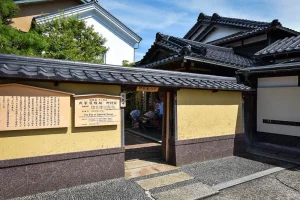
He refers to the Nomura Mansion:

Nomura Samurai House

Travel  Nomura Samurai House

The former residence of the Nomura family (野村家) is located in Nagamachi, the bukeyashiki or samurai quarter of Kanazawa. This quiet district is characterised by its long, straight mud-daub walls topped with traditional wooden slats called kobaita (小羽 板) and covered with straw mats (こも komo) in...

They were retainers of the Maeda, who were arguably one of the most powerful and wealthy samurai clans in Japan.
 
Here is a fun, long, cross-country, challenging, travel adventure in a three-video series. If you enjoy cross-country train travel adventures, this is for you. I love how I can take these long, scenic trips without leaving home. Sit back and enjoy the ride!

This is a three-day trip, from Tokyo to Nemuro, Hokkaido Station, in Easternmost Hokkaido, the easternmost train station in Japan.

The first four minutes of the first video are a bit depressing because he gets delayed bigly by a train accident, but then things get a lot more enjoyable.

Day 1 - Tokyo to Hachinohe (northernmost part of Honshu Island)


Day 2 - Hachinohe to Abashiri, Hokkaido


Day 3 - Abashiri, Hokkaido to Nemuro, Hokkaido. At 8 minutes into the video, the train has to stop because it hits a deer on the tracks! (We never get deer-strike train delays in Tokyo!) No word on how well the deer is doing...

 
Last edited:
Back
Top Bottom