Art Ukiyo-e: Japanese woodblock prints and paintings

Topics, threadsm and news related to Japanese art and artists
Impending Typhoon No.10 made me choose this classical woodblock print by Utagawa Hiroshige (1797-1858):

Sudden Shower over Shin-Ōhashi Bridge and Atake (大はしあたけの夕立 Ōhashi atake no yūdachi), 1857, part of One Hundred Famous Views of Edo (名所江戸百景 Meisho Edo Hyakkei).


Sudden Shower over Shin-Ōhashi Bridge and Atake (大はしあたけの夕立)

The woodblock print showcases a small section of the Shin-Ōhashi bridge, which spans the Sumida River. A boatman is seen guiding his log raft towards the Fukagawa timber yards. In the distance, on the opposite bank, lies a part of Edo known as Atake, named after the Atakemaru, a government ship once moored there. The print depicts two women and four or five men crossing the bridge, seeking refuge from a sudden rain shower under hats, umbrellas, or straw capes. Sudden downpours are a common theme in ukiyo-e artwork. Hiroshige uses a technique called "white rain" to portray the heavy rainfall with numerous thin, dark, parallel lines in two directions, a challenging task in woodblock carving. The dark clouds are rendered using a graduated shading technique known as bokashi and vary considerably between prints. The rain, the people seeking shelter and the log raft in the centre of the image create a sense of movement and dynamism.

Here's Van Gogh's famous copy:
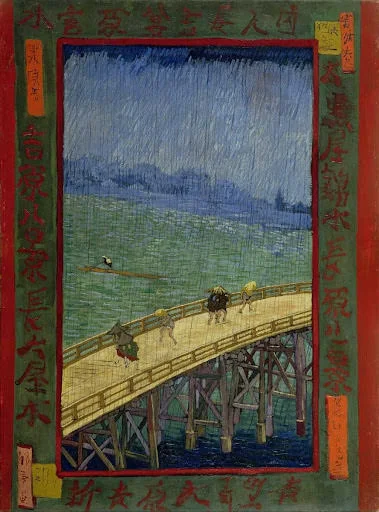
Van Gogh Japonisme
 
We are almost at the end of summer, and here is one more of Kunisada's summer-themed prints:

Utagawa Kunisada (1786-1864), A Pleasure Outing at the Height of Summer (極度の暑さで遊ぶ (極所あそび), Kyokusho asobi), May 1852; Oban Triptych (おばんトリプティク) published by Enshuya Hikobei (遠州屋彦兵衛)


utagawa-kunisada-pleasure-outing-at-the-height-of-summer.webp


A unique experience awaits on the Sumida River: a pleasure boat filled with five kabuki actors performing plays while a tour guide discreetly pours sake behind a screen. The actors remain anonymous, and two are dressed in female attire. To combat the intense summer heat, the performers demonstrate various swimming techniques, including imitating a frog, treading water with a sake bottle, and even swimming upright like a shachihoko fish. The boat is moored to the sturdy wooden pilings of a bridge, allowing curious onlookers to peer down from above and catch a glimpse of this unusual performance.
 
Suzuki Harunobu (鈴木春信; c. 1725-1770), Introductory Meeting (Miai), sheet 1 of the series Marriage in Brocade Prints, the Carriage of the Virtuous Woman (婚礼錦貞女車 - 見合い Konrei Nishiki Misao-guruma), known as the Marriage series, c. 1769.

Woodblock print (Nishiki-e); ink and colour on paper. Horizontal chūban; 20.9 x 28.3 cm. Museum of Fine Arts Boston.


Suzuki Harunobu, Introductory Meeting


A Glimpse into Edo-Period Matchmaking
In a bustling teahouse in Edo, two men are seated: a distinguished older gentleman and a stylish young man. Before them, a beautiful woman in a furisode kimono catches their attention. Her family stands behind her. A bald matchmaker accompanies the young suitor. It's an Edo-period matchmaking event. Unlike today's elaborate courtship rituals, the norm back then was a swift assessment through a single glance. It might seem unconventional, but the intensity of their gazes reveals the remarkable skill involved. In that fleeting moment, they had to evaluate the other person's suitability with utmost seriousness.
 
Kitagawa Utamaro (喜多川歌麿; c. 1753-1806), Child's Nightmare of Ghosts, c.1800/01
Woodblock print (Nishiki-e); ink and colour on paper, vertical ôban; 37 x 24 cm.


Kitagawa Utamaro, Child's Nightmare of Ghosts

A mother comforts her child troubled by a nightmare of ghosts.
 
And now for something more autumn-themed.

I like the first one in particular.

Utagawa Hiroshige (歌川広重), Autumn Moon on the Tama River (玉川秋月 Tamagawa no shugetsu), from the series "Eight Views in the Environs of Edo" (江戸近郊八景之内 Edo kinko hakkei no uchi), ca. 1838, woodblock print; ink and colour on paper.

Autumn Moon on the Tama River (玉川秋月)


Keisai Eisen (渓斎英泉, 1790–1848), Autumn Moon at Mount Atago (愛宕の秋の月 Atagosan no aki no tsuki) from the series Eight Views of Edo (江戸八景 Edo hakkei), ca. 1843–1846.

 Autumn Moon at Mount Atago (愛宕の秋の月)
 
More moonshine ukiyo-e:

Tsuchiya Kōitsu (土屋光逸, 1870-1949), Morigasaki Coast (森が崎海岸), 1930/31. Woodblock print, large oban. From the private collection of Dr Ross F. Walker.

Tsuchiya Kōitsu (土屋光逸, 1870-1949), Morigasaki Coast (森が崎海岸), c. 1930/31


Kōitsu Tsuchiya, born Koichi or Sahei, was a prominent Japanese artist who emerged from humble beginnings in Hamamatsu, Shizuoka. At the tender age of 15, he ventured to Tokyo to pursue his artistic aspirations. Initially apprenticed to the woodblock carver Matsuzaki, he soon found his true calling under the tutelage of the renowned ukiyo-e master Kiyochika Kobayashi. For 19 years, Koitsu dedicated himself to his studies, living under the same roof as his mentor.

Koitsu's artistic journey began with prints depicting the First Sino-Japanese War. However, his mastery of dramatic lighting effects, honed under Kiyochika's guidance, truly set him apart. His collaboration with the Watanabe publishing house, forged after a chance encounter commemorating the 17th anniversary of Kiyochika's death, marked a significant turning point in his career. He also worked with other esteemed publishers, including Doi Sadaichi, Kawaguchi, Baba Nobuhiko, Tanaka Shobido, and Takemura.
 
Utagawa Hiroshige (1797-1858), Illustrated Guide to Famous Places in the Sixty-Old Stations, Naruto Whirlpool, Awa Province, 1853 (六合目名所図会 阿波国鳴門の渦潮)


Utagawa Hiroshige (1797-1858), Illustrated Guide to Famous Places in the Sixty-Old Stations, Naruto Whirlpool, Awa Province, 1853
 
The Hosomi Museum in Kyoto is hosting its first "shunga" exhibition in eight years, featuring erotic works created by some of the most celebrated ukiyo-e artists.

Kaya no Tanoshimi

Kitagawa Utamaro's "Kaya no Tanoshimi" (1801-06, private collection), which is on display for the duration of the exhibition

An exhibition titled "The Beauty of Shunga--Hokusai and Utamaro: Exchange and Competition" is underway in Kyoto's Sakyo Ward, sponsored by The Asahi Shimbun and other organizations. The exhibition, which runs until November 24th, showcases approximately 70 exquisite artworks, including ukiyo-e prints, hanpon (woodblock-printed books), and hand-painted works, emphasizing the beauty of the shunga genre. Shunga, a genre of erotic art, was once considered taboo in Japan. However, a groundbreaking exhibition at the British Museum in London between 2013 and 2014, which garnered critical acclaim, helped to shift public perception. This led to a travelling shunga exhibition held at the Eisei Bunko Museum in Tokyo's Mejiro Ward and the Hosomi Museum from 2015 to 2016.

The venue is closed on Mondays except national holidays, in which case it is closed the following day. No entry is allowed for children aged 17 or younger.


Link:

 
Two autumn-related ukiyo-e, from the Meiji and the Taisho era.

Toyohara Chikanobu (豊原周延, 1838–1912), Beauties in a garden, "Enchu no momiji" (Autumn leaves in a garden), triptych, 1893; 37.2x25cm.

Toyohara Chikanobu (豊原周延, 1838–1912), Beauties in a garden, Enchu no momiji (Autumn leaves in a garden)


Hasui Kawase (川瀬巴水, 1883-1957), Autumn Garden, 1920, Oban.

Hasui Kawase (川瀬巴水, 1883-1957), Autumn Garden
 
Utagawa Hiroshige I (1797–1858), Publisher Ibaya Kyūbei, Taira Kiyomori Haunted by Strange Sights (平清盛怪異を見る図 Taira Kiyomori kaii o miru zu), c. 1844–45. Woodblock print (nishiki-e); ink and colour on paper, ōban triptych—Collection of the Museum of Fine Arts, Boston.

Utagawa Hiroshige I (1797–1858), Taira Kiyomori Haunted by Strange Sights (平清盛怪異を見る図)


The story is based on the Tale of the Heike and is a ghost story in which Taira no Kiyomori, who moved the capital to Fukuhara, was plagued by nightmares. One day, the snow piled up on the trees and stone lanterns in his garden appeared to be countless skulls.
 
Utagawa Toyokuni (歌川豊国; 1769-1825), Gathering Shells at Low Tide (潮干狩り), c. 1789–93, published by Enomotoya Kichibei (Hōeidō), woodblock print (nishiki-e); ink and colour on paper, vertical ōban triptych; 39 x 76.3 cm.

Utagawa Toyokuni (歌川豊国; 1769-1825), Gathering Shells at Low Tide (潮干狩り)
 
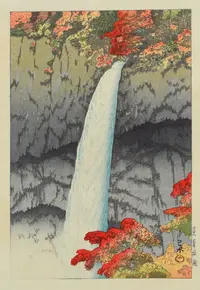
Hasui Kawase (川瀬巴水, 1883-1957), Kegon Falls, Nikkō (華厳滝 Nikkō Kegon no taki), from the series Ukiyo-e monyoshu,1927.

Hasui Kawase (川瀬巴水, 1883-1957), Kegon Falls, Nikkō (華厳滝 Nikkō Kegon no taki)


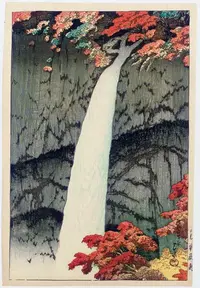
Kegon Waterfall, a renowned natural wonder, is depicted in this striking woodblock print by Kawase Hasui. The waterfall cascades past vibrant autumn leaves and rugged cliffs, transforming from a deep blue hue at its source to a misty spray at its base. The intricate details, including the unique blind printing technique, highlight the immense power and volume of the falling water. This is a testament to the skill of Hasui and the carver and printer who brought this large-scale work to life. Kegon Falls, a popular tourist destination, is exceptionally breathtaking during the autumn foliage season.


Variations:

Hasui Kawase (川瀬巴水, 1883-1957), Kegon Falls, Nikkō (華厳滝 Nikkō Kegon no taki) Hasui Kawase (川瀬巴水, 1883-1957), Kegon Falls, Nikkō (華厳滝 Nikkō Kegon no taki)
 
Not an ukiyo-e but related to Hokusai:

A newly discovered hand-drawn portrait, attributed to the renowned ukiyo-e master Katsushika Hokusai (1760-1849), has ignited a quest to uncover the identity of the enigmatic figure depicted within. Donated to the Hokusai Museum by a Gunma Prefecture resident, the portrait boasts that art historian Toshinobu Yasumura has confirmed Hokusai's signature, seal, and authenticity. The distinctive style, sharp outlines, and depiction of the man's limbs further solidify its attribution to the legendary artist.

hokusai-money-changer.webp

A resident of Gunma Prefecture generously donated the portrait to the Hokusai Museum in 2019. Art historian Toshinobu Yasumura, the museum's director, confirmed the authenticity of the drawing, citing its signature and seal and the artist's characteristic style, including the sharp outlines and depiction of the man's limbs.

Hokusai apparently executed the portrait in his early 40s, based on kanji characters that state it was done in 1803 in the Japanese imperial era. Only a few original portraits drawn by Hokusai survive today, according to Shugo Asano, who heads the Museum Yamato Bunkakan in Nara and is well-versed in ukiyo-e. "It is drawn straightforwardly, compared with other portraits (by Hokusai)," said Asano after viewing a photo of the image. "Since it was drawn relatively early in his career, he had probably not established his style. It is an interesting work." Yasumura believes the man in the portrait is a money changer as he holds what appears to be an abacus in one hand. A scale and a book for keeping track of money are also depicted. Sentences on the upper part of the portrait say the man's family name is Kamiyama. But the name of his store and its location are unknown, Yasumura said.


Not an ukiyo-e but related to Hokusai:

A newly discovered hand-drawn portrait, attributed to the renowned ukiyo-e master Katsushika Hokusai (1760-1849), has ignited a quest to uncover the identity of the enigmatic figure depicted within. Donated to the Hokusai Museum by a Gunma Prefecture resident, the portrait boasts that art historian Toshinobu Yasumura has confirmed Hokusai's signature, seal, and authenticity. The distinctive style, sharp outlines, and depiction of the man's limbs further solidify its attribution to the legendary artist.


A resident of Gunma Prefecture generously donated the portrait to the Hokusai Museum in 2019. Art historian Toshinobu Yasumura, the museum's director, confirmed the authenticity of the drawing, citing its signature and seal and the artist's characteristic style, including the sharp outlines and depiction of the man's limbs.


The fingers look almost AI-generated. Not quite accurate.
 
Utagawa Toyokuni (歌川豊国, 1769–1825), Woman Under Maple and Ginkgo Leaves (紅葉の下に歩く美人), from the series "Comparison of Beauties" (美しんあわせ Bijin awase), 1811; vertical ōban; 38 x 25.7cm.

Woman Under Maple and Ginkgo Leaves (紅葉の下に歩く美人)
 
Utagawa Hiroshige, Fujikawa, a Village in the Mountains Formerly Called Miyajiyama (藤川 山中の里別名宮路山), 1855; Illustrated guide to famous places at the Fifty-three Stations of the Tokaido (五十三次名所図会); woodblock print; ink and colour on paper.


Utagawa Hiroshige, Fujikawa, a Village in the Mountains Formerly Called Miyajiyama
 
Today's theme is "Snow at Miyajima" (雪の宮島), featuring several woodblock prints by Kawase Hasui (川瀬 巴水, 1883-1957) and Tsuchiya Kōitsu (土屋光逸, 1870-1949), all produced in the 1930s.


Tsuchiya Kōitsu, "Snow at Miyajima" (雪の宮島):

Tsuchiya Kōitsu - Snow at Miyajima (雪の宮島)


Tsuchiya Kōitsu - Snow at Miyajima (雪の宮島)


Kawase Hasui, "Snow at Miyajima" (雪の宮島):

Kawase Hasui - Snow at Miyajima (雪の宮島)


Kawase Hasui - Snow at Miyajima (雪の宮島)


Kawase Hasui - Snow at Miyajima (雪の宮島)


Kawase Hasui - Snow at Miyajima (雪の宮島)
 
Today's ukiyo-e topic is sumo.

Utagawa Hiroshige I, Ryōgoku Eko-in (回向院), 1842.

Ekōin Temple, built to commemorate the Great Fire of Meireki victims, became a popular venue for Kanjin Sumo, a traditional Japanese sumo wrestling event to raise funds for temples and shrines. The temple's reed-screened sumo hall hosted these events twice a year, spring and fall, until 1909. Kanjin Sumo was a significant cultural event in Edo, with a regular schedule of four tournaments annually in three cities.

Ryōgoku Eko-in (回向院)


Utagawa Kuniyoshi, Illustration of Sumō Wrestlers entering the Ring at Kanjin Matches (Kanjin Ōzumō Dohyō Iri no Zu).

This Nishiki-e showcased a sumo match at Ekōin Temple in 1849. It depicts the moment when the East team, led by Ōzeki Tsurugizan, finishes their entrance, and the West team begins theirs. This artwork and "Complete Illustrations of Famous Places in Edo-the Precincts of Ryōgoku Ekōin Temple" provide a comprehensive view of sumo halls in the Edo period.

Kanjin Ōzumō Dohyō Iri no Zu


Katsukawa Shunshō (勝川春章, 1726-1793), Illustration of Sumo Wrestling Matches (Sumō Torikumi no Zu), 1782/83.

This ukiyo-e print by Katsukawa Shunshō depicts a sumo match held at Ekōin Temple, featuring famous wrestlers from the Kansei era. The artwork portrays Tanigawa Kajinosuke and Onogawa Kisaburō, who were instrumental in the golden age of sumo during the Tenmei and Kansei eras. Tanikaze Kajinosuke, in particular, was a popular figure known for his gentle appearance and skill.

Sumō Torikumi no Zu


Utagawa Kuniteru II (1830-1874), aka Kunitsuna II, Illustration of Powerful Professional Sumo Wrestlers in Japan (Dainihon Ōzumō Yūriki Sekitori Kagami), 1867.

Dainihon Ōzumō Yūriki Sekitori Kagami


This detailed nishiki-e print provides a comprehensive overview of sumo wrestling in the Edo period. It features portraits and information on 105 famous sumo wrestlers, including their names, domains, and heights. Additionally, the print references mythological figures and kami.
 
Snow, but spring snow.

Tsuchiya Kōitsu (土屋光逸, 1879-1949), Spring Snow at Maruyama (春之雪 京都円山 Haru no Yuki Kyōto Maruyama), Kyoto, 1936

Tsuchiya Kōitsu (土屋光逸, 1879-1949), Spring Snow at Maruyama (春之雪 京都円山)


Maruyama Park (円山公園 Maruyama kōen), a popular spot for cherry blossom viewing in Kyoto, can become quite crowded during April. The park's iconic weeping cherry tree, illuminated at night, is a major draw. New Year's Eve festivals also attract many visitors. The park's main entrance is through Yasaka Shrine, located at the Gion District's eastern end of Shijō Street. To the north, the park borders the expansive Chion-in Temple, followed by the smaller Shōren-in Temple. Maruyama Park is officially recognized as a Place of Scenic Beauty in Japan.
 
Katsushika Hokusai (1760–1849), Shichirigahama in Sagami Province (相州七里浜 Sōshū Shichirigahama), from the series "Thirty-six Views of Mount Fuji" (冨嶽三十六景 Fugaku sanjūrokkei); ca. 1830-32, Woodblock print; ink and colour on paper.


full.jpeg.webp


Location: Shichirigahama (七里ヶ浜)
 
2025 is the Year of the Snake, an animal deeply intertwined with Japanese mythology and culture. Known for their secretive nature, people born in the Year of the Snake are often described as cautious and introspective.

Giant snakes have long been significant in Japanese folklore, appearing in numerous myths and legends. These creatures often symbolize wisdom, protection, and spiritual power. They are featured in tales of gods, heroes, and mythical beings, highlighting the complex and frequently intertwined relationship between humans and the natural world. In Japanese culture, snakes are viewed with fear and reverence. They embody powerful forces, representing life and death, renewal and destruction. This duality has deeply influenced Japanese beliefs, folklore, and cultural symbolism.

Below are a few classic ukiyo-e depicting warriors and heroes fighting giant snakes.

Utagawa Yoshitsuya (歌川芳艶, 1822-1866), Kintarō Grappling with a Snake (Mirror of Warriors of Japan).

Utagawa Yoshitsuya (歌川芳艶, 1822-1866), Kintarō Grappling with a Snake (Mirror of Warriors of Japan)


Utagawa Kuniyoshi (歌川国芳, 1798-1861), Shuma Hiroyuki, later known as Jiraiya, using a heavy gun to defeat a vast snake that preyed on his toads (本朝水滸伝 尾形周馬寛行), c.1830, 39.1 x 26.9 cm.

Utagawa Kuniyoshi (歌川国芳, 1798-1861), Shuma Hiroyuki, later known as Jiraiya, using a heavy gun to defeat a vast snake that preyed on his toads (本朝水滸伝 尾形周馬寛行), c.1830, 39.1 x 26.9 cm


Utagawa Kuniyoshi (歌川国芳, 1798-1861), Matsui Tamijiro, sword in hand, fighting a giant snake (刀を手に大蛇と戦う魔津伊多見治郎), 1840s, oban tate-e.

Utagawa Kuniyoshi (歌川国芳, 1798-1861), Matsui Tamijiro, sword in hand, fighting a giant snake (刀を手に大蛇と戦う魔津伊多見治郎), 1840s, oban tate-e


Utagawa Kuniyoshi (歌川国芳, 1798-1861), Wada Heita Tanenaga Killing a Giant Snake (和田平太胤長), 1834-35.

Utagawa Kuniyoshi (歌川国芳, 1798-1861), Wada Heita Tanenaga Killing a Giant Snake (和田平太胤長), 1834-35


Utagawa Kuniteru (歌川国輝, active 1818-1860), Tainosuke slaying a serpent, from Wakan eiyū gaden (和漢英雄画伝, Heroes of Japan and China), c.1848, 37x24.8cm.

Utagawa Kuniteru (歌川国輝, active 1818-1860), Tainosuke slaying a serpent, from Wakan eiyū gaden (和漢英雄画伝, Heroes of Japan and China), c.1848, 37x24.8cm
 
Utagawa Hiroshige (歌川広重, 1797-1858), Aoyama in the Eastern Capital (東都青山, Tōto Aoyama) in the series Thirty-six Views of Mount Fuji (first version), 1852.

That seems to be the precursor of the modern-day Omotesandō.

Utagawa Hiroshige (歌川広重, 1797-1858), Aoyama in the Eastern Capital (東都青山, Tōto Aoyama)
 
Another famous winter ukiyo-e:

Utagawa Hiroshige, Drum Bridge at Meguro and Sunset Hill (目黒太鼓橋夕日の岡, Meguro Daikobashi Yuhi no Oka)

Utagawa Hiroshige, Drum Bridge at Meguro and Sunset Hill

One of Hiroshige's most famous prints, Drum Bridge at Meguro and Sunset Hill (1857), depicts a serene snowy scene. The bridge was among the few arched stone bridges in Edo, and the artist captured a peaceful yet slightly melancholic moment as a few individuals walked across it. Hiroshige frequently incorporated snow into his artwork, with notable examples including Fukagawa Lumberyards (深川木場, Fukagawa Kiba; featured at the beginning of this article), Nihonbashi: Clearing after Snow (日本橋雪晴, Nihonbashi Yukibare), Bikuni Bridge in Snow (びくにはし雪中, Bikunihashi Setchuu), and Kanbara (蒲原).
 
Back
Top Bottom