- 14 Mar 2002
- 21,051
- 18,904
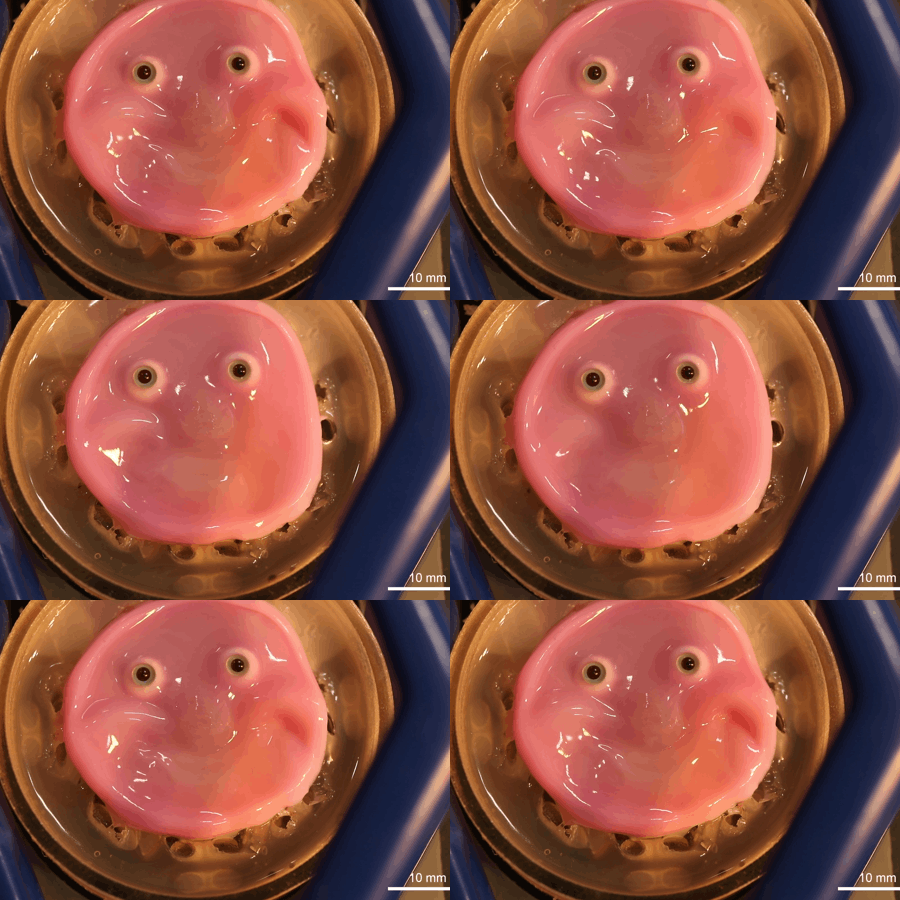
Researchers at the University of Tokyo have developed a method to attach artificial skin from human skin cells to robot faces. This technique allows robots to mimic human expressions, such as smiling, using a flexible face mask to move into different expressions. The artificial skin is durable, elastic, and capable of self-healing, which enhances the robots' human-like appearance and functionality. This advancement aims to improve communication and empathy in human-robot interactions, making robots more effective in healthcare and companionship.
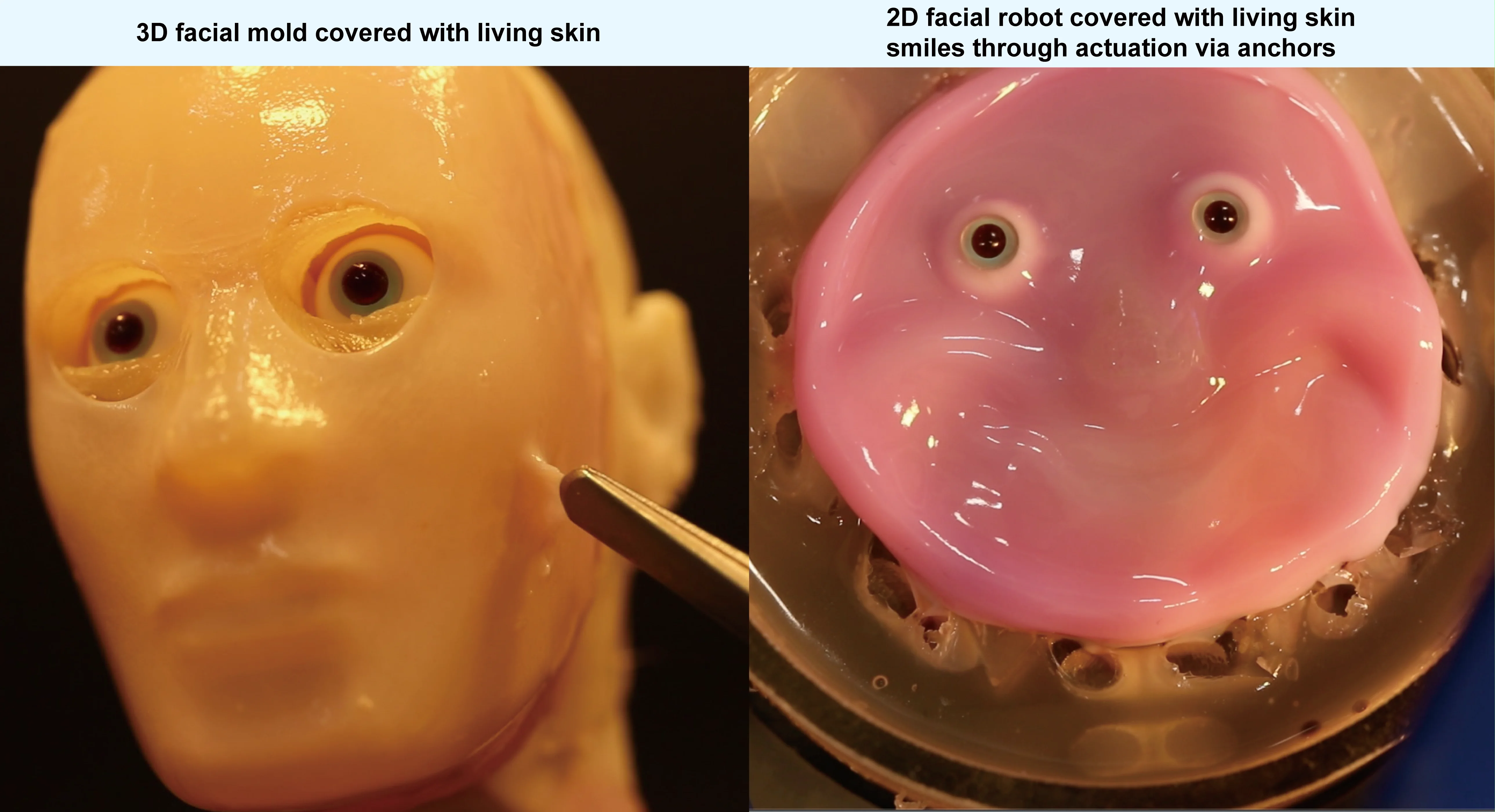
Photo credit: Takeuchi et al. CC-BY-ND
The faces of the robots with artificial skin in Professor Takeuchi's lab cannot sense touch, temperature change or other external stimuli. Professor Takeuchi said that is his next research target. "We aim to create skin that closely mimics the functionality of real skin by gradually constructing essential components such as blood vessels, nerves, sweat glands, sebaceous glands and hair follicles," he said. A robot's electronics would need to power a sensor signal instead of the neural systems that convey sensation in the human body. This development, Professor Wang said, would require much more time and research.

 www.nytimes.com
 www.u-tokyo.ac.jp
 www.hybrid.t.u-tokyo.ac.jp
Photo credit: Takeuchi et al. CC-BY-ND
In 2022, the research team developed a robotic finger covered in living skin, allowing the machine's digit to bend like a human finger, giving it the tactility to perform more precise tasks. Professor Takeuchi's team had tried anchoring the skin with mini-hooks, but those caused tears as the robot moved. So, the team decided to mimic ligaments, the tiny ropes of loose tissue that connect bones. Team members drilled small, V-shaped holes into the robot and applied a gel containing collagen, which plugged the holes and tethered the artificial skin to the robot. "This approach integrates traditional rigid robots with soft, biological skins, making them more 'humanlike,'" said Yifan Wang, an assistant professor at the School of Mechanical and aerospace engineering at Nanyang Technological University in Singapore who researches "soft robots" that mimic biological creatures.
The faces of the robots with artificial skin in Professor Takeuchi's lab cannot sense touch, temperature change or other external stimuli. Professor Takeuchi said that is his next research target. "We aim to create skin that closely mimics the functionality of real skin by gradually constructing essential components such as blood vessels, nerves, sweat glands, sebaceous glands and hair follicles," he said. A robot's electronics would need to power a sensor signal instead of the neural systems that convey sensation in the human body. This development, Professor Wang said, would require much more time and research.
Scientists in Japan Give Robots a Fleshy Face and a Smile (Published 2024)
Researchers at the University of Tokyo published findings on a method of attaching artificial skin to robot faces to protect machinery and mimic human expressiveness.
Robots face the future | The University of Tokyo
www.u-tokyo.ac.jp
Biohybrid Systems Laboratory | Shoji Takeuchi | 東京大学 竹内昌治
Founded in 2001 by Prof. Shoji Takeuchi at the University of Tokyo. Research in biohybrid robotics, cultured meat, bioactuators, MEMS, and microfluidics.
www.hybrid.t.u-tokyo.ac.jp