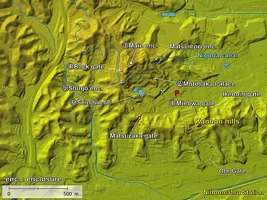
Nihonmatsu Castle (二本松城), also known as Kasumigajō (霞ヶ城, "Misty Castle"), is a Japanese hilltop castle in present-day Nihonmatsu, Fukushima Prefecture . Built atop Shiro-yama (城山), it occupied a strategically important position overlooking the route through central Fukushima. It served as the seat of successive regional lords from the Muromachi period until the Meiji Restoration . Although much of the castle was destroyed during the Boshin War (1868–1869), its ruins survive today as Kasumigajō Park, one of the city's best-known historic sites.
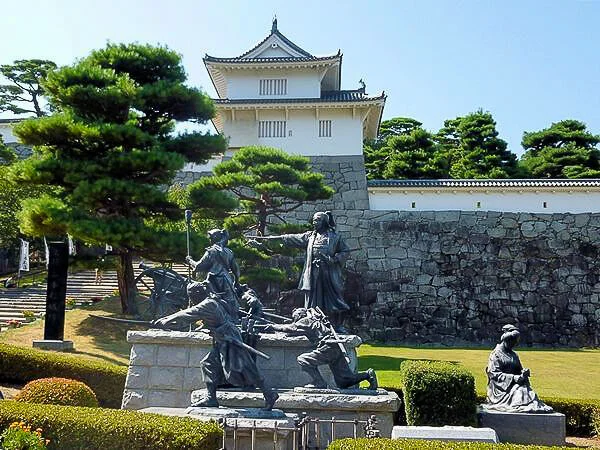
The castle itself was constructed during the first half of the fifteenth century by Nihonmatsu Mitsuyasu (二本松満泰), a descendant of Takakuni. From then on, it became the principal stronghold of the Nihonmatsu clan, which ruled the surrounding region for more than a century.
Its most famous episode came during the Sengoku period . In 1586, Date Masamune (伊達政宗, 1567–1636) launched an attack on Nihonmatsu. Facing defeat, Nihonmatsu Yoshitsugu (二本松義継, 1558–1586) feigned surrender and attempted to abduct Masamune's father, Date Terumune (伊達輝宗, 1544–1585), during negotiations. The plan failed when Masamune ordered his troops to open fire, killing both Terumune and Yoshitsugu. The incident became one of the defining episodes of Masamune's rise to power, and Nihonmatsu Castle soon fell after a fierce assault.
Following the conquest of Aizu, Gamō Ujisato (蒲生氏郷, 1556–1595) took control of the castle. Recognising its strategic importance in defending the Nakadōri corridor (中通り), he extensively rebuilt the fortress, introducing stone walls and other features characteristic of an early modern castle. These works transformed what had originally been a medieval mountain stronghold into a more sophisticated fortification suited to the changing demands of warfare.
During the following decades, the castle passed through the hands of several lords, including the Uesugi, Matsushita and Katō families. In 1643, Niwa Mitsushige (丹羽光重, 1622–1701) entered Nihonmatsu with a domain assessed at 100,000 koku. From that point onward, Nihonmatsu Castle remained the residence of the Niwa clan until the end of the Tokugawa shogunate.
Among the defenders were members of the Nihonmatsu Shōnentai (二本松少年隊), a corps of teenage samurai who became a symbol of the domain's determined but ultimately hopeless resistance. After the castle fell, almost all of its buildings were destroyed by fire, bringing centuries of continuous occupation to an end.
To the south lay the Kannon Hills (観音丘陵), which formed an important forward defensive position overlooking the Ōshū Kaidō, the principal highway linking the Kantō region with northern Japan. This combination of natural topography and layered fortifications made Nihonmatsu an effective defensive stronghold controlling movement through the region.
One of the park's best-known annual events is the Chrysanthemum Doll Festival (菊人形祭り), held between October and November. Elaborate displays of life-sized figures dressed in thousands of chrysanthemum blooms attract large crowds each year. Those wishing to explore the castle ruins in a quieter setting may prefer to visit outside the festival season, when the grounds are considerably less crowded.
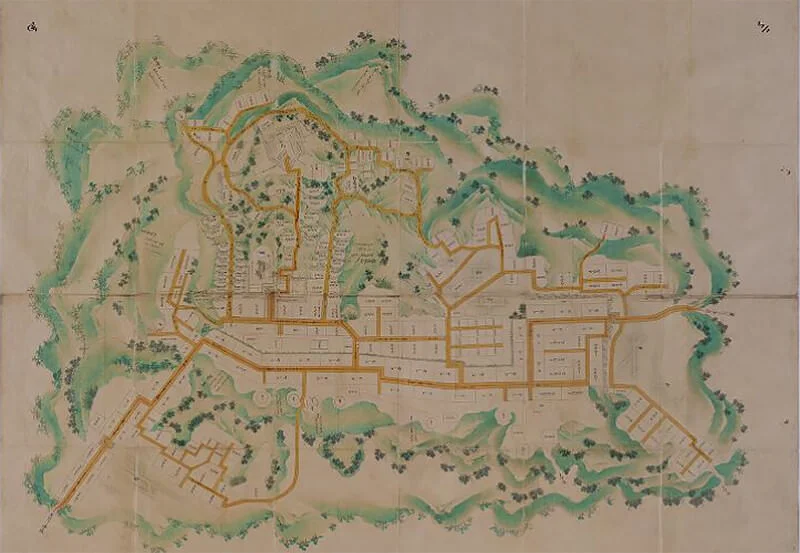
Historic plans, including the "Illustrated Map of Ōshū Nihonmatsu Castle" (奥州二本松城之絵図 Ōshū Nihonmatsu-jō no Ezu), preserved by the National Archives of Japan, provide valuable insight into the layout of the castle during the Edo period .
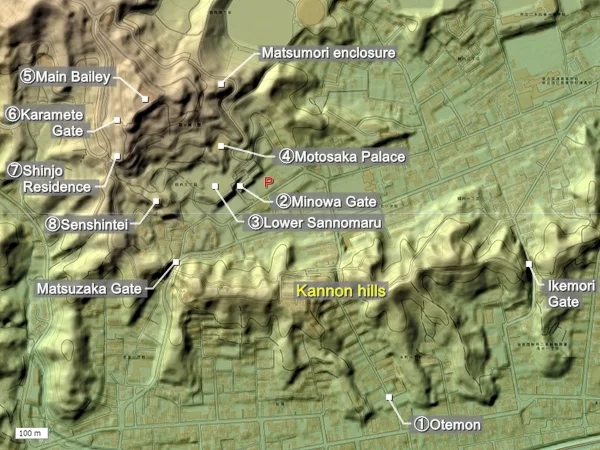
For a guide to the castle grounds, please refer to this Kasumigajō Park map, provided by the Nihonmatsu Tourism Association.
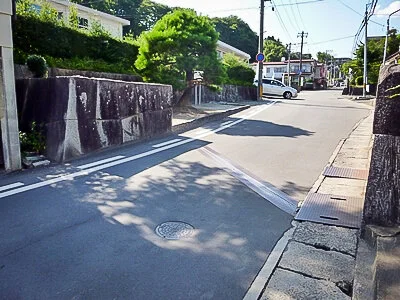
➢ ① Site of the Ōtemon (大手門, Main Gate)
The Ōtemon (大手門) was a yaguramon (櫓門, turret gate) built on the side of the castle facing the Ōshū Kaidō (奥州街道). It was also commonly known as the Sakashita-mon (坂下門, "Lower Slope Gate"). Successive lords of the Nihonmatsu Domain long wished to construct this prestigious main gate, but permission from the Tokugawa shogunate was not granted until 1832 (Tenpō 3), when it was finally built.
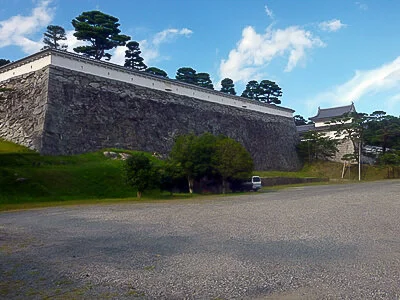
➢ Thousand-Person Assembly Ground (千人溜 Sennin-damari)
This large open area lies in front of the high stone walls (takaishigaki, 高石垣) of the Sannomaru (三ノ丸, Third Bailey). Today, part of the space serves as the castle's main car park.
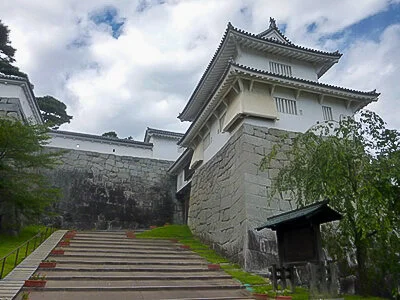
➢ ② Minowa Gate (箕輪門 Minowa-mon)
The Minowa Gate (箕輪門) is the castle's main gate. It was reconstructed in 1982 (Shōwa 57).
➢ ③ Lower Sannomaru (三ノ丸下段 Sannomaru Gedan)
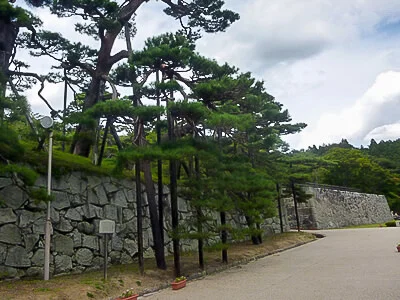
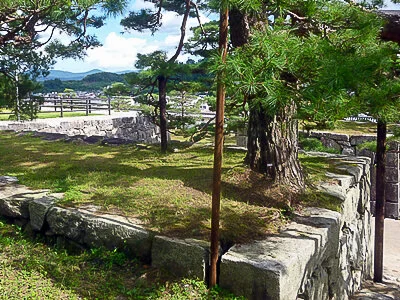
➢ Upper Sannomaru (三ノ丸上段 Sannomaru Jōdan)
Preparations for the annual Chrysanthemum Doll Festival (Kiku Ningyō Matsuri, 菊人形祭り) had already begun.
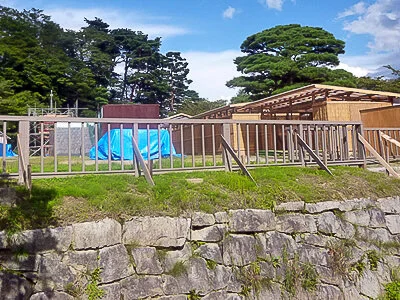
➢ ④ Motosaka Palace (本坂御殿 Motosaka Goten)
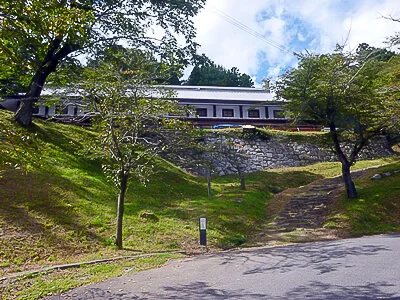
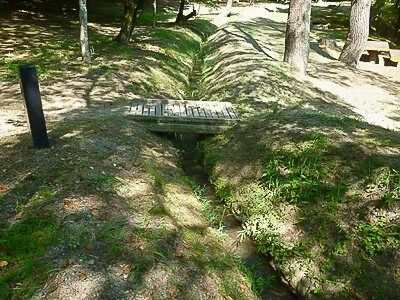
➢ Nigōda Canal (二合田用水 Nigōda Yōsui)
The Nigōda Canal (二合田用水) is an irrigation and water supply channel approximately 18 kilometres long, constructed by Niwa Mitsushige (丹羽光重, 1622–1701) as part of the castle's defensive system. It runs along the hillside of Mount Shiro beneath the castle.
➢ Site of the Suicide of Nihonmatsu Domain Retainers (二本松藩士自尽の地 Nihonmatsu Hanshi Jijin no Chi)
During the Boshin War (1868–1869), the Battle of Nihonmatsu claimed the lives of more than 337 samurai of the Nihonmatsu Domain and over 208 warriors from other domains, making it one of the fiercest engagements in the region. At this site, the domain's chief retainers who had advocated continued resistance—Chief Elder (karō, 家老 ) Niwa Ichigaku (丹羽一学), Castle Governor (jōdai, 城代) Hattori Kyūzaemon (服部久左衛門), and Deputy Castle Governor (kojōdai, 小城代) Niwa Shinjūrō (丹羽新十郎)—accepted responsibility for the defeat and committed seppuku.
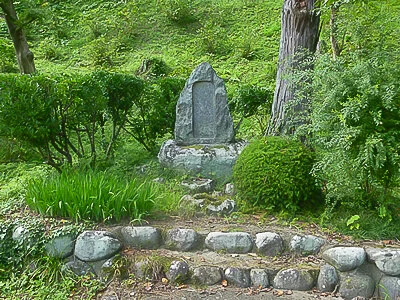
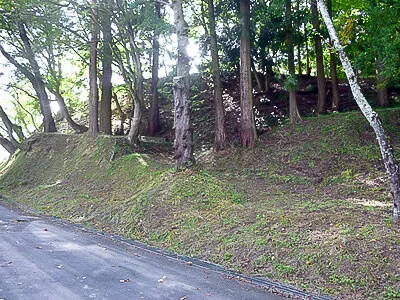
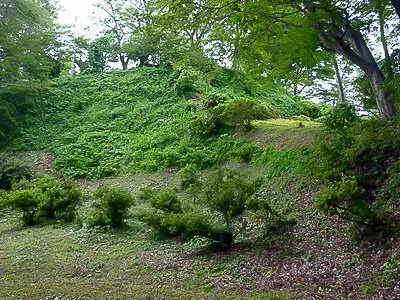
The castle was not built entirely with stone walls. Throughout the grounds are places that still preserve features reminiscent of the medieval mountain fortress that once stood here.
➢ Gunpowder Storehouse (煙硝蔵 Enshōgura)
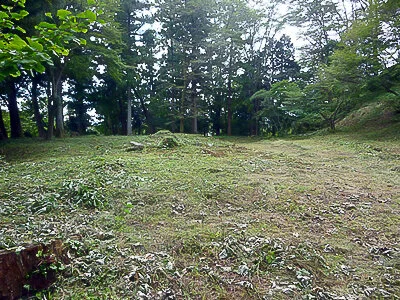
The remains of three storehouse buildings have been discovered here, identified by their granite foundation stones arranged in place.
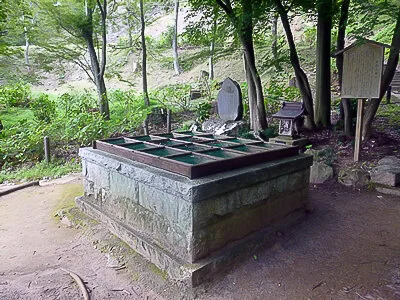
➢ Hikage Well (日影の井戸 Hikage no Ido)
The Hikage Well (日影の井戸, the sun well) is said to be one of Japan's Three Great Wells (日本三大井戸), together with the Tsukikage Well (月影の井戸, the moon well) in Inzai, Chiba Prefecture, and the Hoshikage Well (星影の井戸, the star well) in Kamakura, Kanagawa Prefecture. They come from a phrase of Tsukikage-no-i Engi (月影の井縁起).
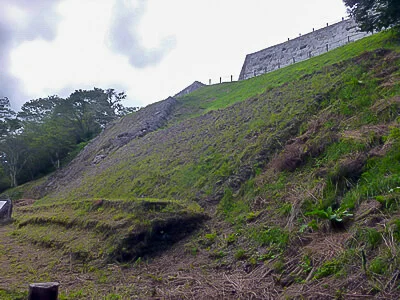
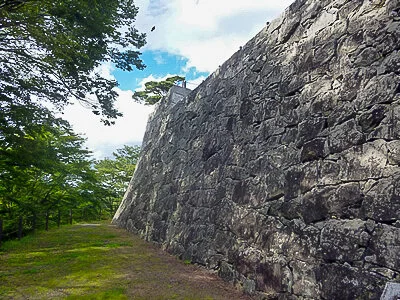
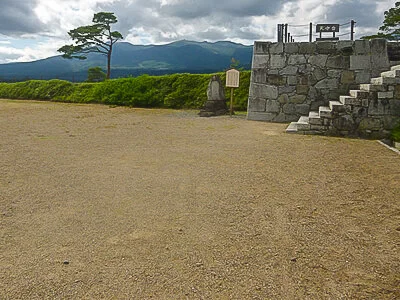
➢ ⑤ Main Bailey (本丸 Honmaru)
The stone walls underwent extensive restoration work in 1991 (Heisei 3).
Main Bailey Entrance (本丸入口 Honmaru Iriguchi)
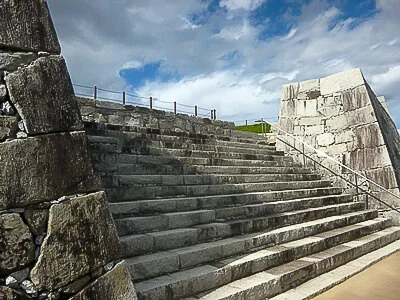
In the distance rises Mount Adatara (安達太良山 Adatara-san).
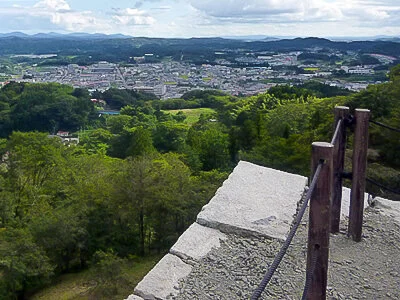
View over the Castle Town of Nihonmatsu.
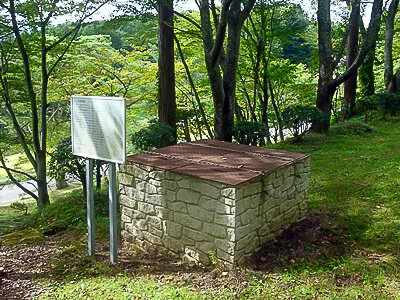
➢ Tokkuri Well (とっくり井戸 Tokkuri Ido)
The well is wider at the bottom than at its opening, giving it the shape of a traditional sake flask (tokkuri). It is from this distinctive form that the well takes its name.
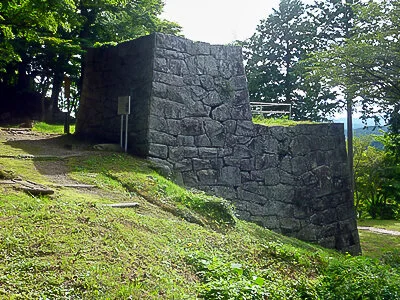
➢ ⑥ Karamete Gate (搦手門 Karamete-mon)
Archaeological excavations have shown that the surrounding stone walls were constructed during the period when the Katō clan held the castle.
➢ ⑦ Shinjō Residence (新城舘 Shinjō-yakata)
During the period when the Gamō clan ruled the castle, two castle governors (城代 jōdai) were appointed. This site served as the residence and administrative quarters of one of them.
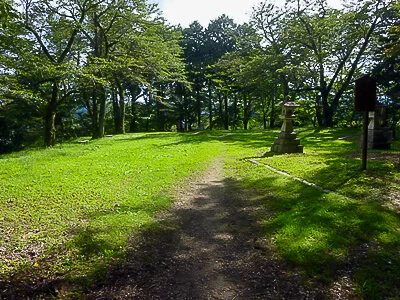
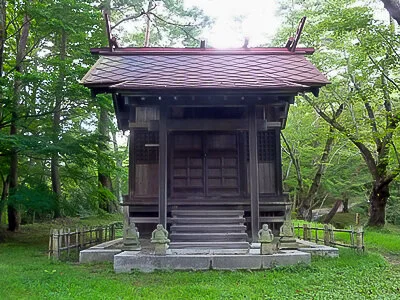
➢ Niwa Shrine (丹羽神社 Niwa Jinja)
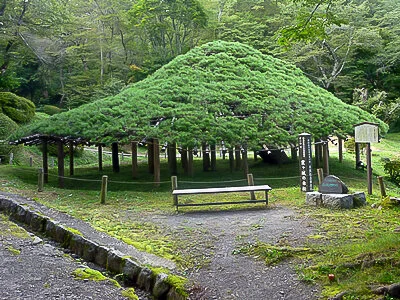
➢ Umbrella Pine (傘マツ Kasa-matsu)
Estimated to be around 300 years old, this pine is notable for its distinctive umbrella-shaped form.
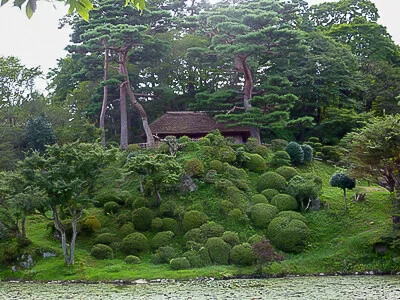
➢ ⑧ Senshintei Tea Pavilion (洗心亭 Senshintei)
Senshintei (洗心亭) is a historic tea pavilion first recorded in 1679 (Enpō 7). It was relocated outside the castle in 1837 (Tenpō 8) and later returned to the castle grounds during the Meiji period .
Dates visited: 14 September 2014 and 4 August 2018.
History
The origins of Nihonmatsu Castle date back to the early Muromachi period. In 1341, Hatakeyama Takakuni (畠山高国, d. 1362), who had been appointed Ōshū Tandai (奥州探題), the Muromachi shogunate's deputy governor for northern Japan, established his residence in the area. At that time, he renamed the locality Nihonmatsu, replacing its earlier place name.The castle itself was constructed during the first half of the fifteenth century by Nihonmatsu Mitsuyasu (二本松満泰), a descendant of Takakuni. From then on, it became the principal stronghold of the Nihonmatsu clan, which ruled the surrounding region for more than a century.
Its most famous episode came during the Sengoku period . In 1586, Date Masamune (伊達政宗, 1567–1636) launched an attack on Nihonmatsu. Facing defeat, Nihonmatsu Yoshitsugu (二本松義継, 1558–1586) feigned surrender and attempted to abduct Masamune's father, Date Terumune (伊達輝宗, 1544–1585), during negotiations. The plan failed when Masamune ordered his troops to open fire, killing both Terumune and Yoshitsugu. The incident became one of the defining episodes of Masamune's rise to power, and Nihonmatsu Castle soon fell after a fierce assault.
Following the conquest of Aizu, Gamō Ujisato (蒲生氏郷, 1556–1595) took control of the castle. Recognising its strategic importance in defending the Nakadōri corridor (中通り), he extensively rebuilt the fortress, introducing stone walls and other features characteristic of an early modern castle. These works transformed what had originally been a medieval mountain stronghold into a more sophisticated fortification suited to the changing demands of warfare.
During the following decades, the castle passed through the hands of several lords, including the Uesugi, Matsushita and Katō families. In 1643, Niwa Mitsushige (丹羽光重, 1622–1701) entered Nihonmatsu with a domain assessed at 100,000 koku. From that point onward, Nihonmatsu Castle remained the residence of the Niwa clan until the end of the Tokugawa shogunate.
The Boshin War
Nihonmatsu Castle played a significant role during the Boshin War. The Niwa family sided with the forces loyal to the Tokugawa shogunate and resisted the advancing Imperial Army. The fighting around the castle was particularly fierce and claimed many lives on both sides.Among the defenders were members of the Nihonmatsu Shōnentai (二本松少年隊), a corps of teenage samurai who became a symbol of the domain's determined but ultimately hopeless resistance. After the castle fell, almost all of its buildings were destroyed by fire, bringing centuries of continuous occupation to an end.
Layout
Nihonmatsu Castle was built on a roughly triangular hill known as Shiro-yama. The honmaru (本丸, main bailey) occupied the summit. At the same time, a series of secondary enclosures (kuruwa) was arranged on the surrounding slopes to create successive defensive lines.To the south lay the Kannon Hills (観音丘陵), which formed an important forward defensive position overlooking the Ōshū Kaidō, the principal highway linking the Kantō region with northern Japan. This combination of natural topography and layered fortifications made Nihonmatsu an effective defensive stronghold controlling movement through the region.
The castle today
The castle ruins are preserved as Kasumigajō Park, a popular destination noted for its stone walls, reconstructed gate, seasonal cherry blossoms and autumn colours. Visitors can still appreciate the castle's terraced layout and commanding views over Nihonmatsu and the surrounding plain.One of the park's best-known annual events is the Chrysanthemum Doll Festival (菊人形祭り), held between October and November. Elaborate displays of life-sized figures dressed in thousands of chrysanthemum blooms attract large crowds each year. Those wishing to explore the castle ruins in a quieter setting may prefer to visit outside the festival season, when the grounds are considerably less crowded.
Map of Nihonmatsu Castle and its castle town (Ōshū Nihonmatsu-jō no Ezu, 奥州二本松城之絵図). This Edo-period domain map depicts the castle's hilltop defences, the surrounding samurai quarters and the planned layout of the castle town beneath the fortress. National Archives of Japan (National Archives of Japan Kokuritsu Kōbunshokan).
Historic plans, including the "Illustrated Map of Ōshū Nihonmatsu Castle" (奥州二本松城之絵図 Ōshū Nihonmatsu-jō no Ezu), preserved by the National Archives of Japan, provide valuable insight into the layout of the castle during the Edo period .
The map is based on the Geospatial Information Authority of Japan's GSI Maps. The locations of the kuruwa (castle baileys) and other features are approximate and should not be regarded as exact.
For a guide to the castle grounds, please refer to this Kasumigajō Park map, provided by the Nihonmatsu Tourism Association.
➢ ① Site of the Ōtemon (大手門, Main Gate)
The Ōtemon (大手門) was a yaguramon (櫓門, turret gate) built on the side of the castle facing the Ōshū Kaidō (奥州街道). It was also commonly known as the Sakashita-mon (坂下門, "Lower Slope Gate"). Successive lords of the Nihonmatsu Domain long wished to construct this prestigious main gate, but permission from the Tokugawa shogunate was not granted until 1832 (Tenpō 3), when it was finally built.
➢ Thousand-Person Assembly Ground (千人溜 Sennin-damari)
This large open area lies in front of the high stone walls (takaishigaki, 高石垣) of the Sannomaru (三ノ丸, Third Bailey). Today, part of the space serves as the castle's main car park.
➢ ② Minowa Gate (箕輪門 Minowa-mon)
The Minowa Gate (箕輪門) is the castle's main gate. It was reconstructed in 1982 (Shōwa 57).
➢ ③ Lower Sannomaru (三ノ丸下段 Sannomaru Gedan)
➢ Upper Sannomaru (三ノ丸上段 Sannomaru Jōdan)
Preparations for the annual Chrysanthemum Doll Festival (Kiku Ningyō Matsuri, 菊人形祭り) had already begun.
➢ ④ Motosaka Palace (本坂御殿 Motosaka Goten)
➢ Nigōda Canal (二合田用水 Nigōda Yōsui)
The Nigōda Canal (二合田用水) is an irrigation and water supply channel approximately 18 kilometres long, constructed by Niwa Mitsushige (丹羽光重, 1622–1701) as part of the castle's defensive system. It runs along the hillside of Mount Shiro beneath the castle.
➢ Site of the Suicide of Nihonmatsu Domain Retainers (二本松藩士自尽の地 Nihonmatsu Hanshi Jijin no Chi)
During the Boshin War (1868–1869), the Battle of Nihonmatsu claimed the lives of more than 337 samurai of the Nihonmatsu Domain and over 208 warriors from other domains, making it one of the fiercest engagements in the region. At this site, the domain's chief retainers who had advocated continued resistance—Chief Elder (karō, 家老 ) Niwa Ichigaku (丹羽一学), Castle Governor (jōdai, 城代) Hattori Kyūzaemon (服部久左衛門), and Deputy Castle Governor (kojōdai, 小城代) Niwa Shinjūrō (丹羽新十郎)—accepted responsibility for the defeat and committed seppuku.
The castle was not built entirely with stone walls. Throughout the grounds are places that still preserve features reminiscent of the medieval mountain fortress that once stood here.
➢ Gunpowder Storehouse (煙硝蔵 Enshōgura)
The remains of three storehouse buildings have been discovered here, identified by their granite foundation stones arranged in place.
➢ Hikage Well (日影の井戸 Hikage no Ido)
The Hikage Well (日影の井戸, the sun well) is said to be one of Japan's Three Great Wells (日本三大井戸), together with the Tsukikage Well (月影の井戸, the moon well) in Inzai, Chiba Prefecture, and the Hoshikage Well (星影の井戸, the star well) in Kamakura, Kanagawa Prefecture. They come from a phrase of Tsukikage-no-i Engi (月影の井縁起).
➢ ⑤ Main Bailey (本丸 Honmaru)
The stone walls underwent extensive restoration work in 1991 (Heisei 3).
Main Bailey Entrance (本丸入口 Honmaru Iriguchi)
In the distance rises Mount Adatara (安達太良山 Adatara-san).
View over the Castle Town of Nihonmatsu.
➢ Tokkuri Well (とっくり井戸 Tokkuri Ido)
The well is wider at the bottom than at its opening, giving it the shape of a traditional sake flask (tokkuri). It is from this distinctive form that the well takes its name.
➢ ⑥ Karamete Gate (搦手門 Karamete-mon)
Archaeological excavations have shown that the surrounding stone walls were constructed during the period when the Katō clan held the castle.
➢ ⑦ Shinjō Residence (新城舘 Shinjō-yakata)
During the period when the Gamō clan ruled the castle, two castle governors (城代 jōdai) were appointed. This site served as the residence and administrative quarters of one of them.
➢ Niwa Shrine (丹羽神社 Niwa Jinja)
➢ Umbrella Pine (傘マツ Kasa-matsu)
Estimated to be around 300 years old, this pine is notable for its distinctive umbrella-shaped form.
➢ ⑧ Senshintei Tea Pavilion (洗心亭 Senshintei)
Senshintei (洗心亭) is a historic tea pavilion first recorded in 1679 (Enpō 7). It was relocated outside the castle in 1837 (Tenpō 8) and later returned to the castle grounds during the Meiji period .
Dates visited: 14 September 2014 and 4 August 2018.
Access:
- Address: 3 Kakunai, Nihonmatsu, Fukushima 964-0904
- Access: From Nihonmatsu Station (二本松駅) on the JR Tōhoku Main Line (JR東北本線): approximately 20 minutes on foot. From Nihonmatsu Interchange (二本松IC) on the Tōhoku Expressway (東北自動車道): approximately 2 km via Prefectural Route 355 (県道355号線).
- Parking: Kasumigajō Park Car Park (霞ヶ城公園駐車場) – free of charge (located at the "P" marked on the map above).