Help Translation on Sword Tang

FreyrStrong

Kouhai
Joined
22 Mar 2024
Messages
32
Reaction score
23
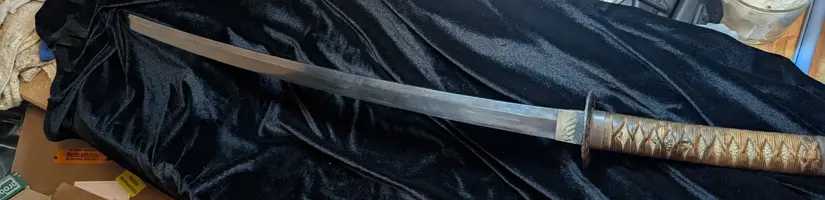
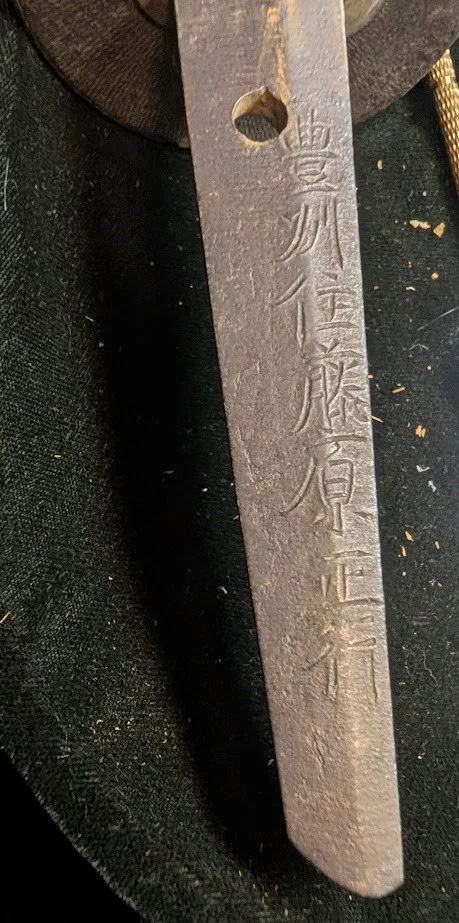
Can someone assist me with this inscription? I would appreciate any help. Thank you!
PXL_20250501_005918148.webp
 

Attachments

  • PXL_20250501_230824929.webp
    PXL_20250501_230824929.webp
    751.6 KB · Views: 98
  • PXL_20250501_230745643.webp
    PXL_20250501_230745643.webp
    572.6 KB · Views: 95
  • PXL_20250501_230723838.MP.webp
    PXL_20250501_230723838.MP.webp
    613.8 KB · Views: 86
  • PXL_20250501_230826782.MP.webp
    PXL_20250501_230826782.MP.webp
    636.2 KB · Views: 78
Oh thank you for sharing 🙏🏽

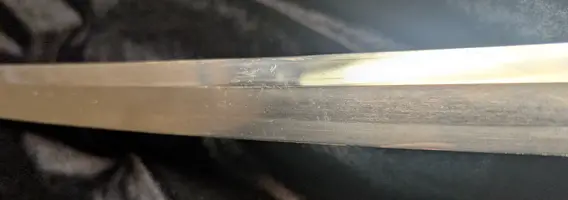
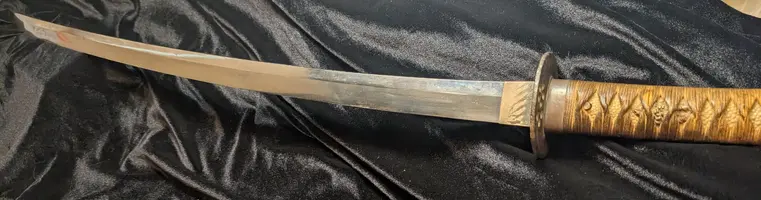
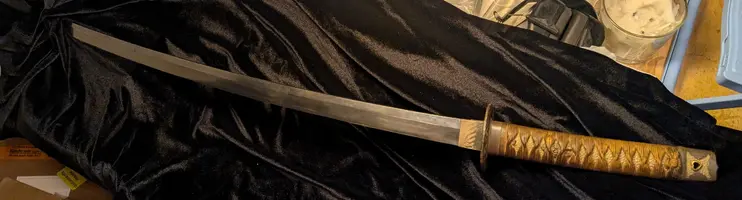
What are you planning to do with it with regards restoring it? I suppose that depends upon it's value/cost to you. I can see it has a 'suguha' hamon and I think I can see a well-packed itame jihada. Having it polished would bring that out and generally improve it's appearence but it's expensive. You could partially do it yourself with a little care. The habaki can be easily polished with 'Flitz' metal Polish (used by watchmakers as it's non-abrashive). The tsuka can be made to look less grubby with Scotchguard upholstery cleaning foam and gently rubbing with a microfibre cloth.

Then protect the blade with regular sword oil and the whole thing with Rennassaine Wax (used by museums for the preservation of their display items).

Anyway, forgive me if I'm 'teaching my grandmother to suck eggs' 🙏🏽
 
I appreciate your comments and advice! I am a novice in the sword world and I have found that there are many diverse opinions on how to proceed with these pieces of art. I have looked into polish but it is prohibitively expensive and I would have to wait 18 to 24 months to get it into any queue I could find. I have come into several of these and intend to sell some of them probably on Ebay.
 
I always wonder how difficult it is to remove the handle to see what's underneath. I would think it would be easy to damage the pegs if they are old and dried out.
 
I always wonder how difficult it is to remove the handle to see what's underneath. I would think it would be easy to damage the pegs if they are old and dried out.
It's very simple and easy! You simply press them out with the point of a 'mekugi nuki'
IMG_4309.webp

I have one made from the tang of an old tantō!

Sometimes the tsuka is a little stuck in place if they haven't been removed in a while so a sharp blow to the wrist of the hand grasping the tsuka usually works it free.

The little bamboo pegs (mekugi) do dry out and shrink a little over time sometimes allowing them to drop out and get lost. They are considered disposable and replaceable and one gets quite good at carving them from smoked bamboo (smoking toughens the bamboo) Traditionally when they were removed you put them in your mouth and let them absorb a little moisture and swell (🤢), or put them in some water.
 
If the sword cost you less that about £1000 ($1,327.40) and the sword is less than 150 years old, I'd have a go at polishing it myself with Flitz just to make it look a bit better (not a mirror finish, of course).

The polishing of my custom forged sword cost £1500 ($1,991.10) but just look at it!

20230417_121800.webp

DSC_1553.webp
 
This is a pretty good video that explains how to get the sword out of the handle/pommel/tsuka.
(Edit: it is all in Japanese, but you can figure out what to do just by watching the guy. It doesn't require Japanese reading skills.)


FreyrStrong, I wouldn't attempt any polish. I'm firmly of the opinion that you shouldn't use any polishes or solvents on a sword, and you should just oil it lightly to stop rust from advancing. But I can see you have already discovered the range of strong opinions on this topic.
Renaissance Wax I am more ambivalent about, but my default position would be to avoid using anything on a sword other than camellia oil, the "clove oil" that sword shops sell, or light machine oil (like sewing machine or electric shaver oil). Actually, some of the commercial "clove oils" that are sold from Japanese sword shops are just camellia oil with some drops of clove oil put in for scent. Anyway the sword only needs a very thin film of oil. It's not good to have so much oil that it pools up where gravity takes it.
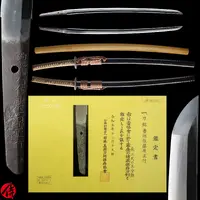
Your sword looks like an authentic wakizashi from mid Edo. Nothing dramatically valuable, but valuable enough so that it should be preserved for future generations to appreciate. I don't know anything about Masayuki, but from the resources I have it seems he was an average smith (c. 1648). Not enough information to determine if the signature is genuine or not, but i wouldn't stress over it too much.
 
FreyrStrong, I wouldn't attempt any polish. I'm firmly of the opinion that you shouldn't use any polishes or solvents on a sword, and you should just oil it lightly to stop rust from advancing. But I can see you have already discovered the range of strong opinions on this topic.
The problem with camelia oil, although it's traditional, is that it is organic and therefore decomposes; You have to remove and reapply very frequently which is fine if you're using the sword and thus doing this anyway. Mineral oil is better and of what choji oil consist these days (with clove oil for scent).

I inspect, clean and oil all my swords once a month. It takes hours because after doing this, I vacuum heat seal them in heavy duty polythene bags with silica gel desiccant pouches! I'm considering filling the bags with inert argon instead of trying to remove air! Yes, I'm obsessive!

Get yourself this excellent book by a materials engineer, who dispels many of the ideas surrounding sword care and gives better alternatives. It's full of graphs and loads of lovely empirical data: 🤤

Analysis of the Iai Katana

For example use thick microfibre cloths to remove oil rather than uchiko powder (which is by definition, abrasive). Use modern rifle oils, often with powerful rust inhibitors, rather than vegetable oils etc. I use a mixture of mineral choji oil and a bit of rifle oil.
Renaissance Wax I am more ambivalent about, but my default position would be to avoid using anything on a sword other than camellia oil, the "clove oil" that sword shops sell, or light machine oil (like sewing machine or electric shaver oil).
If it's good enough for the British Museum/Victoria and Albert Museum and has His Majesty's Royal Warrant , it's good enough for me! It's also entirely removable as all museum restoration substances have to be.
Actually, some of the commercial "clove oils" that are sold from Japanese sword shops are just camellia oil with some drops of clove oil put in for scent. Anyway the sword only needs a very thin film of oil. It's not good to have so much oil that it pools up where gravity takes it.
I used camelia oil for a short while but was alarmed at the way it beaded on highly polished blades (cohesion) leaving some areas apparently untreated. Then, I couldn't easily get it all off (I think I had to use alcohol in the end) before I went back to (mineral) choji oil.

But, just do what you think is best.
 
I appreciate this wealth of information! I will investigate further. I think I will at least start with the light oil to stop any rust. I will research from there. I will use the "hippocratic" method as my guide. Thank you all very very much.
 
It's the same name, but I'd need to dig around to see if it is the same smith. Some names were used by several generations of smiths. Masayuki is a fairly common name, and Bushū Hōshū was a productive sword region, so there could be several generations of Masayuki. One thing that immediately catches my eye is the name on your sword starts right at the peg hole (mekugi-ana), whereas the inscription on the one you posted today starts higher up. Usually these guys are pretty consistent in where they place the hole and where they place their signature, but...its just a superficial observation. Needs a bit more study.

Edit: I meant Hōshū, not Bushū as I initially wrote.
 
Last edited:
It's very simple and easy! You simply press them out with the point of a 'mekugi nuki'
View attachment 126869
I have one made from the tang of an old tantō!

Sometimes the tsuka is a little stuck in place if they haven't been removed in a while so a sharp blow to the wrist of the hand grasping the tsuka usually works it free.

The little bamboo pegs (mekugi) do dry out and shrink a little over time sometimes allowing them to drop out and get lost. They are considered disposable and replaceable and one gets quite good at carving them from smoked bamboo (smoking toughens the bamboo) Traditionally when they were removed you put them in your mouth and let them absorb a little moisture and swell (🤢), or put them in some water.
I was told that a cut down chopstick tip works as a replacement.
 
Back
Top Bottom