


- 14 Mar 2002
- 21,057
- 18,914
Shibuya Ward will introduce a new ordinance that would allow authorities to charge a 2,000-yen fee to anyone caught dropping rubbish on the street, and to hold nearby shops accountable if they do not set out proper bins. The decision was made on 10 December, and the plan is aimed at both people who leave waste behind and businesses around the main stations that sell food and drinks to go. Observers noted that it remained to be seen whether this would actually make the streets any cleaner.
The ward had no intention of adding its own public trash bins, with the mayor saying waste generated by sales should be handled by the shops that produce it. The new framework, therefore, expects each business to provide its own bin. This stance complicates the issue in a city where public bins are already scarce due to security policies.
Yufu City in Oita Prefecture took a different approach: its ordinance sets the same 2,000-yen fine for littering and allows a 50,000-yen penalty for shops that do not provide bins. Roadside rubbish had almost vanished, and the measure appears effective. Yufu City has installed additional public bins and supplies eateries in priority areas with free "Otagai Bako" bins, while the businesses pay for disposal. Extra bins have also been placed in parks. Yufu's approach differs from Shibuya's by building infrastructure first and then seeking business cooperation. Yufu's long-standing culture of keeping streets clean makes voluntary participation more likely than in Shibuya.
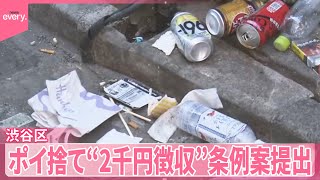
Under the ordinance, pedestrians who litter will face a 2,000-yen penalty, while shops that are required to provide trash bins but fail to do so could be fined up to 50,000 yen. The obligation applies to businesses near Shibuya, Harajuku, and Ebisu stations that sell items likely to generate waste. The rules concerning trash-bin installation will take effect in April 2026, with fines beginning in June. Ward data presented at the assembly show that among businesses where the source of discarded waste could be identified, convenience stores accounted for 62.7% and cafés for 12.0%. Most convenience stores already provide trash bins. Separately, Shibuya Ward found that roughly 68% of eateries have trash bins, excluding vending machines. At the tapioca tea shop Koufukudou, management said they do not provide a trash bin because waste from other stores is likely to be discarded there, adding that even if they installed one, they are unsure whether customers would sort their trash appropriately. The shop also expressed concern about the additional disposal costs, noting that waste unrelated to the business would inevitably be mixed in.
The ward had no intention of adding its own public trash bins, with the mayor saying waste generated by sales should be handled by the shops that produce it. The new framework, therefore, expects each business to provide its own bin. This stance complicates the issue in a city where public bins are already scarce due to security policies.
Yufu City in Oita Prefecture took a different approach: its ordinance sets the same 2,000-yen fine for littering and allows a 50,000-yen penalty for shops that do not provide bins. Roadside rubbish had almost vanished, and the measure appears effective. Yufu City has installed additional public bins and supplies eateries in priority areas with free "Otagai Bako" bins, while the businesses pay for disposal. Extra bins have also been placed in parks. Yufu's approach differs from Shibuya's by building infrastructure first and then seeking business cooperation. Yufu's long-standing culture of keeping streets clean makes voluntary participation more likely than in Shibuya.
Shibuya Passes Plan for 2,000-Yen Fine for Littering
Shibuya Ward has approved an ordinance that would impose a 2,000-yen fine for littering on public streets, while also penalizing shops that fail to provide trash bins. The measure was passed on December 10th and targets both individuals who discard waste and businesses near major stations that...
newsonjapan.com


