Painting research

Dinho

後輩
Joined
22 Feb 2014
Messages
8
Reaction score
3
Hey guys,

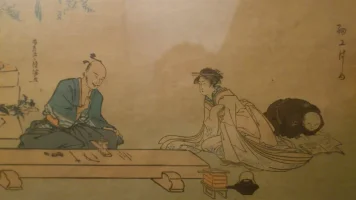
I'm researching a painting that I got from my mums inheritance. I wonder how she got it and what the painting means. Without many clues I have to start somewhere.

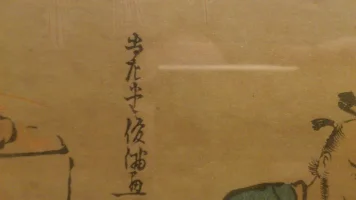
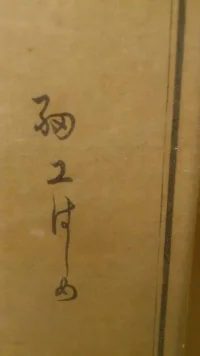
I think the painting is a Japanese woodblock print . But I'm far from sure. Do you guys recognise the text from the attached pictures as Japanese? (and even better, do you know what is says?)

And am I correct in looking at the scene and thinking the tools on the table are tattooing tools?

Any help is much appreciated. But of course I understand it completely if this beyond your scope.
Japan1.webp Japan2.webp Japan3.webp
 
Last edited:
I love cultural art like this, but sadly I cannot help you in translating it.
 
You are correct. That's ukiyoe, a Japanese woodblock print. The text on the left side is the name of the artist. The last character 画 shows it. His given name would be 俊○ "Shun~", but I can't find the artist in a database of ukiyoe.
The text on the right side is the title of the picture 細工はじめ Saiku hajime "Starting a work". "Work" might refer to tattoo, as you presumed.
 
Thanks a lot for that Toritoribe! That gives me some clues to find out more about this painting. 🙂:

edit: found it:

HUAM-CARP04216.webp


It's called "Craftsman in the New Year's Day" by Kubo Shumman. Thanks again!
 
Last edited:
Wow! Nice detective work. Wonder what kind of craftsman is in the picture? I looked around on the net, but couldn't find anything. The artist also goes by the name 尚左堂俊満 (Naosado Shunman??), but no clues as to what the tools might be for. Kind of an enigmatic picture.

Here's his wiki entry 窪俊満 - Wikipedia
 
It's called "Craftsman in the New Year's Day" by Kubo Shumman.
"Hajime" can mean "the first work of the year (e.g. 仕事始め, 歌会始)", so it would be used in this meaning here.

The signature on the left side is exactly 尚左堂俊満. It's read "Shōsadō Shunman".
 
"Hajime" can mean "the first work of the year (e.g. 仕事始め, 歌会始)", so it would be used in this meaning here.

The signature on the left side is exactly 尚左堂俊満. It's read "Shōsadō Shunman".

Thanks again!

How old could it be, and from which era? around 150-200 years, and the Edo period, correct?

Seems like that's perfectly spot on. One of the links I found the image on states: "Edo period, circa 1790-1799". Another one mentions 1795 specifically. :)

Wonder what kind of craftsman is in the picture? I looked around on the net, but couldn't find anything.

One of the links states "Woodcarver(?)". But still trying to find that one out.
 
I looked into the hairstyles of Japanese women. When they were in, and not. Maybe if you find out what kind of hairstyle the woman has in the picture, you could narrow it even more down.
 
Dug around some more and found out it is a plate from an illustrated book called Momo Saezuri (百さへづり) or A Hundred Twitterings. It was published in 1796.

British Museum - Image gallery: Momo saezuri 百さへづり (A Hundred Twitterings)

I still don't know what kind of craftsman he is. Tattoo artist doesn't feel right to me given the woman and the child in the picture (and the lack of inks). Even hundreds of years ago there is a bit of an underground or counter-culture aura to tattoos, and I don't think you would see a refined woman and child lounging around a tattooist. But the tools look very delicate for woodworking. Maybe the clue is in one of the poems on the preceding pages.

Also remember that since it is a woodblock print, it is by definition one of hundreds or thousands that were printed - and it could even be a print from a much, much later date. The date of 1796 doesn't necessarily mean that your print is the same vintage. But... having said that somewhat discouraging disclaimer, I would be keen to know more. I mean, if it is one of the big name, popularized ukiyoe, the likelihood of it being a reprint, or re-re-re-reprint is very high. Yours seems a bit of an obscurity, and so... could be interesting. Your mother left you a nice bit of history.
 
Wow, that's a very nice find Majestic! I was actually browsing the British Museum files last night, but hadn't stumbled onto that one yet.

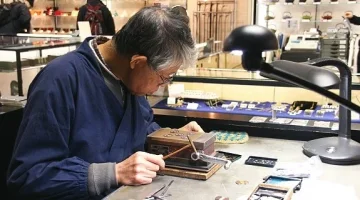
As for the craftsmanship. He seems about to start and she seems eager to see what he's going to do. I'm currently leaning towards a specialized wooden box carver. For example like what the gentleman in the pic below is doing.

3944_03.webp

Also remember that since it is a woodblock print, it is by definition one of hundreds or thousands that were printed - and it could even be a print from a much, much later date. The date of 1796 doesn't necessarily mean that your print is the same vintage.

I do realize that. But during the research I haven't seen a whole many references or prints of this particular picture. So who knows. Guess I have to find an expert to look at it.

I'm trying to track down where she got the painting from as well. But that's a dead end at the moment. The painting has a note on the back of the frame stating. "A.J. Huinck - Utrecht - Steenweg 8". Which I tracked down to an art gallery that closed it's Utrecht business in 1930. But my mum was born in 1956, so I guess she inherited it as well from someone.
 
You can zoom in the picture here.

百さへづり

I don't know about the craftsman, but I know the rope at the upper left. It's "shimenawa". The leaves hung on the rope are "urajiro (a kind of fern)" and "yuzuriha". These leaves are decorated in new year days even now.
And you can see the same leaves on the stand "sanpō" at the left side of the picture. There are "kagami mochi", "daidai" and "iseebi" on it.
You can also see that red ribbons are tied around chopsticks and "chōshi (sake bottle)" in the lower center. The chopsticks are called "iwai-bashi (celebratory chopsticks)", so what is in the nest of boxes under it is "osechi cuisine", and "otoso" is in the "chōshi".
In conclusion, the picture represents a new year's event.
 
Thanks Toritoribe! Those clues seem very clear indeed. This is the fun part in researching something like this. You get to learn a ton of new and fascinating stuff. :)

Btw; found this page in Japanese that seems to have some more info on the painting. Tried the different online translators, but what they translate seems like a kind of gibberish to me.
 
Unfortunately, it describes the contents and condition of the book on sale, not an explanation about the picture.
 
Unfortunately, it describes the contents and condition of the book on sale, not an explanation about the picture.

Guess it would have been too easy to stumble upon a description that would explain everything. ;-) Thanks though!
 
I've emailed an expert about the painting,.If I hear anything back, I'll update the thread with the results. Thanks for all the help! :)
 
It does look like Shougatsu ... they do love their seasonal references.
Could she be visiting a physician?
 
Back
Top Bottom