

Navigation
Install the app
How to install the app on iOS
Follow along with the video below to see how to install our site as a web app on your home screen.
Note: This feature may not be available in some browsers.
More options
Style variation
System
Light
Dark
You are using an out of date browser. It may not display this or other websites correctly.
You should upgrade or use an alternative browser.
You should upgrade or use an alternative browser.
New Sword Purchase
- Thread starter Ukigumo
- Start date

- 21 May 2003
- 14,310
- 4,404

- 2 Jul 2010
- 245
- 683
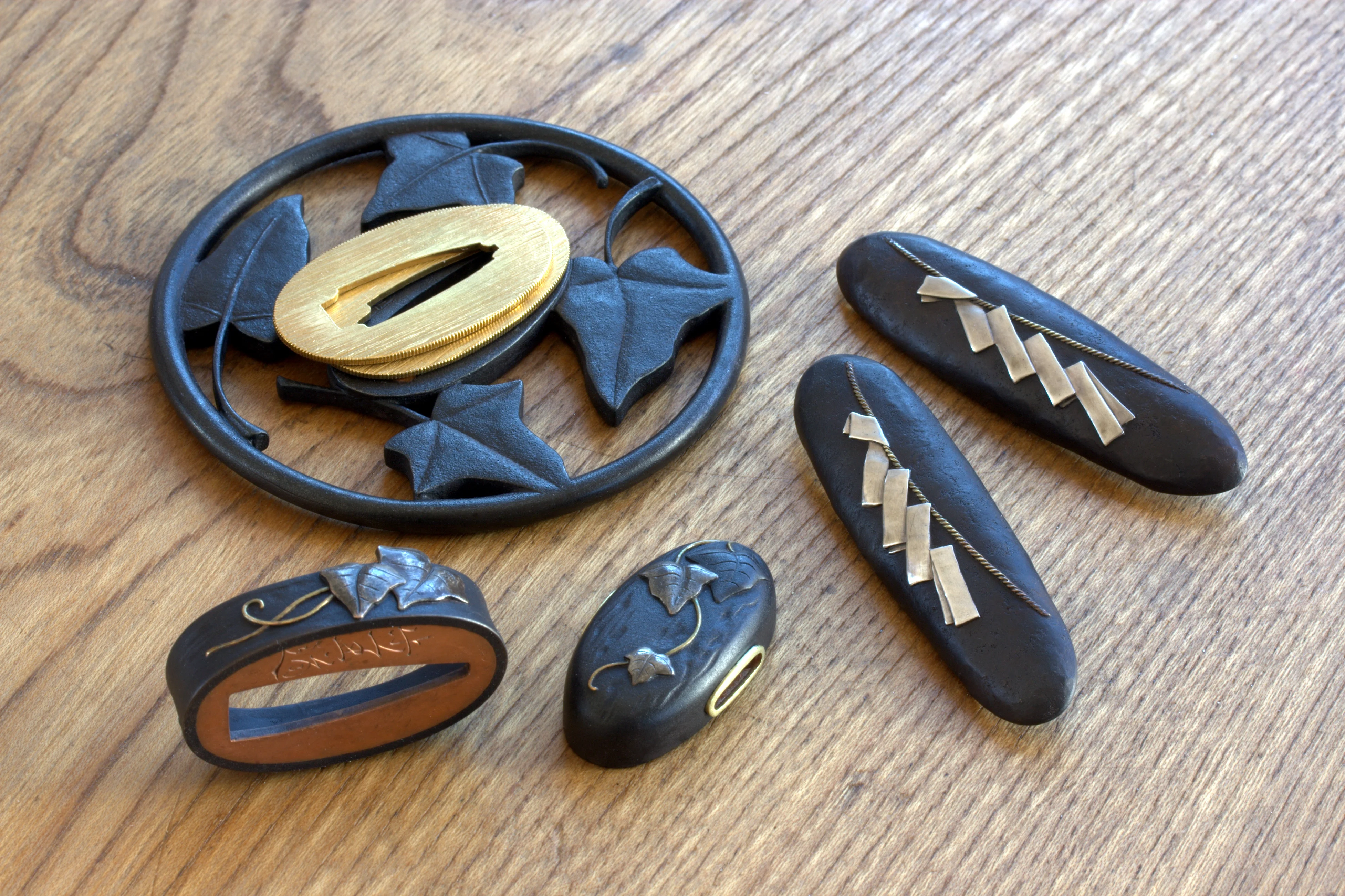
It is a very beautiful sword with fittings made by this incredible gentleman, Ford Hallam (RIP)
I believe he was one of the few artisans asked to conserve and repair the Japan's Imperial sword fittings.
I just watched both videos, part 1 and 2. The hours required to make the utsushi is mind-blowing. Just thinking of the fur and the stripes beneath it? It is a crazy amount of labour that goes into, as he says so himself, creating "an incredibly sophisticated and subtle effect."
Craftsmanship at its finest.

Ukigumo
後輩
- 15 Mar 2025
- 1,382
- 2,684
- Thread starter
- #6
He really was an amazing artisan. Putting in that fur that is a slightly different shade of black to the rest of the tiger!
I once went for a walk in the country park behind my house (Cockington) and to their 'craft square' and to a jewellery maker who makes unusual coloured gold for her rings etc; green hues, red hues even blue! Very pretty and unusual. I asked if she'd heard of the purple/black Japanese alloy called 'shakudo'?
"Actually my partner makes it and makes Japanese stuff from it." I was so surprised!
"Might I have heard him?" I asked.
"Perhaps, he's Ford Hallam!"
I cnould't believe the coincidence. I don'teven know he was in the UK never mind my corner of Devon! We had a long conversation....
Ford was putting together a series of books with details on Japanese metal crafting to follow along with his videos. Unfortunately, he suffered a myocardial infarction before he finished putting them all together. His partner now works in Dartmouth...
I once went for a walk in the country park behind my house (Cockington) and to their 'craft square' and to a jewellery maker who makes unusual coloured gold for her rings etc; green hues, red hues even blue! Very pretty and unusual. I asked if she'd heard of the purple/black Japanese alloy called 'shakudo'?
"Actually my partner makes it and makes Japanese stuff from it." I was so surprised!
"Might I have heard him?" I asked.
"Perhaps, he's Ford Hallam!"
I cnould't believe the coincidence. I don'teven know he was in the UK never mind my corner of Devon! We had a long conversation....
Ford was putting together a series of books with details on Japanese metal crafting to follow along with his videos. Unfortunately, he suffered a myocardial infarction before he finished putting them all together. His partner now works in Dartmouth...
Ukigumo
後輩
- 15 Mar 2025
- 1,382
- 2,684
- Thread starter
- #7
My kidneys etc are sold so I now own the new sword. Here's the toushin

It's a high resolution image so you should be able to zoom in to see the amazing 'mokume' grain in the steel which looks like the burls in timber. Note that the hamon deepens a little toward the cutting part of the blade (monouchi), this reflects swords from the Nambokuchō era (1336-1392) and was designed this way so if it partially chipped off, there'd still be hard steel available to resharpen.
It's a high resolution image so you should be able to zoom in to see the amazing 'mokume' grain in the steel which looks like the burls in timber. Note that the hamon deepens a little toward the cutting part of the blade (monouchi), this reflects swords from the Nambokuchō era (1336-1392) and was designed this way so if it partially chipped off, there'd still be hard steel available to resharpen.
Ukigumo
後輩
- 15 Mar 2025
- 1,382
- 2,684
- Thread starter
- #8
These are the fittings that were made by the late, great Ford Hallam (RIP). Ivy represents vitality, resilience and continuity in Japanese culture, I believe, due to its evergreen nature and ability to thrive in various, often harsh, conditions. Its strong, clinging vines represent enduring, unbreakable bonds in relationships, while its deep roots symbolize a strong, persistent connection to the earth.


Ukigumo
後輩
- 15 Mar 2025
- 1,382
- 2,684
- Thread starter
- #18
I've bitten the bullet and decided to go and pick up my sword from Edinburgh before my 'busy period' commences and makes it impossible for several months.
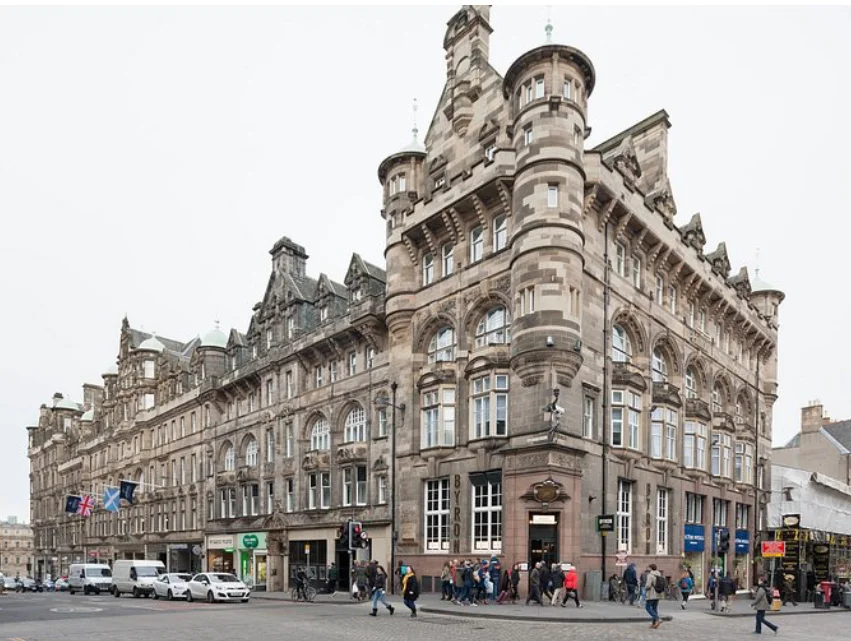
Next Tuesday 14th April, I'm taking the train, first class (@£500 and 8hours each way!) and meeting my friend to take custody of the daisho. I decided against a budget hotel and instead will be staying in the beautiful, historic, Hilton Edinburgh Carlton which is in the centre of the old town and right next to Edinburgh Waverly Railway station. It didn't cost much more than staying in a budget hotel so why not? YOLO
Next Tuesday 14th April, I'm taking the train, first class (@£500 and 8hours each way!) and meeting my friend to take custody of the daisho. I decided against a budget hotel and instead will be staying in the beautiful, historic, Hilton Edinburgh Carlton which is in the centre of the old town and right next to Edinburgh Waverly Railway station. It didn't cost much more than staying in a budget hotel so why not? YOLO
Ukigumo
後輩
- 15 Mar 2025
- 1,382
- 2,684
- Thread starter
- #19
The katana is called Sōhō Fūsetsu (双峰風雪) ;
I feel this kind of name is very typical of classical Japanese naming, where meaning is layered rather than spelled out.
Twin Peaks (双峰)
These are your hamon's defining feature:
This is where the name becomes alive.
風雪 (fūsetsu) is a very classical compound. It appears in literature to describe:
Twin peaks standing—
through wind that never rests,
through snow that quietly endures.
Or more abstractly:
Sōhō Fūsetsu seems especially fitting for this sword because:
with motion beneath…
and two quiet summits rising through both.
- 双峰 (Sōhō) — Twin Peaks - making reference to the twin, mountain-like peaks in the hamon.
- 風雪 (Fūsetsu) — Wind and Snow -making reference to the whiteish colour of the hamon and the swirling 'mokume' grain in the steel.
I feel this kind of name is very typical of classical Japanese naming, where meaning is layered rather than spelled out.
Twin Peaks (双峰)
These are your hamon's defining feature:
- Two rising forms near the tip
- Balanced, deliberate, almost symbolic
- Like paired summits emerging from a ridge
- Duality in harmony
- Balance (in/yo-duality)
- A quiet sense of symmetry and control
This is where the name becomes alive.
風雪 (fūsetsu) is a very classical compound. It appears in literature to describe:
- Harsh mountain weather
- Endurance through time
- The passage of seasons
- Beauty within austerity
- The jihada becomes wind — subtle, swirling, never still
- The hamon becomes snow — bright, settled, crystalline
Twin peaks standing—
through wind that never rests,
through snow that quietly endures.
Or more abstractly:
- Form (peaks)
- Movement (wind)
- Stillness (snow)
Sōhō Fūsetsu seems especially fitting for this sword because:
- It is not just describing what you see
- It expresses how the blade feels
with motion beneath…
and two quiet summits rising through both.
Ukigumo
後輩
- 15 Mar 2025
- 1,382
- 2,684
- Thread starter
- #21
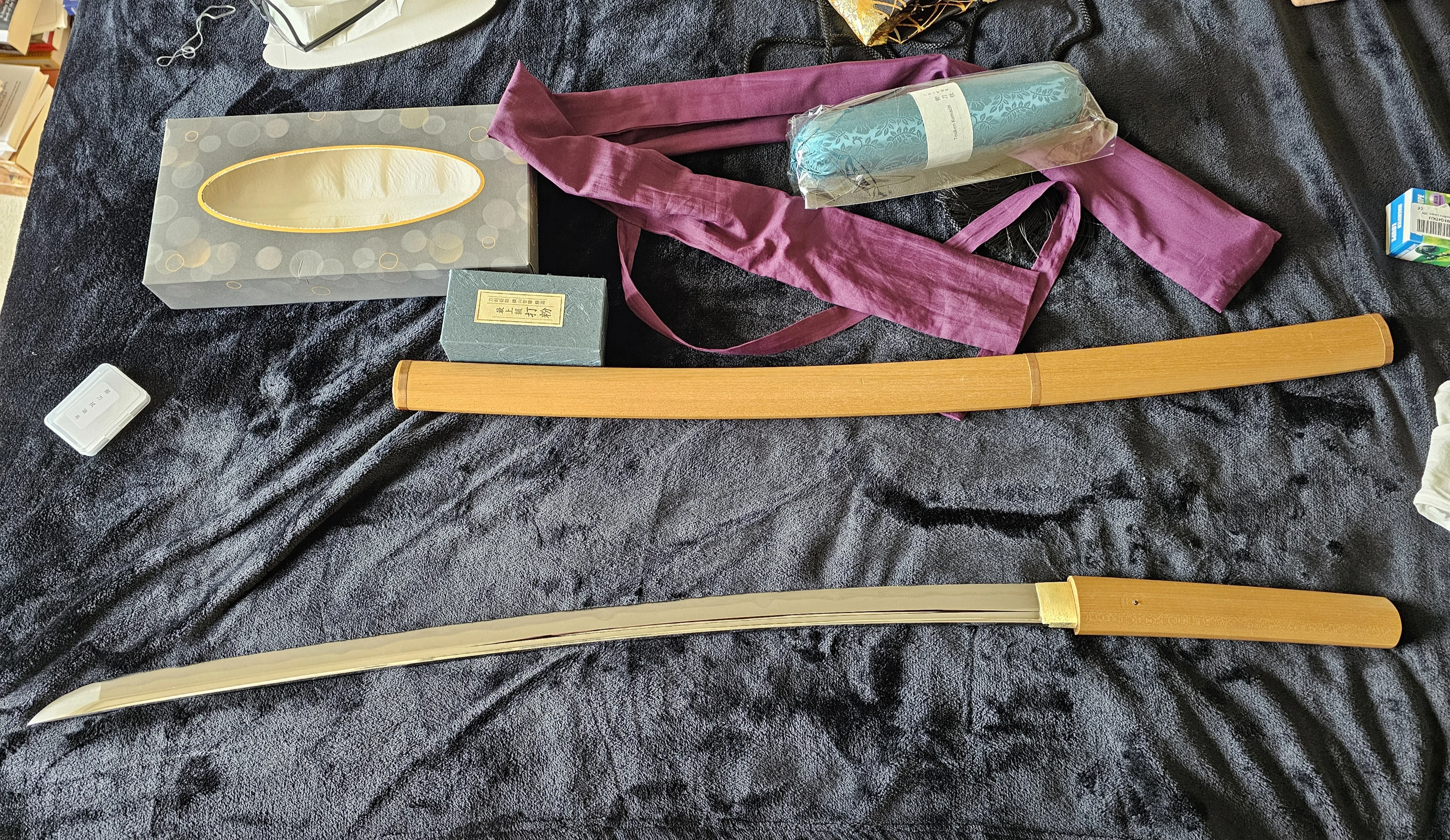
Here's the sugata or overall shape of the blade. Can you see the maximum curvature (sori) is slightly more to the handle (tsuka) end. This is know as 'koshi sori' and is characteristic of blades made in the Kamakura era (1185-1333) /Nanbokuchō (1336-1392). It allows for a higher end (monouchi) velocity when cutting.
Ukigumo
後輩
- 15 Mar 2025
- 1,382
- 2,684
- Thread starter
- #22
Ukigumo
後輩
- 15 Mar 2025
- 1,382
- 2,684
- Thread starter
- #24
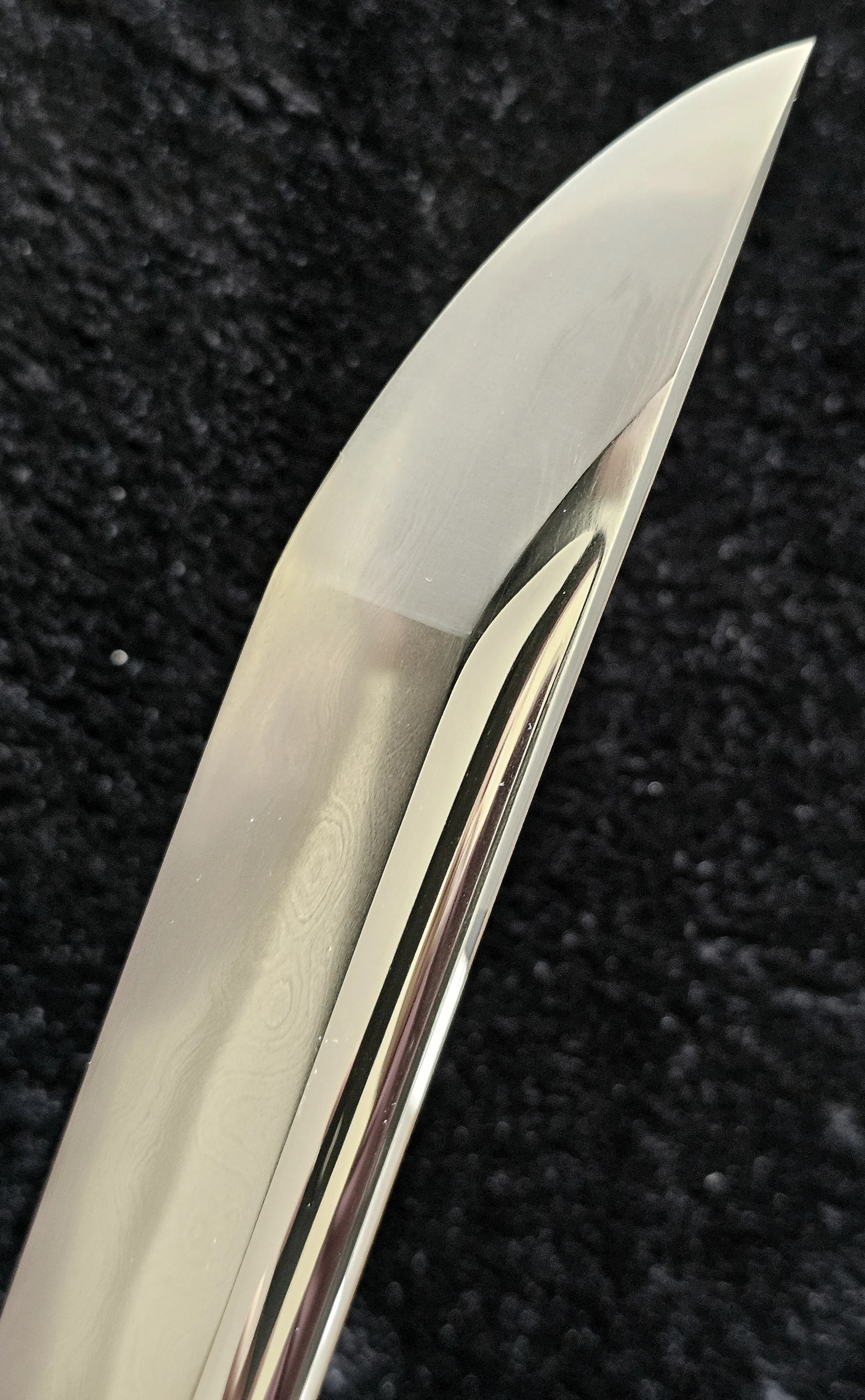
The point (kissaki) is elegantly long but not quite a very long 'Okissaki'. However, performing the advanced 'okuiai' kata, with its snappy fast noto, will be dicey! I couldn't capture the hamon of the kissaki (boshi or hat), but its beauty need not be questioned. It is hakikake/kaen in form.
Ukigumo
後輩
- 15 Mar 2025
- 1,382
- 2,684
- Thread starter
- #25
It is frighteningly sharp and thus cleaning and oiling was performed with great care. I think I mentioned it was forged by Sadayoshi Enomoto (1908-2000) who, had he accepted the role of head of the 'Nihon Bijutsu Token Hozon ' or the 'Society for the Preservation of Japanese Art Swords', would've been designated as a living national treasure ('Ningen Kokuho'), but he turned it down. I am privileged to be this sword's new custodian.
Next, I'll post images of its sister kowakizashi or small short sword.
Next, I'll post images of its sister kowakizashi or small short sword.


