Katana translation

Greg Williams

Registered
Joined
30 May 2024
Messages
3
Reaction score
2
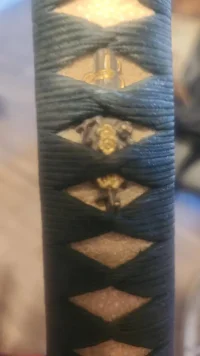
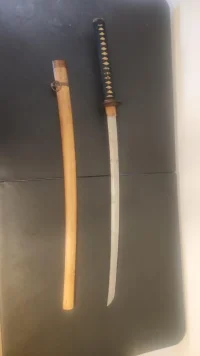
Hi. This is a sword my Father took off a soldier that tried to kill him on Luzon. It has been in my family since. It recently came into my possession. Can anyone help with translations and history?

swordribbon.webp
 

Attachments

  • katana01.webp
    katana01.webp
    29.3 KB · Views: 84
  • katana02.webp
    katana02.webp
    16.4 KB · Views: 88
The tag has some names on it. The top one is Isobe (磯部), a fairly common name. After that I'm not sure. It might help if the crease were flattened out. Anyway, I would expect the next two characters to be a given name. Then the following four characters are another name (2 for family name, 2 for given name).

The sword is a non-standard sword for the army. Looks more like a family sword (i.e. not military equipment). Its possible that a soldier carried his family's sword off to battle, but typically these heirloom swords would be outfitted in military style scabbards and furnishings. Have you tried removing the handle to see if there is any inscription on the tang? The handle is (usually) held in place by a simple bamboo peg that goes through the handle and the tang. If you remove this peg, the handle will come off, and you can view the tang. There are videos on youtube that show you how to do this (its simple and people do it all the time without damaging either the sword or the furnishings). If your sword is rusted in place, you shouldn't force the handle off. But really, the handle is made to be removed and replaced as needed, so its usually not too difficult to remove.

Also, you probably already know, but you should always wipe off any fingerprints right away, because these things rust very, very quickly. The best thing to do is to never touch the blade directly, and to always keep a thin film of lightweight oil on the blade (sewing machine oil). You can touch the tang with your bare hands, but always use a cloth or gloves when handling the actual blade.
 
The tag has some names on it. The top one is Isobe (磯部), a fairly common name. After that I'm not sure. It might help if the crease were flattened out. Anyway, I would expect the next two characters to be a given name. Then the following four characters are another name (2 for family name, 2 for given name).

The sword is a non-standard sword for the army. Looks more like a family sword (i.e. not military equipment). Its possible that a soldier carried his family's sword off to battle, but typically these heirloom swords would be outfitted in military style scabbards and furnishings. Have you tried removing the handle to see if there is any inscription on the tang? The handle is (usually) held in place by a simple bamboo peg that goes through the handle and the tang. If you remove this peg, the handle will come off, and you can view the tang. There are videos on youtube that show you how to do this (its simple and people do it all the time without damaging either the sword or the furnishings). If your sword is rusted in place, you shouldn't force the handle off. But really, the handle is made to be removed and replaced as needed, so its usually not too difficult to remove.

Also, you probably already know, but you should always wipe off any fingerprints right away, because these things rust very, very quickly. The best thing to do is to never touch the blade directly, and to always keep a thin film of lightweight oil on the blade (sewing machine oil). You can touch the tang with your bare hands, but always use a cloth or gloves when handling the actual blade.
Thanks for the advice! yes I expected by the writing that it was likely someone's name. I plan to try and flatten the Ribbon a little more. the thing was a really horrible wrinkly mess when I got it I was afraid to damage it too much. I have always suspected that it was cannot blade due to the scabbard, and the cap beefing decorated as it is. I will consider removing the handle next. Thanks for the contribution!
 
Back
Top Bottom