News Junior high school students perform poorly in English speaking test

thomas

Unswerving cyclist
Admin
Joined
14 Mar 2002
Messages
21,050
Reaction score
18,903
According to the results of the National Assessment of Academic Ability released yesterday, only 12.4% of third-year junior high school students responded correctly in the speaking section.
36375181cf636d0f66ae6b4599ba2e73.webp

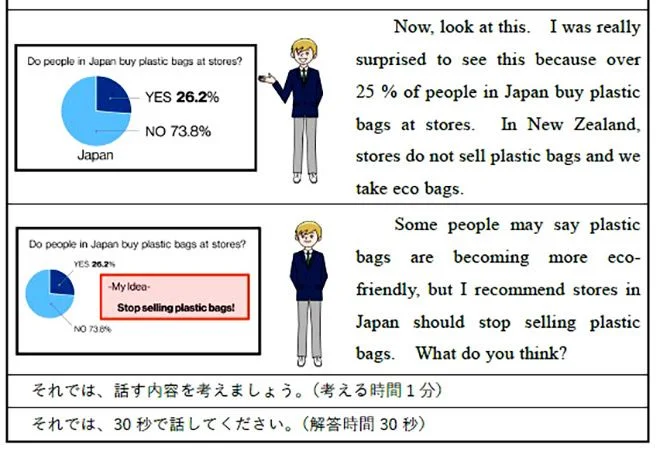
In the three other areas of the English test, the listening comprehension section had the highest average percent of correct answers at 58.9%, followed by 51.7% in reading comprehension and only 24.1% in writing. The speaking section consisted of five questions based on the school curriculum guidelines, which place importance on learning how to express and share ideas and feelings in English. For one question, students listened to a presentation in English about an environmental issue by a native English-speaking student studying in Japan. The students were then given 60 seconds to think about their views before having to express them in English within 30 seconds. An average of only 4.2% of students responded correctly. More than 60% of students responded incorrectly to all five questions. "The questions were aimed at assessing the ability to express thoughts and reasons based on what students hear, but the set up was too complicated, so it might have been difficult for the students," said a senior member of the National Institute for Educational Policy Research, which prepared the test. The institute is part of the Education, Culture, Sports, Science and Technology Ministry. For the speaking section, students used digital devices provided to each of them to deliver the voice data of their responses. This online format was used for the first time. As for overall results on the English test, Tokyo topped all prefectures, with Aichi and Kanagawa prefectures tied for second.


Way to go Aichi (in which Mikawa is located)!

I agree with the assessment that the setup was complicated, and I don't even know how I would have done in English on that same example. Even though I'm a native speaker!

That being said, it's very difficult to create tests that accurately measure what you're trying to.

EDIT: Added the word "how".
 
I thought the survey was asking the question "Do people in Japan buy plastic bags at stores?" and that the results were the number of respondents who said so. (That is, the person responding may or may not buy plastic bags but is saying that some people in Japan do or don't.) Otherwise the title on the graph should be "The percentage of people in Japan who buy plastic bags at stores."

Anyway I wonder what would happen if you answer in perfect English but going off script in terms of content.

What do you think?
"I think people in New Zealand should mind their own business. If they want to carry their groceries in pouches made of kiwi feathers that's up to them. I think Japanese stores should give plastic bags for free. Moreover they should individually wrap or bag every purchased item before being placed in the bag."
 
I thought the survey was asking the question "Do people in Japan buy plastic bags at stores?" and that the results were the number of respondents who said so. (That is, the person responding may or may not buy plastic bags but is saying that some people in Japan do or don't.) Otherwise the title on the graph should be "The percentage of people in Japan who buy plastic bags at stores."

Anyway I wonder what would happen if you answer in perfect English but going off script in terms of content.

What do you think?
"I think people in New Zealand should mind their own business. If they want to carry their groceries in pouches made of kiwi feathers that's up to them. I think Japanese stores should give plastic bags for free. Moreover they should individually wrap or bag every purchased item before being placed in the bag."
I heard you like bags, so I put your bag in a bag in a bag. Did you want a bag for your bags? :P

That example was rather confusing. Maybe its in Kiwi English? :ROFLMAO: :P

I actually met a New Zealander in Nara city last year. He had bought a house there as he had been in Japan on and off for a number of years and decided he liked it more there than in New Zealand.
 
Back
Top Bottom