


- 14 Mar 2002
- 21,050
- 18,903
China's prominence in humanoid robotics was evident at a major robotics exhibition in Tokyo in December, where more than 80 Chinese firms participated. Observers noted that this level of participation persisted even though Beijing has continued to advise caution over travel to Japan, a sign that political frictions have not affected cooperation in the robotics field and that China's industrial ambitions remain extensive. The fair, now more than 50 years old, is being reshaped by rapid advances in robotics and the growing importance of artificial intelligence in the design of new machines.
Exhibits ranged from consumer-oriented prototypes, including a soft, cushion-like chair that enveloped the user and reacted to spoken commands, to industrial robots capable of interpreting verbal instructions, identifying objects and carrying out precise tasks without human intervention. One of the demonstrations featured a robot that asked to place a blue cube on the number shown by a yellow die. When the die showed a three, the machine recognised it and quietly carried the cube to the right spot. In another corner of the hall, an assembly robot was shown altering its stance to tighten screws in line with the shape of the object in front of it, a level of adjustment made possible by AI-guided movement.
A Chinese robotics representative said Beijing now sees humanoid robots as a strategic industry that could drive wider technological growth, especially as China's ageing population increases the need for automation. Data at the exhibition showed how China has overtaken Japan in industrial robot installations since 2015 and now leads in humanoid-related patents, backed by strong state support. Commentators noted that although Japan once dominated the field, leadership has shifted.
Experts stressed that humanoid robotics remains technically demanding, and China's advantage lies in training robots with vast virtual datasets. Japan's plan to invest 400 billion yen over ten years was welcomed but viewed by some as being too late. Ethical issues were also raised, as humanoids may eventually move into defence and other sensitive areas, prompting calls for Japan to guide responsible development while keeping pace in a rapidly intensifying global race.
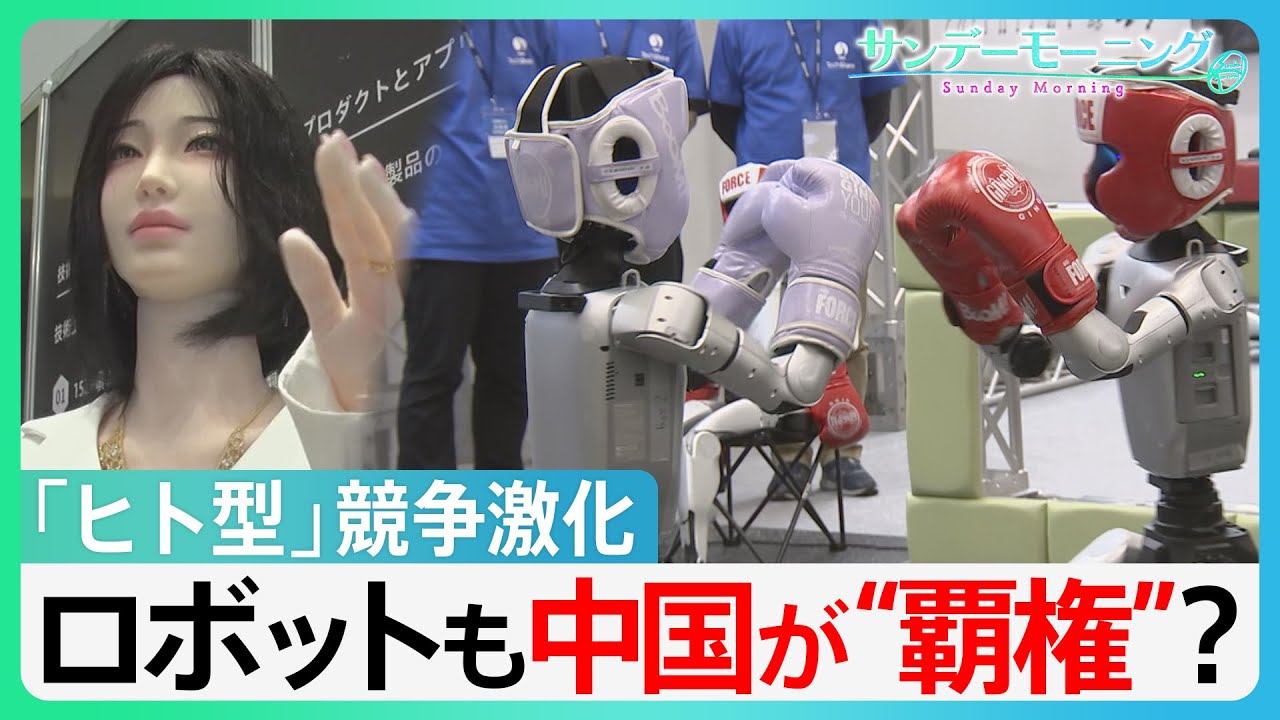
Good to see Chinese company representatives still present in Japan, despite official Sino-Japanese relations hitting a historic low.
Exhibits ranged from consumer-oriented prototypes, including a soft, cushion-like chair that enveloped the user and reacted to spoken commands, to industrial robots capable of interpreting verbal instructions, identifying objects and carrying out precise tasks without human intervention. One of the demonstrations featured a robot that asked to place a blue cube on the number shown by a yellow die. When the die showed a three, the machine recognised it and quietly carried the cube to the right spot. In another corner of the hall, an assembly robot was shown altering its stance to tighten screws in line with the shape of the object in front of it, a level of adjustment made possible by AI-guided movement.
Competition is particularly fierce in the field of humanoid robots, where advances have accelerated sharply. While humanoids were unveiled for the first time in Russia last month, one model stumbled immediately after taking the stage, underscoring the unevenness among countries. In contrast, Chinese companies have emerged as a dominant force. Kawasaki Heavy Industries presented its own humanoid at the fair, explaining that machines built in a human form can replicate human motions and perform tasks in a wide variety of environments. Unlike industrial robots with narrowly defined roles, humanoids can open doors, operate tools, and carry out tasks similar to human workers, making them potentially valuable in disaster zones where physical strength and adaptability are essential. In one demonstration, a robot lifted a 30-kilogram shelf to rescue a toy kitten placed underneath. Company representatives highlighted the advantage of building robots in a human shape, noting that daily environments—from door handles to tool designs—are engineered for human use, making a human-like structure the most efficient universal form. Chinese manufacturers also showcased robots capable of dancing and boxing with fluid, lifelike motion, drawing significant attention. Japanese trading companies collaborating with Chinese robot makers emphasized that Chinese products now stand out not only for performance but also for affordability, making them the most practical option for real-world deployment.
A Chinese robotics representative said Beijing now sees humanoid robots as a strategic industry that could drive wider technological growth, especially as China's ageing population increases the need for automation. Data at the exhibition showed how China has overtaken Japan in industrial robot installations since 2015 and now leads in humanoid-related patents, backed by strong state support. Commentators noted that although Japan once dominated the field, leadership has shifted.
Experts stressed that humanoid robotics remains technically demanding, and China's advantage lies in training robots with vast virtual datasets. Japan's plan to invest 400 billion yen over ten years was welcomed but viewed by some as being too late. Ethical issues were also raised, as humanoids may eventually move into defence and other sensitive areas, prompting calls for Japan to guide responsible development while keeping pace in a rapidly intensifying global race.
AI Race Intensifies as China Showcases Advances in Humanoid Robotics at Tokyo Exhibition
China’s leading position in humanoid robotics was on full display at one of the world’s largest robot fairs held in Tokyo on December XXth, where more than 80 Chinese companies participated despite Beijing’s ongoing calls for travel restraint to Japan, highlighting how the two countries’...
newsonjapan.com
Good to see Chinese company representatives still present in Japan, despite official Sino-Japanese relations hitting a historic low.


