


- 14 Mar 2002
- 21,050
- 18,903
In a Nikkei commentary, Sze-Fung Lee explains how Beijing manipulates Japanese social media to disseminate its narratives.
An example is an opinion piece by the state-owned Xinhua News that was originally labelled a commentary, then published as a news report by Xinhua in Japanese, and republished by Japanese media outlets.
The author wondered whether NTT Docomo, KDDI, and others were aware of the aggregated news they were republishing.
According to him, Beijing's information manipulation pipeline does not stop at news aggregators or regional television broadcasters. It is also active across several social media platforms. The official X account of the Chinese Consulate in Niigata, operating under the friendly local persona of the Niigata Consulate "Shin-chan", has repeatedly amplified Chinese state media content in Japanese about 1 or 2 days after it first appeared. This included the same Xinhua video on a Tokyo rally, as well as identical material from the Japanese edition of The People's Daily, a Chinese state mouthpiece, opposing Tokyo's intelligence reforms.
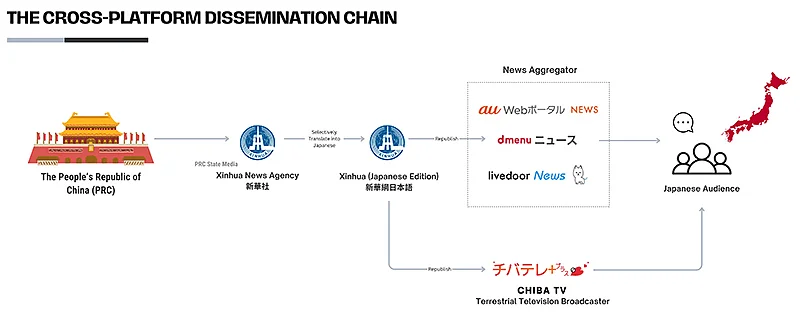
Image created by the author.
But the content moving through this pipeline is not simply crude pro-Chinese Communist Party or anti-Japanese propaganda, which many Japanese readers would quickly recognise. Influence operations are often more subtle than that. They can involve selecting real Japanese voices, sometimes local and genuine ones, and selectively amplifying them to create confusion and deepen division.
Paywall alert:

 asia.nikkei.com
Sze-Fung Lee's Bluesky account:

 bsky.app
These tactics had been flying under the radar until now. There is a complete dissemination chain -- a direct influence operation pipeline from Beijing's flagship state media into Japan's information channels -- that operates systematically via mainstream news aggregators and regional television broadcasters.
An example is an opinion piece by the state-owned Xinhua News that was originally labelled a commentary, then published as a news report by Xinhua in Japanese, and republished by Japanese media outlets.
On May 27, Chinese state-owned Xinhua News Agency published an article titled, "With its intelligence apparatus upgraded, Japan takes another step toward 'new militarism.'" The piece was written by Xinhua reporter Yue Dong and was labelled "commentary." Three days later, on May 30, the article appeared on Xinhua's Japanese-language website, translated and repackaged. The byline is gone, the "commentary" label disappeared, and the content is now presented in Japanese. It was made to look like a neutral wire news report on the surface, yet that deliberate repackaging of a state-directed opinion piece into an institutional news dispatch before entering the Japanese information space is only one example of Beijing's broader campaign of cognitive warfare. In less than an hour, the repackaged article was republished by Japan's local news aggregators, including Docomo, AU, and Livedoor, with the exact title and content on their own platforms and no indication that the article was originally an opinion piece.
The author wondered whether NTT Docomo, KDDI, and others were aware of the aggregated news they were republishing.
According to him, Beijing's information manipulation pipeline does not stop at news aggregators or regional television broadcasters. It is also active across several social media platforms. The official X account of the Chinese Consulate in Niigata, operating under the friendly local persona of the Niigata Consulate "Shin-chan", has repeatedly amplified Chinese state media content in Japanese about 1 or 2 days after it first appeared. This included the same Xinhua video on a Tokyo rally, as well as identical material from the Japanese edition of The People's Daily, a Chinese state mouthpiece, opposing Tokyo's intelligence reforms.
Image created by the author.
But the content moving through this pipeline is not simply crude pro-Chinese Communist Party or anti-Japanese propaganda, which many Japanese readers would quickly recognise. Influence operations are often more subtle than that. They can involve selecting real Japanese voices, sometimes local and genuine ones, and selectively amplifying them to create confusion and deepen division.
Paywall alert:
China's influence pipeline is already active in Japan's information space
Beijing is repackaging state narratives through aggregators, broadcasters and social media
asia.nikkei.com
Sze-Fung Lee's Bluesky account:
Sze-Fung Lee 李紫楓 (@imleeszefung.bsky.social)
Independent analyst specializing in Chinese hybrid warfare as an integrated cross-domain system, with a focus on FIMI, gray-zone operations, and cognitive warfare. 🚏 Views expressed are my own. linktr.ee/szefung_lee
bsky.app

