Fire code laws in Japan for buildings?

Emoni

先輩
Joined
20 Sep 2003
Messages
1,779
Reaction score
67
Hello all.

I've got a rather specific problem. I live in an old apartment on the third floor partially associated with my university through a contract set up between them and a company that allows students to live in the apartment complex. It's old, but spacious and nice...

However,the building feels like an absolute tinderbox death trap however. It is entirely tatami, gas pipes for the stove and bath, most people use liquid kerosine (or some fuel) for portable heaters they set around the room (even the storage room smells of leaked fuel). There is only one stair way up and down and exit from this place unless I want to jump off the balcony.

Finally, the big problem. There is no fire extinguisher outside or inside the apartments. Nor is there even an escape ladder. If ANYTHING catches fire we are screwed and this place will burn in seconds. Add to that the fact that a lot of people seem to smoke in this place.

I have contact the university by email twice explaining my concerns but unlike other emails they have outright ignored me. I don't know the laws well in Japan, but this certainly can't be legal here. It certainly isn't safe. Of course, if I do complain they could threaten to cut off the contract that lets students stay here. It's a problem.

Does anyone have experience in dealing with this sort of safety concern or know the laws?

Thank you.
 
Your description of the building is pretty standard here. Tatami, kerosene heaters, etc.

As Mike wrote, go to the official sources for fire extinguisher info. I suspect that there should be one in the hallway, but am not sure.

And, it won't make a difference if people smoke. Your bigger concern should be earthquakes, which is why so many places burn down here. Don't leave on your kerosene heater when you are out of the house, or sleeping. That's about all you can do. Fire ladders? Never had one in any American or Japanese apartment building I ever lived in!
 
The only places I've seen fire ladders is on warehouses or large office buildings. I once worked in a brand-new four story warehouse and the very first thing they did after the fire marshal signed off on the building was to have the contractor come move the signs indicating the exits to a height out of compliance with the fire code so forklifts could pass under them. I had to raise hell to get them to quit blocking all the fire hoses with stacks of freight. I was told "Nobody smokes in here so we can't possibly have a fire".

All trucks are required to have a fire extinguisher, and without even looking I can tell you mine is about five years past its inspection date. A couple months ago I brought up in a company meeting that nobody ever checks them and that probably a lot of drivers don't even know where they are mounted on their trucks or if their truck even actually has one or not. The idea of spending money to make sure they were all actually certified and operable was greeted like the proverbial turd in a punch bowl. I've actually had a truck catch fire before, a truck with TWO fire extinguishers....both ancient, one with the operating handle rusted solid and one with no operating handle at all. I had to run into a restaurant and just grab one from the kitchen. (That was a different company).

Point is, nobody takes it seriously unless and until something or somebody gets burned up. Trying to get anybody to care is an exercise in spitting into the wind.
 
Do you like life? Do you want to protect it?

They say that God helps those who help themselves. I don't believe in God but its good advice. The typical reaction to safety demands in Japan is to listen, reply with something irrational (either because they are irrational or not really thinking about it), maybe talk to someone else or have a meeting, then do absolutely nothing.

And rules? They are made to be broken. Nowhere is it more true than in Japan. And then when somebody dies the Japanese get all Nazi-like about the rules for a few months to a year and then its back to normal.

You can buy fire extinguishers at D2, Watahan, Cainz Home and so forth. They are not that expensive. Get one for the hallway and one for your own room. Encourage others in your building to do the same.

You could also buy a rope to escape, and I don't mean a glorified string, I mean a rope. It won't be cheap. You can use that to escape. It might be cheaper to get some of that glorified string and make a rope ladder yourself. You just better test it. It will stretch.

Even some chain might do the trick. I think Plus One might be the place for that. Cheaper than you might think. But get yourself some cheapo leather gloves from Workman, because dealing with that chain in winter won't be any fun. Leave the gloves with the chain at all times, in a box on the veranda or next to the window or door, and make sure there is a way to secure it, if not have one end already secured coming out of the box.

Also, do you have fire alarms? They can also be bought but I won't say they are cheap. If you already have them, test them. They tend to come with a test button. The batteries could be dead or dying. You might be able to inspect the dates on the batteries and the alarms.

I strongly suggest you take this bull by the horns yourself. No matter how right your complaints are, they won't save you in the event of a fire.
 
Japan for decades banned smoke detectors because they contain radioactive material. Now they are mandatory in apartment buildings. If your landlord hasn't installed them, raise hell.

You should have a home fire extinguisher in your apartment regardless of whether there is one in the hall or not. They are not expensive. You can get models for the kitchen which are about the size of a tall spray paint can and should cost around a thousand yen. Make sure you understand the difference between Class A, B, and C fires and know and understand the rating on the extinguisher. Read the label so you know how far it will shoot and how long it will last. Always aim at the base of a fire.

You can probably find collapsible escape ladders intended for your veranda; check a good-sized home center.

If your school is ignoring you on your concerns and they made the arrangements for the apartment, include the term 連帯責任 (れんたいせきにん) in your communications and send them by registered letter instead of e-mail.
 
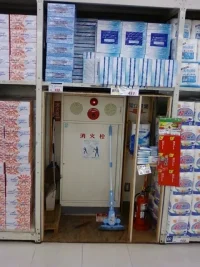
D2firehose.webp

In case of fire, pray to God its not the tissue that is burning or you will never get to the alarm, hose or fire extinguisher.

This is at a D2 home center, a big store. The shelves go up near the ceiling, towering above the equipment.

If there was an earthquake, the falling boxes of tissue would obscure the equipment, so if you were just a customer, you would not know where to dig if a fire broke out.

I will be the first to admit that Americans can go over-board on safety issues. But the Japanese are far too lax.
 
Last edited:
At my old conversation school, which was in a large hotel downtown and run by a major media company, staff cleared away boxes of old mags and junk away from a fire door the day before the fire inspector came. Ten minutes after he left, they replaced them. Wasn't there a big fire in Tokyo or Osaka a few years ago, where someone was killed because of so much clutter on the stairway? Wouldn't surprise me if they had done what my school did.

Protect yourself.
 
Thanks everyone. Thank you Mike for that advice on handling the school, half the question was how to deal with them actually since being ignored on this was an issue.

I do have fire alarms though, at least that is in this tinder box.
 
A note on smoke alarms that I remember reading when I installed the last one I purchased is that you are supposed to replace them after 10 years. Most new smoke alarms, decent brand not the super cheap ones, come with a Lithium Power Cell that lasts 10 years as well. The recommendation was that at 10 years you don't replace the batter, you throw the whole thing and get a new one. Dust build-up in the censor can diminish their ability to detect the smoke. Also, you are supposed to run the test once a month to make sure they are functioning correctly.
 
I think this may be the fire Glenski has in mind. Forty-four people were killed. The building had a fire alarm, but it was switched off. The detection system in the fourth floor ceiling was blocked by ceiling tiles, rendering it useless. I seem to recall from news accounts at the time reports that the stairwell was largely obstructed with junk, as many of the building tenants used it as a storage space, making it impassable, as well as being loaded with flammable materials.

The building owner received a suspended sentence.
 
Jez... :/ To even have the ability to "turn it off" worries me.

I see things like that, then look at Fukushima, and other horrible disasters and deaths brought about by shear negligence, and I wonder if anyone is held responsible for such inaction.
 
And rules? They are made to be broken. Nowhere is it more true than in Japan. And then when somebody dies the Japanese get all Nazi-like about the rules for a few months to a year and then its back to normal.

On a related note, how seriously is workplace safety taken in Japan, compared to say the UK or Australia/NZ?
 
Back
Top Bottom