1. Global Capitalism led by Anglo-American fallen.
2. Fake/Fabrication culture spread by China & Korea facing their limits.
3. Religious conflicts between Islam and Christianity becoming more serious over Middle East and Afghanistan.
4. EU has become more united for being one country - not multi-nations.
6. Russia revives ...
1 All I can say is huh? You have to remember, Japan, though not a Western country IMO, still has a strong capitalist system. Japan exports and imports and outsources to Thailand/Indonesia/China.
Has it fallen? I think it's more attention is now paid to the matter of scandals, and overcompensation to some top executives, regardless of the bottom-line results. Nothing that is going to bring the system down.
2 Uh, Japan recently seems to be floating more issues with this in the food industry, though China's dumpling (gyoza) woes have grabbed more of the headlines. Any country with weak intellectual property laws will have problems with counterfeit goods. Remember it was only 15 years or so ago that Japan didn't used to honor patents held outside of Japan!
3 Must agree, though some of it is fluff. There have always been conflicts, just more are emphasized with terrorist attacks now.
4. True, but more like one trading bloc, not necessarily a single country.
5(6). Russia has somewhat recovered, though it still has nice spats with its former regions.
However, Japan remains unchanged - being relatively peacefully - because it
is less affected by external world.
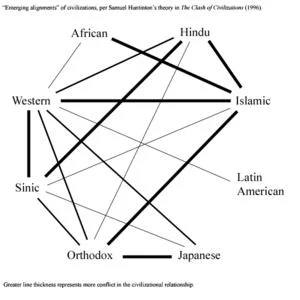
Political scientist Samuel P. Huntington, said JAPAN is uniquely developed civilization with its long history of consistency.
Could someone define what exactly the bolded part means?
Japan, considered a hybrid of Chinese civilization and older Altaic patterns.
In some cases, the Sinic, Hindu, Buddhist and Japonic civilizations are merged into a single civilization called Eastern World.
The above quotes are from the wiki link
Astro gave. So perhaps the Japanese are more related to the Chinese than they care to admit?
Huntington also argues that the widespread Western belief in the universality of the West's values and political systems is naive and that continued insistence on democratization and such "universal" norms will only further antagonize other civilizations. Huntington sees the West as reluctant to accept this because it built the international system, wrote its laws, and gave it substance in the form of the United Nations. Huntington identifies a major shift of economic, military, and political power from the West to the other civilizations of the world, most significantly to what he identifies as the two "challenger civilizations", Sinic and Islam.
In other words, regional powers such as the two Koreas and Vietnam will acquiesce to Chinese demands and become more supportive of China rather than attempting to oppose it.
I agree with the West's power declining, but you notice he doesn't mention capitalism per se.
Oh, oh, and since Japan has such 'good' relations with China, what do you think that will mean for Japan?
Despite his expectations, more rigorous empirical studies have not shown any particular increase in the frequency of intercivilizational conflicts in the post-Cold War period. [4] In fact, regional war and conflict spiked immediately after the end of Cold War, then it has declined slowly and steady since then. However, what proportion of existing conflict can be attributed to "intercivilizational conflict" and whether such conflict increase in proportion to the overall conflict would remain to be seen.
Some have argued that his identified civilizations are fractured and show little internal unity.[5] The Muslim world is severely fractured along ethnic lines with Arabs, Persians, Turks, Pakistanis, and Indonesians all having very different world views. Moreover, the criteria of the proposed delineation are not clear. One can argue, for instance, that cultural differences between China and Japan are not more important than between China and Vietnam.[4] However, Vietnam is put together with China under the label of the Sinic civilization while Japan is supposed to form a separate civilization.
So, you have one theory, but nowhere does he talk about Japan not changing. If anything 3# is overstated, and Huntington's definitions and boundaries of cultures are being challenged.
It has been claimed that values are more easily transmitted and altered than Huntington proposes.[5] Nations such as India, Turkey, Japan, Taiwan as well as most Eastern European countries and Latin American countries have become successful democracies in recent period, and the West itself was rife with despotism and fundamentalism for most of its history.[citation needed] Some also see Huntington's thesis as creating a self-fulfilling prophecy and reasserting differences between civilizations.[5] Edward Said issued a response to Huntington's thesis in his own essay entitled "The Clash of Ignorance."[7] Said argues that Huntington's categorization of the world's fixed "civilizations" omits the dynamic interdependency and interaction of culture. All his ideas are based not on harmony but on the clash or conflict between worlds. The theory that each world is ツ"self-enclosedツ" is applied to the world map, to the structure of civilizations, to the notion that each race has a special destiny and psychology.[8] According to Said, it is an example of an imagined geography, where the presentation of the world in a certain way legitimates certain politics. Interventionist and aggressive, the concept of civilizational clash is aimed at maintaining a war time status in the minds of the Americans. Thus, it continues to expand the Cold War by other means rather than advancing ideas that might help us understand the current scene or that could reconcile the two cultures.[9]
In summary, Said argues that Huntington's view is flawed, as he is considering many countries as only a separate entity, rather than as part of a global culture. As to Japan's 'psychology', isolation is probably no longer an option. Look at what happened to N. Korea and Myanmar!