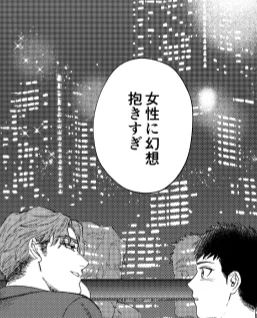
Can someone please translate the Kanji

cwang

Registered
Joined
27 Jul 2022
Messages
11
Reaction score
0
I got most of the sentence here but I don't get the last part. The Kanji translates to strangle or something and the hiragana says "ki su gi". I don't get it-what does this mean? I read the English translation but I don't get how it translated. Plz help if anyone knows tnx....:(
20220726_161022.webp
 
抱く (いだく)= to hold/harbor (a feeling in mind)
 
Thank you...but why does it say ki sugi after it? I really appreciate your help ^^
 
Also is the first part "josei ni gensou..." because that is what I got from a Kanji dictionary online. Gensou=illusion? I just want to make sure it is
 
Wait I got it! Because ki= feeling and sugi=good so it means a good feeling about the idea of the illusion of the woman? :D Sorry if I am wrong :/
 
First of all, have you learned the conjugation of verbs?
 
First of all, have you learned the conjugation of verbs?
I thought if it was -ku wouldn't it go to -kimasu or -kimashita? It is changing into -kisugi right? If it were impolite wouldn't it just stay ku?
 
Oh also I just realized I found the wrong one:
扼す
So that's why I was confused. Sorry
 
hint:
1) すぎ is the -masu stem/i-form of 過ぎる. Check in your dictionary the meaning of 過ぎる as the second verb of a compound verb "-masu stem of a verb + すぎる".

2) を is omitted after 女性に幻想, thus, 幻想 is the object of 抱きすぎる.
 
So is it:
josei ni gensou itakisugi
Translates to:
The idea of the fantasy woman you hold on to too much

??
Oooh hang on I think I remember this now
 
Last edited:
typo
idakisugi

に is the particle to indicate the target/what the subject of 抱きすぎる has a feeling about. Thus, the subject has an illusion about women.
The subject is omitted, but it's "you".
抱きすぎ works as a noun here, and the copula だ is also omitted at the end of the sentence.
 
Why would ni not be acting as a location particle? Does it literally translate to "illusion in women" then? Is ni usually used like that in other instances or this a special case? So far I've just seen ni used for locations.
 
に has so many functions. To indicate the location of existence is just one of them.
e.g.
彼女に手紙を送った。
I sent her a letter.
に indicates the recipient.

東京に着いた。
I arrived at Tokyo.
に indicates the destination.

彼は医者になった。
He became a doctor.
に indicates the result of change.

部下に行かせた。
I made my subordinate go.
に indicates the causee in a causative sentence.

There are many other functions.
 
Oh...thanks so much :)
Btw
In the sentence:
部下に行かせた
Why isn't it a -saserareru ending?
 
Ok. I still don't really understand those yet. Thanks for the help!
 
As explained in the wikipedia page, causative passive is literally passive of causative.

causative
私は彼に映画を見させた。
I made him watch a movie.
The subject(= "I") is the causer.
に indicates the causee.

causative passive
私は彼に映画を見させられた。
I was made to watch a movie by him.
The subject(= "I") is the causee.
に indicates the causer.
 
Ok. I think that makes more sense. I went over those conjugations but I haven't been practicing reading so I haven't really come across them. I've mostly been seeing the present/future tense, past tense, volitional...so hopefully I can get more exposure to other conjugations. There is alot more to go over I guess ._. Thanks
 
Back
Top Bottom