ず vs ぬ on Intransitive Verbs

Haruto Uzumaki

渦巻ハルト
Joined
24 Apr 2022
Messages
382
Reaction score
470
Hey guys, sorry in advance in case this is in the wrong section, and sorry for having to ask this question at all, since I usually figure it out on my own, but it's bothering me and I would really like some clarity on this topic.
Due to the fact that I can't constantly ask Japanese people questions about their language on a daily basis, I often ask ChatGPT about complex questions that can't be answered with simple Google searches or textbooks and such. Usually, it helps me understand to a higher degree, but this time, I was only left with responses that caused more confusion than I began with.

ChatGPT said that the ending 「ず」 cannot be used for an intransitive verb. ChatGPT and I have been arguing confusingly on why this is the case.
The clearest answer ChatGPT gave was as follows:
The difference between ぬ and ず is that ぬ is used to negate the existence or presence of something, while ず is used to negate the completion or occurrence of an action.

When used with a transitive verb, ぬ negates the existence or presence of the object that the verb refers to. For example, "食べない" (tabenai) means "not eating" or "won't eat," and negates the existence or presence of food that the subject would eat.

On the other hand, when used with a transitive verb, ず negates the completion or occurrence of the action that the verb refers to. For example, "食べずに帰る" (tabezu ni kaeru) means "return without eating" and negates the completion or occurrence of the action of eating.

In contrast, intransitive verbs do not take an object, so ぬ cannot be used to negate the existence or presence of anything. Therefore, ず is not used with intransitive verbs. And while ぬ technically could be used with intransitive verbs to negate the completion or occurrence of the action, it is not commonly used in that way.
The ぬ ending is used to indicate the absence of a state or condition that is expected to be present. It can also be used to express negation in a poetic or literary sense. The ぬ ending can be used with both transitive and intransitive verbs.

The ず ending, on the other hand, is used to indicate the absence of an action or event that was expected to occur. It can only be used with transitive verbs and cannot be used with intransitive verbs.

I then argued with it some more in confusion of what it was saying, failing to understand why 「ず」 can't be used on intransitive verbs.
I also asked this:
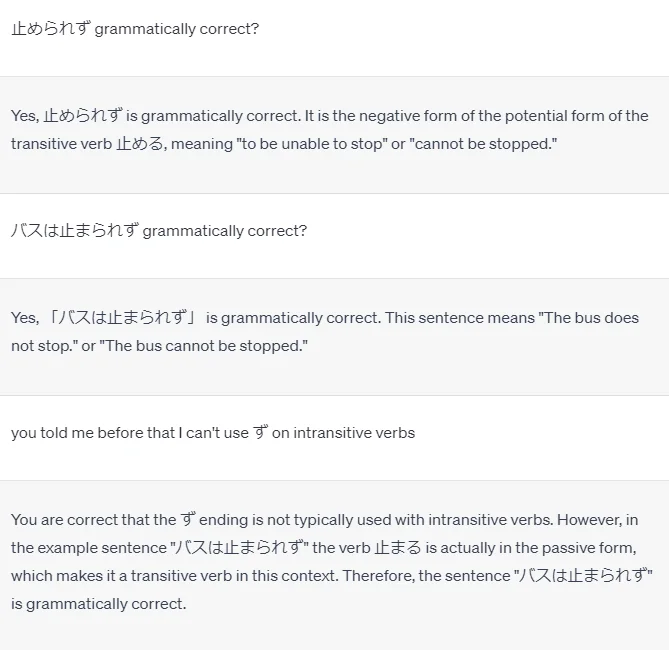
1681414197823.png

That also led to more confusion, because I thought the passive form was being used the whole time in my conversation with ChatGPT. All I did was add 「バスは」...

Anyway, I also ended up asking a Japanese person about this, because it was something I really had to know, and though he cleared up some things, it was really difficult for me to understand through my limited understanding of Japanese and looking back and forth with the original text and English translation.

He said the following (keeping in Japanese, doesn't make much sense in English anyway):
「ず」を使う場合、「バスは止められず」または「バスは止まらず」となりますね。
「止められず」の場合、他人がバスを停止しようとしたが、バスは止まらなかった。というのを意味します。
「止まらず」の場合は、バス自身が止まらなかったことを意味します。
「彼はバスを止めようとしたが、バスは止まらず走り去っていった」という文章なら成り立ちますね。
「ぬ」を使う場合、古い言い方になります。
時代ドラマなどで「それはなりませぬ!」みたいな言葉なので、現代では使いませんね。
「バスは暴走しているのだから、そう簡単なことでは止まれぬ!」という、セリフ的な言い方ならば通じます。
この場合の「ぬ」は、「バス自身が止まれない」というのを意味します
「バスは暴走しているのだから、そう簡単なことでは止められぬ!」ならば
この場合の「ぬ」は、「他人がバスを止める」というのを意味します。
つまり、CHATGPTは間違ったことを言っていたわけではないのです。
日本では、「止まられず」という言い方がなく「止められず」「止まらず」という言い方が正しいということなのですね。
「ぬ」に突っ込んで言うと、「ぬ」は時代的な言い方ですが、現代日本では「ぬ」を「ん」に言い換えるのが多いです。
「無理だ! どうやっても止められぬ!」を「無理だ! どうやっても止められん!」ならば、現代でも普通に喋りますね。

With that, I at least understood that the correct way to say something like「止まられぬ」 with 「ず」instead of 「ぬ」was actually 「止まらず」or 「止まれず」, but I still didn't really understand why that is, or even why ChatGPT says intransitive verbs can't be used with 「ず」. The Japanese person I talked with said that basically ChatGPT is correct, so I'm still a little confused what I'm missing. I told him that I would ask some bilingual people (AKA you guys on Jref) to maybe give me some English examples which could hopefully explain 1:1 why 「ず」 can't be used on intransitive verbs. He gave me some Japanese examples, which I'd also like some clarity on, since I found it extremely difficult to track down a pattern going on in his examples:
そうですね、日本語として正しいのは「止まらず」または「止められず」であって、「止まられず」という言い方は日本語にないのです。
「ず」と「ぬ」はかなり難しいですね。
当たらぬ宝くじ、みたいな言い方はしますけど、当たらず宝くじ、みたいは言い方はしませんし。
この場合は「当たらない宝くじ」というわけですし。
しかも、「当たらぬ宝くじ」って「当たるわけもない宝くじ」という、侮蔑的な言い方にもつながるんですよ。
「宝くじは当たらず」だと文法は通じますが、この場合、「宝くじは当たらなかった」という過去形になります。
「宝くじは当たらぬ」だと「宝くじは当たらなかった」という過去形と「宝くじなんて当たるわけがない」という両方の意味がありますからね……
こうやって、自分で説明しているとわかりますけど、日本語って難しすぎますね……
かと言って「当たらぬ宝くじ」だと「宝くじは当たらなかった」という過去形にはなりませんし。
でも、文章の流れとして「当たらぬ宝くじだった」だと、過去形にはなるからなぁ……

The only thing I could truly get from this was that it might not be something that actually has a pattern 🤔 But of course, it's not like I could actually fully understand what he was saying at all, so I've come to you guys in hopes that maybe these things can be explained and discussed in an open forum for the benefit of every Japanese learner's knowledge!

A short summary of the discussion I want to have:
1. Why aren't intransitive verbs allowed to have 「ず」 attached to them?
2. Was ChatGPT wrong about something? (it was wrong about other things for sure and sometimes switched around the particles on accident, so I didn't put them in the post)
3. Can we have a discussion of what exactly it is that makes 「ぬ」 usable on intransitive verbs, but not 「ず」, especially if "ず is used to negate the completion or occurrence of an action"
4. Is there a pattern in the examples given by the Japanese person? How do I go about understanding them?
5. Are there any English examples that can give the same sense of "wrongness" in using 「~ず」?

Hoping for a great discussion soon 🙇 Thanks!
(and yes, I am aware that understanding this may have little to no real world usage, but I still want to know, for other reasons)
 
Very important: don't use chatGPT for language learning like this. While it seems intelligent it's not at all. It gives completely wrong information while sounding authoritative. It works by some "AI" textual pattern matching technique not by knowledge in the human sense. So don't bother trying to understand what it says or discuss with it. It might be helpful for some things at your level but still I would recommend not using it for language learning at all.

First of all, rather than trying to nail down a grammar point that you might never use in real life, can we take a step back and focus on what you want to say?
Do you have any example sentences of thoughts you want to get across?
As he says ぬ is not even used in modern Japanese so I don't really see the point of trying to distinguish it from ず.
Also you weren't really stating your question on the basis of transitive or intransitive.
止める => transitive
止まる => intransitive

止められる means "be able to stop <something>"
 
Very important: don't use chatGPT for language learning like this.
Yeah, I guess you're right, although I'd still usually prefer a ChatGPT answer than no answer at all (which can then be replaced when I get more understanding)
Most of the time when I'm asking it stuff, it's about slang or strange usage of words in context to try to understand what my friends meant whenever DeepL can't translate it properly, for example. I'm still aware that it's just a generative model that doesn't truly use logic, but it's been helpful, and I've gotten way further into understanding Japanese with it than without it, keeping in mind it could be both right or wrong. I either let the facts (dis)prove themselves, or I ask people when possible, but I can't always do that especially if there's a question that no regular human could answer.
First of all, rather than trying to nail down a grammar point that you might never use in real life, can we take a step back and focus on what you want to say?
I don't have any in particular except the original example which was "unstoppable" essentially. But I want to know more about the poetic sense of Japanese and such. It's still commonly used today in songs/poetry, so that's one reason why I want to know more about it for myself. One example is good, but I want to understand it in a way that I can apply it to many examples and get it right more often than not, as well as understand the specific nuances involved with the word choice.
By the way, curiosity killed the cat, not the other way around, you know 👀 Is it right to extinguish my deep curiosity for Japanese just because it may not prove to be that useful in real life situations? Or should we promote the learning process, wherever it is, in hopes of creating a deeper connection to the learning material when interest is involved? 🤔 It may be somewhat unproductive to know about things you might not need to know about (though I want to know about it), but might it be even less productive to snuff out the interest in things related to what you do need?
Also you weren't really stating your question on the basis of transitive or intransitive.
止める => transitive
止まる => intransitive
A misunderstanding, maybe...
My question was why 「ず」 is not to be used on intransitive verbs, such as 「止まる」, which is intransitive. It's apparently fine to use it on 「止める」 and hence 「止められる」, but not 「止まられる」 (if there is such a form). ChatGPT confused me by saying later that 「バスは止まられず」is grammatically correct because it's in "passive form" which I thought was already the case when it told me 「止まられず」 was ungrammatical. Just as in my previous concerns, I felt that this could be completely wrong (because it goes against what the Japanese person said about ChatGPT's original statements).

Also, there's more than one question, so I was hoping we could discuss on things other than just what ChatGPT said... As you might've noticed, I did listen to a Japanese person as well, but I'm having a lot of trouble understanding his examples and finding the pattern that makes ず allowed or not allowed on a word, or specifically intransitive verbs maybe... I don't even know that for sure, but what I do know is that I could use some help and have some light shed on his answer... Are we able to discuss that as well, if my other questions aren't suitable? Also any English equivalents that could help me understand (and potentially others who view this site) would be great.
I'm just a glutton for knowledge when it comes to Japanese, so I'd really like to try and understand these things. If I can't understand it at this level, trying really hard then coming back later will cause it to click eventually, so there's still some purpose even if it might be way beyond my level (I do this a lot; watch grammar videos above my level, become like Gon from HxH with steam coming out of my ears, then watch it again a month later when I've gotten more familiar with it, till it one day clicks in).
 
By the way, curiosity killed the cat, not the other way around, you know 👀 Is it right to extinguish my deep curiosity for Japanese just because it may not prove to be that useful in real life situations? Or should we promote the learning process, wherever it is, in hopes of creating a deeper connection to the learning material when interest is involved? 🤔 It may be somewhat unproductive to know about things you might not need to know about (though I want to know about it), but might it be even less productive to snuff out the interest in things related to what you do need?
You're going to learn and forget more than you know before you can even hold a conversation. Hopefully the bits and pieces will click for you at some point. That should happen in Japan.

My question was why 「ず」 is not to be used on intransitive verbs, such as 「止まる」, which is intransitive. It's apparently fine to use it on 「止める」 and hence 「止められる」, but not 「止まられる」 (if there is such a form). ChatGPT confused me by saying later that 「バスは止まられず」is grammatically correct because it's in "passive form" which I thought was already the case when it told me 「止まられず」 was ungrammatical. Just as in my previous concerns, I felt that this could be completely wrong (because it goes against what the Japanese person said about ChatGPT's original statements).
When you're asking Japanese people about stuff like this it's usually not useful to ask "why." They probably can't answer anyway because they don't know. It's like if I asked you, why is it ok to say "If I were you..." and it's wrong to say "If I was you..." Please tell me so that I can understand English better.
Go ahead... tell me the reason. I dare you.

Back to your original question, this form can be used on intransitive verbs such as 止まる as a web search confirms:
痛みと共に涙が止まらず、痛みが激烈な場合には目が開けられなくなる場合もあります

Also, there's more than one question, so I was hoping we could discuss on things other than just what ChatGPT said... As you might've noticed, I did listen to a Japanese person as well, but I'm having a lot of trouble understanding his examples and finding the pattern that makes ず allowed or not allowed on a word, or specifically intransitive verbs maybe... I don't even know that for sure, but what I do know is that I could use some help and have some light shed on his answer... Are we able to discuss that as well, if my other questions aren't suitable? Also any English equivalents that could help me understand (and potentially others who view this site) would be great.
For sure don't let me discourage you. Please ask questions here and we'll help you. There are other uses but the easiest rule of thumb is that ず(に) can take the place of ~ないで.
I went without eating
たべないでいきました。
たべずにいきました。
Another common use is that it can indicate a reason or cause for what precedes it. It usually takes the potential negative (not able to do) form.
I couldn't read Japanese signs so I got lost.
日本の看板を読めず、迷いました。
 
why is it ok to say "If I were you..." and it's wrong to say "If I was you..." Please tell me so that I can understand English better.
I believe this has to do with "were" being part of a conditional sentence, but "was" is used simply for past tense and other things, but not conditional sentences. When you use "if", it becomes a conditional sentence.

I couldn't be detailed about it, but I think that could count as understanding English at least 1% better, right?
I actually help people with English pretty frequently on HiNative, so I'm used to sometimes receiving questions like that, and at that point I would simply research the topic for a moment, sprinkle my native touch, and provide as clear an answer as possible. Of course, I didn't research the topic before giving that answer, but I'll show you what just 2 minutes of looking it up will do to my answer:


If I was~ is a sentence form called "simple past" that you use when an event really occurred in the past (not hypothetically). "If I was awake too late, my parents would scold me." In this sentence, I am describing an if/then (cause and effect) scenario, where the "if" part of the statement comes before the comma, and the "then" part of the statement comes after the comma. Note that "then" is often omitted, in many cases. You may also use this form to talk about things that happened in your past in chronological order, which can give a slight nuance of storytelling, in some cases.

If I were~ is a sentence form called "subjunctive mood". You mainly use it when you are talking about a state of being that you potentially could be in, but haven't previously been, in the past. "If I were a popsicle, it would be pretty delicious." It can also be used on other people: "If you were a popsicle, I would eat you!" In these sentences, I am describing a hypothetical situation or state of being that hasn't been attained, in the past or present. It can also be considered an if/then statement, where becoming a popsicle would lead to being delicious, or being eaten.

I admit that it took a bit long to write the answer, maybe 10-15 minutes (the Japanese guy spent more time), but I am happy to spend that time to help English language learners get a better understanding of the language. I specifically reach out to Japanese people with questions as well, to help counteract the low English proficiency issue.
1681449221975.png

As you can see, I even let it take priority over my own learning sometimes, a bit regrettably. I grind answering Japanese people's English questions, and most of the time, they seemed to really be helped quite a lot, and if they need clarification, I clarify. I try to be aware of my own language as much as possible in order to help others. And even without the desire to help others, I remember the vast majority of the lessons I had in first grade (and various things from kindergarten and even pre school, since I could read when I was 2), so I still to some degree understand some things about our language. Something I don't understand is why we say stuff like "the more __, the more __" which sounds pretty broken when you think about it.

They probably can't answer anyway because they don't know.
I was talking to someone who studied Japanese grammar himself. He said it in a text that he had to, but I guess I didn't include that because I didn't expect to be arguing over this part.
そうですね……私も小説や脚本の制作の仕事をしていますが、確かに訓練のときには正しい日本語文法の本を読んだ記憶があります。
それも、日本で育っている上に、小学校や中学校で国語を学んでいるからこそ、高度な文法の本を理解できたのだと、今実感しましたね……
So there you have it. He works on novels, screenplays, and such... He had to read advanced Japanese grammar books in order to do his job properly. I think he can be considered exceptionally qualified to explain his language at least to some degree, except for the fact that he doesn't speak English, so it's hard to communicate it to a low level noob like me.

For sure don't let me discourage you. Please ask questions here and we'll help you.
Trust me, I won't let anyone discourage me 🤝 and I appreciate your help!

There are other uses but the easiest rule of thumb is that ず(に) can take the place of ~ないで.
I went without eating
たべないでいきました。
たべずにいきました。
Another common use is that it can indicate a reason or cause for what precedes it. It usually takes the potential negative (not able to do) form.
I couldn't read Japanese signs so I got lost.
日本の看板を読めず、迷いました。
That's pretty helpful! So, does this imply that it's most commonly used in sentences connected with the「~ないで」form? Or in better words maybe, it has the additional function of connecting sentences the same way 「で」 does on 「ない」 form of verbs?
It's interesting that it also has a cause and effect feature to it as well. It seems manageable so far to understand these things about it :)) I will have my uses for this information 🤫👀

Back to your original question, this form can be used on intransitive verbs such as 止まる as a web search confirms:
痛みと共に涙が止まらず、痛みが激烈な場合には目が開けられなくなる場合もあります
Thanks, I probably should've done that myself honestly but didn't think of it for various reasons. Good to know, it was just that I conjugated wrong (「止まられず」 instead of the correct 「止まらず」)
 
I believe this has to do with "were" being part of a conditional sentence, but "was" is used simply for past tense and other things, but not conditional sentences. When you use "if", it becomes a conditional sentence.

I couldn't be detailed about it, but I think that could count as understanding English at least 1% better, right?
...
If I was~ is a sentence form called "simple past" that you use when an event really occurred in the past (not hypothetically). "If I was awake too late, my parents would scold me." In ...
If I were~ is a sentence form called "subjunctive mood". You mainly use it when you are talking about a state of being that you potentially could be in, but haven't previously been, in the past. "If I were a popsicle, it would be pretty delicious." It can also be used on other people: "If you were a popsicle, I would eat you!" In these sentences, I am describing a hypothetical situation or state of being that hasn't been attained, in the past or present. It can also be considered an if/then statement, where becoming a popsicle would lead to being delicious, or being eaten.

I admit that it took a bit long to write the answer, maybe 10-15 minutes (the Japanese guy spent more time), but I am happy to spend that time to help English language learners get a better understanding of the language. I specifically reach out to Japanese people with questions as well, to help counteract the low English proficiency
I don't know... my feeling is that overly linguistical explanations are arguably not worth the time for either side. At some point you have to remember it. I suppose if you use a "rule" to remember, even if it's not correct, it might be helpful.

As you can see, I even let it take priority over my own learning sometimes, a bit regrettably. I grind answering Japanese people's English questions, and most of the time, they seemed to really be helped quite a lot, and if they need clarification, I clarify. I try to be aware of my own language as much as possible in order to help others. And even without the desire to help others, I remember the vast majority of the lessons I had in first grade (and various things from kindergarten and even pre school, since I could read when I was 2), so I still to some degree understand some things about our language. Something I don't understand is why we say stuff like "the more __, the more __" which sounds pretty broken when you think about it.
Teaching others about your own language does help you in the long run though.

So there you have it. He works on novels, screenplays, and such... He had to read advanced Japanese grammar books in order to do his job properly. I think he can be considered exceptionally qualified to explain his language at least to some degree, except for the fact that he doesn't speak English, so it's hard to communicate it to a low level noob like me.
That's also a question. Is a linguist more qualified to teach languages than a talented and knowledgeable teacher? But anyway he sounds like a great resource and you're lucky to have found him.

That's pretty helpful! So, does this imply that it's most commonly used in sentences connected with the「~ないで」form? Or in better words maybe, it has the additional function of connecting sentences the same way 「で」 does on 「ない」 form of verbs?
It's interesting that it also has a cause and effect feature to it as well. It seems manageable so far to understand these things about it :)) I will have my uses for this information 🤫👀
I'm not a linguist or all that knowledgeable. I've only been speaking Japanese for 30 years. So I'm afraid I can't answer questions like when is the most appropriate time to use this form vs the other, or what is the change in meaning/nuance. Although I suppose I could make an authoritative statement like chatGPT does and pretend I know something about it. However I did consult a grammar reference last night and it said the -zu form is mainly used in written form. Though I do use those forms during conversation sometimes, especially the "without" pattern so I don't know. Maybe it sounds odd or stilted when I do that.

He said the following (keeping in Japanese, doesn't make much sense in English anyway):
Actually I think it makes a lot of sense. It's probably worth understanding what he wrote.

「ず」を使う場合、「バスは止められず」または「バスは止まらず」となりますね。
When using "zu" it would be 「バスは止められず」or「バスは止まらず」
「止められず」の場合、他人がバスを停止しようとしたが、バスは止まらなかった。というのを意味します。
If you say 止められず it means somebody tried to stop the bus but couldn't stop it (ie the bus didn't stop).
「止まらず」の場合は、バス自身が止まらなかったことを意味します。
In the case of 「止まらず」it means the bus itself didn't stop. [This is the intransitive case.]
「彼はバスを止めようとしたが、バスは止まらず走り去っていった」という文章なら成り立ちますね。
So putting it all together in a sentence you could say "He tried to stop the bus but it didn't stop and kept going."
「ぬ」を使う場合、古い言い方になります。
Regarding "nu" this is an obsolete way of speaking.
時代ドラマなどで「それはなりませぬ!」みたいな言葉なので、現代では使いませんね。
So you'll hear it in historical dramas as in "Sore ha narimasenu" but it's not used in modern speech.
「バスは暴走しているのだから、そう簡単なことでは止まれ!」という、セリフ的な言い方ならば通じます。
A line such as "the bus is out of control, it can't be stopped so easily" would be understood.
この場合の「ぬ」は、「バス自身が止まれない」というのを意味します
In this case the nu means the bus itself can't stop.
「バスは暴走しているのだから、そう簡単なことでは止められ!」ならばこの場合の「ぬ」は、「他人がバスを止める」というのを意味します。
That is, somebody else will stop the bus.
つまり、CHATGPTは間違ったことを言っていたわけではないのです。
So chatGPT is not entirely wrong.
日本では、「止まられず」という言い方がなく「止められず」「止まらず」という言い方が正しいということなのですね。
In Japanese, 「止まられず」is not correct. 「止められず」and「止まらず」are correct.
「ぬ」に突っ込んで言うと、「ぬ」は時代的な言い方ですが、現代日本では「ぬ」を「ん」に言い換えるのが多いです。
Regarding nu, it's an obsolete way of speech. In modern Japanese nu has been commonly changed to n.
「無理だ! どうやっても止められぬ!」を「無理だ! どうやっても止められん!」ならば、現代でも普通に喋りますね。
So if you phrase 「無理だ! どうやっても止められ!」as 「無理だ! どうやっても止められ!」it becomes normal, modern speech.

そうですね、日本語として正しいのは「止まらず」または「止められず」であって、「止まられず」という言い方は日本語にないのです。
Yes, the correct words are 「止まらず」or 「止められず」. 「止まられず」is invalid Japanese. [He's repeating what he said above.]
「ず」と「ぬ」はかなり難しいですね。
zu and nu are difficult aren't they?
当たらぬ宝くじ、みたいな言い方はしますけど、当たらず宝くじ、みたいは言い方はしませんし。
So you could say "no-win lottery" as 当たらぬ宝く but you can't say 当たらず宝く.
この場合は「当たらない宝くじ」というわけですし。
In this case it would mean never-win lottery.
しかも、「当たらぬ宝くじ」「当たるわけもない宝くじ」という、侮蔑的な言い方にもつながるんですよ。
If you say these two, they are kind of derogatory phrasing.
「宝くじは当たらず」だと文法は通じますが、この場合、「宝くじは当たらなかった」という過去形になります。
「宝くじは当たらず」would be understood but this means the lottery wasn't won.
「宝くじは当たらぬ」だと「宝くじは当たらなかった」という過去形と「宝くじなんて当たるわけがない」という両方の意味がありますからね……
For「宝くじは当たらぬ」the meaning could be "the lottery wasn't won" or "there's no way to win the lottery."
こうやって、自分で説明しているとわかりますけど、日本語って難しすぎますね……
In this way I can understand my own explanation but Japanese is too difficult...
かと言って「当たらぬ宝くじ」だと「宝くじは当たらなかった」という過去形にはなりませんし。
btw 「当たらぬ宝くじ」doesn't mean "the lottery wasn't won" in the past tense.
でも、文章の流れとして「当たらぬ宝くじだった」だと、過去形にはなるからなぁ……
However 「当たらぬ宝くじだった」would be in the past tense...

Unfortunately you had him going down this rabbit hole of nu. It was kind of a waste of his and your time. It would be like getting into some detail of Shakespearen speech which really won't help you much. To be honest with you I never picked up this use of nu in 30 years. Probably I would have picked it up if I read books or watched historical dramas but all I do is converse daily and my reading/writing is limited to mostly work emails or technical documents.
 
1)
"Intransitive vs. transitive" has nothing to do with ず vs. ぬ.

2)
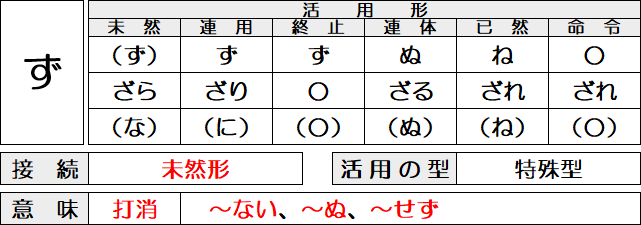
Both ず and ぬ are originally a conjugation form of an auxiliary verb ず. The reason why 当たらず宝くじ is wrong is because ず is the predicative form (終止形), and therefore it cannot modify a noun. The attributive form (連体形), i.e., ぬ should be used for this case, so 当たらぬ宝くじ is correct. You can also use another attributive form 当たらざる宝くじ.

ず is a bit special auxiliary verb. There are three different types of conjugations (ぬ系統, ず系統 and ざり系統) for this auxiliary verb. The dictionary and following site explain about the historical background.


Incidentally, the conjugation of ず is taught in classical Japanese class in Japanese high school, so the Japanese answerers to your question must learn it. I don't want to blame them, but they just don't remember it. (And an answerer seems to be confused about the past form, too.)

3)
ず and ぬ are classical Japanese, but still remain in modern Japanese often in set phrases, proverbs or as written language. Confusingly enough, there are differences between modern Japanese and classical Japanese in meaning and usage of ず and ぬ. As in the explanation about ぬ in the dictionary I linked above, ぬ is originally the attributive form, but also used as the predicative form in modern Japanese. It has specific meanings in this uasge, which is pertially explained by an answerer.

4)
止まられず is actually grammatical as adversative passive since 止まる is treated as an unergative verb (非能格動詞) here.
e.g.
今日はいつもと違ってうちの前でバスに止まられずに済んだ。

The transive version バスを止められずに済んだ is far more common and natural, though.
 
I don't know... my feeling is that overly linguistical explanations are arguably not worth the time for either side. At some point you have to remember it. I suppose if you use a "rule" to remember, even if it's not correct, it might be helpful.
Yeah you're right, especially when the explanation is in their target language, it may be best to use a rule that works most of the time. I tried to give examples as well to give the feel of the situation it's used in since that kind of thing would help me as well.

Teaching others about your own language does help you in the long run though.
I guess I never really thought about it like that :unsure:

That's also a question. Is a linguist more qualified to teach languages than a talented and knowledgeable teacher? But anyway he sounds like a great resource and you're lucky to have found him.
Luckily, I think he might be both. I see him frequently in that discord channel (a channel specifically for asking tough questions or asking for advice) giving long explanatory answers that always leave everyone saying 「なるほど。。。😮」 But yeah, I think a great teacher is necessary and more qualified for teaching a language, and at the same time a linguist might have a unique perspective that can provide valuable insight as well, secondarily.
And yes, I'm lucky to have found him :) It was my first time talking to him directly but I'm glad that he will help even foreigners learning the language.

I'm not a linguist or all that knowledgeable. I've only been speaking Japanese for 30 years. So I'm afraid I can't answer questions like when is the most appropriate time to use this form vs the other, or what is the change in meaning/nuance. Although I suppose I could make an authoritative statement like chatGPT does and pretend I know something about it. However I did consult a grammar reference last night and it said the -zu form is mainly used in written form. Though I do use those forms during conversation sometimes, especially the "without" pattern so I don't know. Maybe it sounds odd or stilted when I do that.
"only" 30 years 😭 more than 2/3 my life and you consider that length of time insignificant enough to use the word "only"?! 😮‍💨
But that's okay, 「何でもは分からない、分かる事だけ」right? I think that's how it goes... But anyway, I think it just depends on the time in your life you started, like if you started in early childhood then you'd probably know in just 20 years or less, so I don't think it's that you don't have enough experience!

Also, I appreciate it so much that you really consulted a grammar reference about it 🙇‍♂️ and I think he's right too, except I think I would hear 「~ず」 on the news more commonly as well (and generally more written form words show up in the Japanese news than real life so it makes sense)
Hopefully it doesn't sound weird when spoken normally, but if not, hopefully it's not hard to break the habit 😅

Actually I think it makes a lot of sense. It's probably worth understanding what he wrote.
I really appreciate you spending all that time translating the whole thing while leaving the examples in tact! You didn't have to do that, really 🥹 also it was mainly the second half that I was having trouble with, but after reading the explanation part in english and being able to compare the difference between the examples in Japanese, I think I'm starting to understand a little bit at least. For sure I could at least take away that putting the「ぬ」 on the verb vs the noun (or before the copula?) as well as the order in which the sentence is written/spoken has varying negation effects. So I'll have to look out for that kind of pattern which might be difficult considering it's not used in real life that much.

Unfortunately you had him going down this rabbit hole of nu. It was kind of a waste of his and your time. It would be like getting into some detail of Shakespearen speech which really won't help you much.
A waste of his time, yes, but I still wouldn't consider it a waste of my time. That Shakespearean feel is exactly what I'm looking for. Of course, not for daily interactions, but you might know of some of the things I'd like to do in Japan, which require me to build a portfolio that can showcase/sell my skills. Other than that, in terms of understanding things, there really are so many songs that use 「ぬ」 in interesting ways. It's true that most people won't have a purpose of learning about it, but for the purpose of songwriting and understanding songwriting, knowledge about poetic Japanese can be invaluable. There's also a cool anime I watched called "Onihei" I think is based on 鬼平犯科帳 [Onihei Hankachou] and takes place in the late Edo Period of the Tokugawa Shogunate. Their script also uses language from the Edo period such as verbs commonly containing 「ぬ」, fathers being called 「父上」, etc. Although that's just out of pure interest for fun and not out of "necessity" if you know what I mean (not that it's a necessity to understand poetic Japanese songwriting, but it's the direction I'm heading. If it's possible to PM, I'll show you something, but since there are people stalking me, I have to be careful what I reveal on the internet).
Probably I would have picked it up if I read books or watched historical dramas but all I do is converse daily and my reading/writing is limited to mostly work emails or technical documents.
Yeah, my focus is definitely still on real life stuff for like 85% percent of my studies, but 15% of me wants to explore the hidden unknown parts of Japanese that people don't talk about, the stuff that people just forget about. It's like how maybe most people are interested in the "futuristic" stuff about Japan, but some people like the traditional stuff too or can appreciate it. I personally just think that poetic Japanese is so beautiful and has an unending amount of expression that I wouldn't be able to begin to describe. I want to capture that for myself. That's all there is to it, but I hope that's valid enough to spend at least some time learning about it. Remember, I still focus mainly on real life stuff, this is just one question that I found trouble getting an answer for (for good reason), that's all...
 
"Intransitive vs. transitive" has nothing to do with ず vs. ぬ.
Thanks for clearing that up for certain! Now I know 🙇‍♂️
Both ず and ぬ are originally a conjugation form of an auxiliary verb ず. The reason why 当たらず宝くじ is wrong is because ず is the predicative form (終止形), and therefore it cannot modify a noun. The attributive form (連体形), i.e., ぬ should be used for this case, so 当たらぬ宝くじ is correct. You can also use another attributive form 当たらざる宝くじ.
Wow!! In other words, there is a connection to 「ず」and「ぬ」similar to how "am" and "is" are connected? It's really helpful to know that 「ず」isn't supposed to be used on nouns. So that means I could say something like 「勉強ぬ」 (unlearnable?) but not 「勉強ず」, it would have to be 「勉強しまず」(unable to learn?), not that these are actual words, but just asking in case I got the usage correctly.
I did some research on ぬ vs ざる, and it seems that ざる might be a form that originated from chinese literature? Or either way, when both 「ぬ」and 「ざる」 can be used, it's apparently up to stylistic choice where 「ぬ」 provides a 和文 feel and 「ざる」 provides a 漢文 feel, which is pretty interesting to think about! I also read that it has to do with literacy rates between men and women long ago in Japan as well, with women having to mainly use hiragana and couldn't read kanji as much if at all, so it kinda makes sense that 「ざる」 might feel different in a way, compared to「ぬ」.

Even though it's difficult to understand overall, I feel like I still learned something by hearing this :) and I'm sure within a few months, looking back at this post it'll be much clearer for me than it is now (just as when I first started learning Japanese, I knew nothing about phonetics when you guys taught me about them, but learning about Japanese by nature caused me to learn a whole lot about phonetics, and now I can understand much of it!)
Incidentally, the conjugation of ず is taught in classical Japanese class in Japanese high school, so the Japanese answerers to your question must learn it. I don't want to blame them, but they just don't remember it. (And an answerer seems to be confused about the past form, too.)
Haha, yeah I can't blame them either, I didn't really retain much about middle english when I was in school. It was way too much at the time and honestly I just wasn't even capable of understanding writing like that back then. It's impressive that he was able to give an answer at all 😄 even more impressive that you could explain it perfectly!!
ず and ぬ are classical Japanese, but still remain in modern Japanese often in set phrases, proverbs or as written language. Confusingly enough, there are differences between modern Japanese and classical Japanese in meaning and usage of ず and ぬ. As in the explanation about ぬ in the dictionary I linked above, ぬ is originally the attributive form, but also used as the predicative form in modern Japanese. It has specific meanings in this uasge, which is pertially explained by an answerer.
That's interesting. Would that explain why 「当たらぬ宝くじ」 has a different meaning than 「宝くじは当たらぬ」? The 「ぬ」in the first sentence modifies 「宝くじ」 , while the「ぬ」in the second sentence modifies 「当たら」? I think I'm starting to get it!!
The transive version バスを止められずに済んだ is far more common and natural, though.
Yeah, that makes sense for sure. Most of the stuff involving my question probably isn't in any way natural in normal circumstances, but I think it's interesting to know something about it :)
And in this sentence, would it be that 「ずに」 is actually modifying 「済んだ」 here as well? If it was split into two sentence chunks, could it be something like "the bus being stopped... was never done."? or maybe the second part might be more like "couldn't be done", but my main question is that it's modifying the ending, isn't it?
I appreciate everyone for having this discussion with me by the way 😄
 
By the way, I'm definitely coming back to these posts in order to reinforce the knowledge and capture more later, and won't let everyone's teachings go to waste!!

If it's possible to PM, I'll show you something
@mdchachi I think that in order to be able to message you privately, we have to follow each other or something. If you'd like to see what I have to share with you, please allow me to message you ☺️
 
By the way, I'm definitely coming back to these posts in order to reinforce the knowledge and capture more later, and won't let everyone's teachings go to waste!!


@mdchachi I think that in order to be able to message you privately, we have to follow each other or something. If you'd like to see what I have to share with you, please allow me to message you ☺️
There's no contact button when you click on my name?
1681514007149.webp
 
In other words, there is a connection to 「ず」and「ぬ」similar to how "am" and "is" are connected?
While the difference between "am" and "is" is for the subject, the difference ず and ぬ is for its function. It's more likely "to draw a picture (used as a verb)" vs. "a drawn picture (the past participle used as an adjective)".

I could say something like 「勉強ぬ」 (unlearnable?) but not 「勉強ず」, it would have to be 「勉強しまず」(unable to learn?)
As I wrote, ず and ぬ are an auxiliary verb, so it's attached to a verb or auxiliary verb. However, 勉強 is a noun, so both 勉強ぬ and 勉強ず are ungrammatical as same as "I will student" is ungrammatical in English. ず and ぬ are attached to 未然形(pre -nai form), so it should be 勉強ず and 勉強ぬ. Similarly, the correct form is 勉強しまず, not 勉強しまず. (勉強しませず is a rather oldish expression which is almost never used.)

Incidentally, 勉強しませぬ is exactly the etymology of the negative form 勉強しません. ん is the n-euphonic change of ぬ.

You seem to be misunderstanding the meaning of this negative form. "未然形 of a verb + ず/ぬ" doesn't have the meaning "able". 勉強せず, 勉強せぬ or 勉強しません are just "not to learn". 勉強できず, 勉強できぬ or 勉強できません are for "enable to learn".
e.g.
止まず/止まぬ: not to stop
止まず/止まぬ (i.e. negative potential form): not to be able to stop

I did some research on ぬ vs ざる, and it seems that ざる might be a form that originated from chinese literature? Or either way, when both 「ぬ」and 「ざる」 can be used, it's apparently up to stylistic choice where 「ぬ」 provides a 和文 feel and 「ざる」 provides a 漢文 feel
漢文 is a method to read (classical) Chinese texts as Japanese sentences. It is Japanese, not Chinese origin. ざる indeed has a stiff nuance, so it's often used in 漢文, but it doesn't have something to do directly with 漢文. In fact, as in the pages I linked above, ざり is originally made to connect ず to other auxiliary verbs.

「ざり」は、旺文社の『古語辞典』(松村明・山口明穂・和田利政、1960年)によれば、「他の助動詞との接続を補う意味で、連用形『ず』に動詞『あり』が付いた」ことで成立した
「ず」の活用は「ず」の系列「(ず)・ず・ず・〇・〇・〇」と、「ぬ」の系列「(な)・(に)・〇・ぬ・ね・〇」とからなるが、さらにその不備を補うため、連用形「ず」に動詞「あり」の付いた「ずあり」の音変化形「ざり」系列「ざら・ざり・〇・ざる・ざれ・ざれ」が生じた。

Would that explain why 「当たらぬ宝くじ」 has a different meaning than 「宝くじは当たらぬ」?
I was talking about ぬ as the predicative form (終止形), i.e., the difference between 宝くじは当たらぬ and 宝くじは当たらず. They are different in nuance, which was partially explained by an answerer.
(「ぬ」は)文語の打消しの助動詞「ず」の連体形が口語の終止形となったもの

The 「ぬ」in the first sentence modifies 「宝くじ」 , while the「ぬ」in the second sentence modifies 「当たら」?
当たらぬ is a modifying phrase which modifies 宝くじ in 当たらぬ宝くじ. This is not a sentence but a noun phrase. On the other hand, 宝くじは当たらぬ is a sentence. 当たらぬ doesn't modify anything. It's like "(prize) is not won". "Modify (修飾)" is not usually used to negate a verb like ぬ in Japanese.

in this sentence, would it be that 「ずに」 is actually modifying 「済んだ」 here as well?
~ずに is an adverbial phrase, so it's not wrong to say that it modifies the main verb of the sentence 済んだ.

If it was split into two sentence chunks, could it be something like "the bus being stopped... was never done."? or maybe the second part might be more like "couldn't be done", but my main question is that it's modifying the ending, isn't it?
済む originally means "to come to a conclusion" here, and ~ずに済む means "to come off without doing" as a set.
 
"only" 30 years 😭 more than 2/3 my life and you consider that length of time insignificant enough to use the word "only"?! 😮‍💨
But that's okay, 「何でもは分からない、分かる事だけ」right? I think that's how it goes... But anyway, I think it just depends on the time in your life you started, like if you started in early childhood then you'd probably know in just 20 years or less, so I don't think it's that you don't have enough experience!

Also, I appreciate it so much that you really consulted a grammar reference about it 🙇‍♂️ and I think he's right too, except I think I would hear 「~ず」 on the news more commonly as well (and generally more written form words show up in the Japanese news than real life so it makes sense)
Hopefully it doesn't sound weird when spoken normally, but if not, hopefully it's not hard to break the habit 😅
Well I didn't mean it to be insignificant but the fact is that I haven't actively studied Japanese in the past 20 years. Of course I still pick things up in daily life and conversations like this. I know more about this -ぬ form now and will probably recognize it thanks to your thread. Previously if I heard it on tv I would have assumed it was some sort of regional dialect as opposed to a historical dialect.
Wow!! In other words, there is a connection to 「ず」and「ぬ」similar to how "am" and "is" are connected? It's really helpful to know that 「ず」isn't supposed to be used on nouns. So that means I could say something like 「勉強ぬ」 (unlearnable?) but not 「勉強ず」, it would have to be 「勉強しまず」(unable to learn?), not that these are actual words, but just asking in case I got the usage correctly.
As toritoribe-san said, it's verb conjugation. So you can't tack it onto a noun. Some nouns becomes verbs by adding "do" like this one.

勉強=studies (noun)
勉強する= study (verb)

The ず form of する is せず. So it would be 勉強せず. I don't know about ぬ. Maybe 勉強せぬ?
Also you're confusing the "unable to" form with this negative form. Not to mention that 勉強 doesn't mean "learn" any more than "studying" means "learning." I mean they're related but not quite the same. So to say "unable to study" I'd use the "able to" verb できる. i.e.
勉強できず試験を受けました => I took the test without being able to study.
This is of course a little different than
勉強せず試験を受けました => I took the test without studying.
The former implies that you literally could not study for some reason. Whereas the latter implies you could have but didn't.
 
Toritoribe beat me to the punch and in much greater detail than I so I'm just going to erase my redundant post and point out what an asset he's been to JREF!

Dang, even in writing this short post mdchachi also posted to the same effect. Y'all are amazing.

Only one thing left to point out for now:
Another way to translate the set construction of Xずに済む is "to get by without X-ing," where X is the 〜ず-conjugated verb.

Where are there deep linguistic questions asked on discord? I just installed it for the first time to play with AI tools and it feels a bit like the old IRC days.
 
Toritoribe beat me to the punch and in much greater detail than I so I'm just going to erase my redundant post and point out what an asset he's been to JREF!

Dang, even in writing this short post mdchachi also posted to the same effect. Y'all are amazing.

Only one thing left to point out for now:
Another way to translate the set construction of Xずに済む is "to get by without X-ing," where X is the 〜ず-conjugated verb.

Where are there deep linguistic questions asked on discord? I just installed it for the first time to play with AI tools and it feels a bit like the old IRC days.
I almost deleted my reply after I saw his because when Toritoribe is on the case everything else is redundant and, in my case, often not quite right.
 
you shouldn't have to follow someone, let alone mutually follow each other, to be able to use the contact function
 
While the difference between "am" and "is" is for the subject, the difference ず and ぬ is for its function. It's more likely "to draw a picture (used as a verb)" vs. "a drawn picture (the past participle used as an adjective)".
Ahh okay, I think I kinda get it with that explanation :unsure: thanks then!

As I wrote, ず and ぬ are an auxiliary verb, so it's attached to a verb or auxiliary verb. However, 勉強 is a noun, so both 勉強ぬ and 勉強ず are ungrammatical as same as "I will student" is ungrammatical in English. ず and ぬ are attached to 未然形(pre -nai form), so it should be 勉強ず and 勉強ぬ. Similarly, the correct form is 勉強しまず, not 勉強しまず. (勉強しませず is a rather oldish expression which is almost never used.)
Whoops 😅 I guess I got it completely wrong then, but if you're saying 「ぬ・ず」 are only attached to the 未然形 form, then that helps a lot with knowing at least where it can't go. In other words, it can only go where 「~ない」 would go, right? I guess I got confused before because I didn't know which was the noun in the example sentence, but I'm realizing since it's the predicative form, that must mean it comes before the noun, not after, so what you were trying to tell me was that 「ず」 can't modify nouns that come after it, but 「ぬ」 can? Neither one can modify nouns that come before it? If so, then I think I understand now! チョン↑パァ!! Nevermind, I still got it completely wrong 💀 下手糞を許されるといいな 🥲 Also, by "oldish" do you mean that it will also sound like it's coming from an elderly person, (even in poetry/songs), or just that it's an antiquated phrase nobody uses anymore?

You seem to be misunderstanding the meaning of this negative form. "未然形 of a verb + ず/ぬ" doesn't have the meaning "able". 勉強せず, 勉強せぬ or 勉強しません are just "not to learn". 勉強できず, 勉強できぬ or 勉強できません are for "enable to learn".
Well, I thought it just meant negation of whatever it was attached to, so I assumed that if it was attached to a noun, it would make that noun an un[noun]able thing. So I thought it would make a noun like 「勉強」 without 「する」attached to it mean something like an unstudiable thing, something that can't be studied/learned, or something like that. I thought it would only have a meaning like "not to learn" when it was attached to the 「する」, so I guess the confusion lied within the fact that I didn't know it wasn't allowed to be attached to the end of nouns until after reading your post.
I also assumed that there was a sense of "not able" because many of the words I hear it with are translated with un___able like 「許さぬ」being "unforgivable", and also the example I gave (even though it has to do with the form it's in) and I thought that meant it would work in a similar way to how sometimes we use [verb]-ables as a noun, like "burnables" and stuff like that, or maybe like how adding "thing" after a verb/adjective makes it a noun (「笑うこと」). Sorry if I explained it in a kinda confusing way, but that was my thinking 😅

漢文 is a method to read (classical) Chinese texts as Japanese sentences. It is Japanese, not Chinese origin. ざる indeed has a stiff nuance, so it's often used in 漢文, but it doesn't have something to do directly with 漢文. In fact, as in the pages I linked above, ざり is originally made to connect ず to other auxiliary verbs.
Ahh I see, my mistake. I worded the sentence wrong and also misunderstood the meaning of 漢文.

I was talking about ぬ as the predicative form (終止形), i.e., the difference between 宝くじは当たらぬ and 宝くじは当たらず. They are different in nuance, which was partially explained by an answerer.
Yikes, I'm not getting anything right 😮‍💨 but I see now, I at least understand that ぬ and ず have a different nuance. So fundamentally, would you say the main difference is the colloqualism?
It'll take me a while to fully get everything, but I don't expect to understand in one day, so I'm alright, I think...

当たらぬ is a modifying phrase which modifies 宝くじ in 当たらぬ宝くじ. This is not a sentence but a noun phrase. On the other hand, 宝くじは当たらぬ is a sentence. 当たらぬ doesn't modify anything. It's like "(prize) is not won". "Modify (修飾)" is not usually used to negate a verb like ぬ in Japanese.
I guess I misunderstood what exactly modify meant then. So the first phrase is basically a "lottery not won"? Making 「当たらぬ」 almost like an adjective, maybe?
It feels like it might be similar to how we might say something like "a memory not forgotten" in English. And then "a memory that is not forgotten" would be a bit like the second sentence when you add は? I don't know, still probably not even close, but at least I'm thinking 😂

~ずに is an adverbial phrase, so it's not wrong to say that it modifies the main verb of the sentence 済んだ.
Woohoo, finally understood something remotely correctly 🥳

済む originally means "to come to a conclusion" here, and ~ずに済む means "to come off without doing" as a set.
I couldn't find the right words for it, but I think I meant it in that way :)

Thank you very much! And I appreciate everyone for putting up with my low-IQ-like understanding 😅 I can guarantee that one day I'll come to understand it all like it's second nature ^_^
 
Well I didn't mean it to be insignificant but the fact is that I haven't actively studied Japanese in the past 20 years. Of course I still pick things up in daily life and conversations like this. I know more about this -ぬ form now and will probably recognize it thanks to your thread. Previously if I heard it on tv I would have assumed it was some sort of regional dialect as opposed to a historical dialect.
Understood, but I still think it's commendable that you've made a life for yourself through the other 10 years that you did spend studying in order to live in a way where you can maintain the language without directly studying it anymore :) Also, I'm glad that this thread might help you as well, even if a little bit! I hope that it can help anyone curious enough about the language that wants to know more than just the surface and daily interactions. I know most of this information might be easily accessible to Japanese people, but I made this thread in hopes that English speakers could also learn about it and have just that little tid-bit of info to make them just a little bit more fluent, including my future self.

勉強=studies (noun)
until you wrote that, it didn't click, exactly what 勉強 could be translated as on its own, but now it makes sense as a noun. Thanks!!

I mean they're related but not quite the same. So to say "unable to study" I'd use the "able to" verb できる. i.e.
The reasons I said "unlearnable" were because I thought "unstudiable" might sound weird, as well as because I've seen 「勉強している」 translated as "learning" before by some people, even though I know that's 「学ぶ」(and sometimes 「覚える」).

But yeah, I already realized my silly mistakes 😅 Thanks guys!!
 
Another way to translate the set construction of Xずに済む is "to get by without X-ing," where X is the 〜ず-conjugated verb.
Wow, that's a good pattern to keep in mind then. At the very least I think I can remember this pattern with the way you translated it. Much appreciated, as always 🙏
Dang, even in writing this short post mdchachi also posted to the same effect. Y'all are amazing.
Everyone on jref is awesome!! Including you, nice gaijin!
Where are there deep linguistic questions asked on discord? I just installed it for the first time to play with AI tools and it feels a bit like the old IRC days.
It's not necessarily linguistic questions in particular, just tough questions that people have or deep wonderings, that the one guy always ends up being the answerer to, in which he always answers with great detail. I'll send the link if you're interested, but it might not be as language-related as you might hope for.
I don't even know if I should send it here out in the open because people lurk on this site for information on people...
 
It's not necessarily linguistic questions in particular, just tough questions that people have or deep wonderings, that the one guy always ends up being the answerer to, in which he always answers with great detail. I'll send the link if you're interested, but it might not be as language-related as you might hope for.
I don't even know if I should send it here out in the open because people lurk on this site for information on people...
200.gif
 
if you're saying 「ぬ・ず」 are only attached to the 未然形
Nevermind, I still got it completely wrong
Your understanding is correct. As same as ない in modern Japanese, ぬ and ず are attached to 未然形. 未然形 of modern verbs is the same as the classical ones, but the only one exception is する and -suru verbs. (The same goes with adjectives, though.)

modern: ない
classical: ず/

ぬ and ず are a classical auxiliary verb, as I wrote, so they follow classical Japanese grammar. The classical form of する is す, and 未然形 of す is せ. This is the reason why it's せず/せぬ, and not しず/しぬ.

Also, by "oldish" do you mean that it will also sound like it's coming from an elderly person, (even in poetry/songs), or just that it's an antiquated phrase nobody uses anymore?
It's the latter. ~ませず used to be used in Meiji period , i.e., a hundred or so years ago, but it's obsolete now.

So fundamentally, would you say the main difference is the colloqualism?
ず is a proper way of negation in classical grammar, so it has a neutral and objective nuance like the narrative part of a novel. ぬ is often used in spoken utterance, so it's often connotes the speaker's emotion, like the examples 宝くじは当たらぬ or そう簡単なことでは止められぬ you got in the replies to your question.

So the first phrase is basically a "lottery not won"? Making 「当たらぬ」 almost like an adjective, maybe?
That's right.

"a memory that is not forgotten" would be a bit like the second sentence when you add は?
宝くじは当たらぬ is a sentence, so it's like "A memory is not forgotten." "A memory that is not forgotten" is also a noun phrase. It's the same as "a memory not forgotten" in meaning, right?
 
My favorite sentence of all time that uses ~ず was used in American Express Card TV commercials in Japan in the 1970's. The Amex promotional slogan at that time was, "Don't Leave Home Without It." This translates into Japanese as, "出かける時は忘れずに。" (でかける とき は わすれず に。) (Dekakeru toki wa wasurezu ni.)

Here is their TV commercial in English. The promotional slogan is at the end of the video.


Here are two of their TV commercial in Japanese grouped into one video. The promotional slogan 出かける時は忘れずに is shown on the screen in Japanese is at the end of each commercial, at 0:28 and 0:58.


Here is a famous Japanese woman saying 出かける時は忘れずに at the end of the video.


Here is a goofy video of the famous American golfer Jack Nicholas saying 出かける時は忘れずに in a really bad American accent at 0:27 and 0:41.


It eventually became kind of a fad to listen to Americans saying 出かける時は忘れずに in a really bad American accent. Listen from 0:03. (The same famous Japanese woman says 出かける時は忘れずに from 0:17.)

 
Last edited:
I think the ad is useful also because it shows its not really "ancient" or old-timey Japanese. The conjugation may be classic, but its still in use and is still understood by everyone without any problem.

Maybe also helpful to point out that it its not a one-for-one translation of "Don't leave home without it".
Rather it becomes, "When you leave home, don't forget it".

Another thing that popped into my mind: the Japanese title for the Clint Eastwood movie "The Unforgiven" is 許されざる者
Probably dragging the OP way off course here, so no need to spend any time on this. I'm just trying to point out that these forms are still in use. Stick to basic, everyday grammar and you will build a strong foundation for understanding these more advanced grammar concepts later. (Well, that's the theory anyway...I struggle with advanced Japanese grammar myself and I've been at this a while).
 
I think the ad is useful also because it shows its not really "ancient" or old-timey Japanese. The conjugation may be classic, but its still in use and is still understood by everyone without any problem.

Maybe also helpful to point out that it its not a one-for-one translation of "Don't leave home without it".
Rather it becomes, "When you leave home, don't forget it".

Another thing that popped into my mind: the Japanese title for the Clint Eastwood movie "The Unforgiven" is 許されざる者
Probably dragging the OP way off course here, so no need to spend any time on this. I'm just trying to point out that these forms are still in use. Stick to basic, everyday grammar and you will build a strong foundation for understanding these more advanced grammar concepts later. (Well, that's the theory anyway...I struggle with advanced Japanese grammar myself and I've been at this a while).
Nobody was saying that ず isn't still used. At least I don't think so but I'm not going to re-read the whole thread.
Do you have any examples of ぬ be used similarly in modern Japanese?
 
Back
Top Bottom