


Haruto Uzumaki
渦巻ハルト
- 24 Apr 2022
- 382
- 470
Hey guys, sorry in advance in case this is in the wrong section, and sorry for having to ask this question at all, since I usually figure it out on my own, but it's bothering me and I would really like some clarity on this topic.
Due to the fact that I can't constantly ask Japanese people questions about their language on a daily basis, I often ask ChatGPT about complex questions that can't be answered with simple Google searches or textbooks and such. Usually, it helps me understand to a higher degree, but this time, I was only left with responses that caused more confusion than I began with.
ChatGPT said that the ending 「ず」 cannot be used for an intransitive verb. ChatGPT and I have been arguing confusingly on why this is the case.
The clearest answer ChatGPT gave was as follows:
I then argued with it some more in confusion of what it was saying, failing to understand why 「ず」 can't be used on intransitive verbs.
I also asked this:
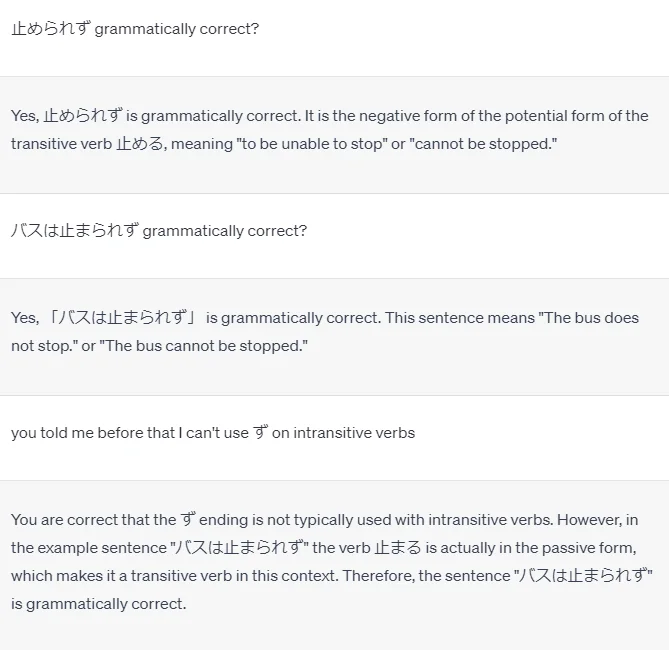
That also led to more confusion, because I thought the passive form was being used the whole time in my conversation with ChatGPT. All I did was add 「バスは」...
Anyway, I also ended up asking a Japanese person about this, because it was something I really had to know, and though he cleared up some things, it was really difficult for me to understand through my limited understanding of Japanese and looking back and forth with the original text and English translation.
He said the following (keeping in Japanese, doesn't make much sense in English anyway):
With that, I at least understood that the correct way to say something like「止まられぬ」 with 「ず」instead of 「ぬ」was actually 「止まらず」or 「止まれず」, but I still didn't really understand why that is, or even why ChatGPT says intransitive verbs can't be used with 「ず」. The Japanese person I talked with said that basically ChatGPT is correct, so I'm still a little confused what I'm missing. I told him that I would ask some bilingual people (AKA you guys on Jref) to maybe give me some English examples which could hopefully explain 1:1 why 「ず」 can't be used on intransitive verbs. He gave me some Japanese examples, which I'd also like some clarity on, since I found it extremely difficult to track down a pattern going on in his examples:
The only thing I could truly get from this was that it might not be something that actually has a pattern But of course, it's not like I could actually fully understand what he was saying at all, so I've come to you guys in hopes that maybe these things can be explained and discussed in an open forum for the benefit of every Japanese learner's knowledge!
A short summary of the discussion I want to have:
1. Why aren't intransitive verbs allowed to have 「ず」 attached to them?
2. Was ChatGPT wrong about something? (it was wrong about other things for sure and sometimes switched around the particles on accident, so I didn't put them in the post)
3. Can we have a discussion of what exactly it is that makes 「ぬ」 usable on intransitive verbs, but not 「ず」, especially if "ず is used to negate the completion or occurrence of an action"
4. Is there a pattern in the examples given by the Japanese person? How do I go about understanding them?
5. Are there any English examples that can give the same sense of "wrongness" in using 「~ず」?
Hoping for a great discussion soon Thanks!
(and yes, I am aware that understanding this may have little to no real world usage, but I still want to know, for other reasons)
Due to the fact that I can't constantly ask Japanese people questions about their language on a daily basis, I often ask ChatGPT about complex questions that can't be answered with simple Google searches or textbooks and such. Usually, it helps me understand to a higher degree, but this time, I was only left with responses that caused more confusion than I began with.
ChatGPT said that the ending 「ず」 cannot be used for an intransitive verb. ChatGPT and I have been arguing confusingly on why this is the case.
The clearest answer ChatGPT gave was as follows:
The difference between ぬ and ず is that ぬ is used to negate the existence or presence of something, while ず is used to negate the completion or occurrence of an action.
When used with a transitive verb, ぬ negates the existence or presence of the object that the verb refers to. For example, "食べない" (tabenai) means "not eating" or "won't eat," and negates the existence or presence of food that the subject would eat.
On the other hand, when used with a transitive verb, ず negates the completion or occurrence of the action that the verb refers to. For example, "食べずに帰る" (tabezu ni kaeru) means "return without eating" and negates the completion or occurrence of the action of eating.
In contrast, intransitive verbs do not take an object, so ぬ cannot be used to negate the existence or presence of anything. Therefore, ず is not used with intransitive verbs. And while ぬ technically could be used with intransitive verbs to negate the completion or occurrence of the action, it is not commonly used in that way.
The ぬ ending is used to indicate the absence of a state or condition that is expected to be present. It can also be used to express negation in a poetic or literary sense. The ぬ ending can be used with both transitive and intransitive verbs.
The ず ending, on the other hand, is used to indicate the absence of an action or event that was expected to occur. It can only be used with transitive verbs and cannot be used with intransitive verbs.
I then argued with it some more in confusion of what it was saying, failing to understand why 「ず」 can't be used on intransitive verbs.
I also asked this:
That also led to more confusion, because I thought the passive form was being used the whole time in my conversation with ChatGPT. All I did was add 「バスは」...
Anyway, I also ended up asking a Japanese person about this, because it was something I really had to know, and though he cleared up some things, it was really difficult for me to understand through my limited understanding of Japanese and looking back and forth with the original text and English translation.
He said the following (keeping in Japanese, doesn't make much sense in English anyway):
「ず」を使う場合、「バスは止められず」または「バスは止まらず」となりますね。
「止められず」の場合、他人がバスを停止しようとしたが、バスは止まらなかった。というのを意味します。
「止まらず」の場合は、バス自身が止まらなかったことを意味します。
「彼はバスを止めようとしたが、バスは止まらず走り去っていった」という文章なら成り立ちますね。
「ぬ」を使う場合、古い言い方になります。
時代ドラマなどで「それはなりませぬ!」みたいな言葉なので、現代では使いませんね。
「バスは暴走しているのだから、そう簡単なことでは止まれぬ!」という、セリフ的な言い方ならば通じます。
この場合の「ぬ」は、「バス自身が止まれない」というのを意味します
「バスは暴走しているのだから、そう簡単なことでは止められぬ!」ならば
この場合の「ぬ」は、「他人がバスを止める」というのを意味します。
つまり、CHATGPTは間違ったことを言っていたわけではないのです。
日本では、「止まられず」という言い方がなく「止められず」「止まらず」という言い方が正しいということなのですね。
「ぬ」に突っ込んで言うと、「ぬ」は時代的な言い方ですが、現代日本では「ぬ」を「ん」に言い換えるのが多いです。
「無理だ! どうやっても止められぬ!」を「無理だ! どうやっても止められん!」ならば、現代でも普通に喋りますね。
With that, I at least understood that the correct way to say something like「止まられぬ」 with 「ず」instead of 「ぬ」was actually 「止まらず」or 「止まれず」, but I still didn't really understand why that is, or even why ChatGPT says intransitive verbs can't be used with 「ず」. The Japanese person I talked with said that basically ChatGPT is correct, so I'm still a little confused what I'm missing. I told him that I would ask some bilingual people (AKA you guys on Jref) to maybe give me some English examples which could hopefully explain 1:1 why 「ず」 can't be used on intransitive verbs. He gave me some Japanese examples, which I'd also like some clarity on, since I found it extremely difficult to track down a pattern going on in his examples:
そうですね、日本語として正しいのは「止まらず」または「止められず」であって、「止まられず」という言い方は日本語にないのです。
「ず」と「ぬ」はかなり難しいですね。
当たらぬ宝くじ、みたいな言い方はしますけど、当たらず宝くじ、みたいは言い方はしませんし。
この場合は「当たらない宝くじ」というわけですし。
しかも、「当たらぬ宝くじ」って「当たるわけもない宝くじ」という、侮蔑的な言い方にもつながるんですよ。
「宝くじは当たらず」だと文法は通じますが、この場合、「宝くじは当たらなかった」という過去形になります。
「宝くじは当たらぬ」だと「宝くじは当たらなかった」という過去形と「宝くじなんて当たるわけがない」という両方の意味がありますからね……
こうやって、自分で説明しているとわかりますけど、日本語って難しすぎますね……
かと言って「当たらぬ宝くじ」だと「宝くじは当たらなかった」という過去形にはなりませんし。
でも、文章の流れとして「当たらぬ宝くじだった」だと、過去形にはなるからなぁ……
The only thing I could truly get from this was that it might not be something that actually has a pattern
But of course, it's not like I could actually fully understand what he was saying at all, so I've come to you guys in hopes that maybe these things can be explained and discussed in an open forum for the benefit of every Japanese learner's knowledge!A short summary of the discussion I want to have:
1. Why aren't intransitive verbs allowed to have 「ず」 attached to them?
2. Was ChatGPT wrong about something? (it was wrong about other things for sure and sometimes switched around the particles on accident, so I didn't put them in the post)
3. Can we have a discussion of what exactly it is that makes 「ぬ」 usable on intransitive verbs, but not 「ず」, especially if "ず is used to negate the completion or occurrence of an action"
4. Is there a pattern in the examples given by the Japanese person? How do I go about understanding them?
5. Are there any English examples that can give the same sense of "wrongness" in using 「~ず」?
Hoping for a great discussion soon
Thanks!(and yes, I am aware that understanding this may have little to no real world usage, but I still want to know, for other reasons)

 Is it right to extinguish my deep curiosity for Japanese just because it may not prove to be that useful in real life situations? Or should we promote the learning process, wherever it is, in hopes of creating a deeper connection to the learning material when interest is involved?
  and I appreciate your help!
 ) I will have my uses for this information


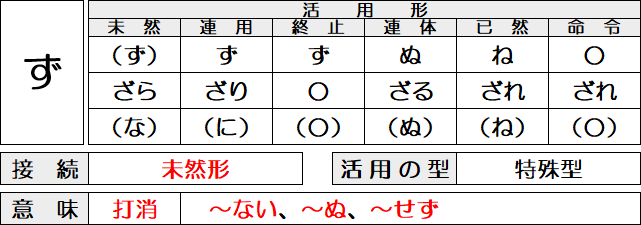

 」 But yeah, I think a great teacher is necessary and more qualified for teaching a language, and at the same time a linguist might have a unique perspective that can provide valuable insight as well, secondarily.
 more than 2/3 my life and you consider that length of time insignificant enough to use the word "only"?!
 and I think he's right too, except I think I would hear 「~ず」 on the news more commonly as well (and generally more written form words show up in the Japanese news than real life so it makes sense)
 also it was mainly the second half that I was having trouble with, but after reading the explanation part in english and being able to compare the difference between the examples in Japanese, I think I'm starting to understand a little bit at least. For sure I could at least take away that putting the「ぬ」 on the verb vs the noun (or before the copula?) as well as the order in which the sentence is written/spoken has varying negation effects. So I'll have to look out for that kind of pattern which might be difficult considering it's not used in real life that much.
 even more impressive that you could explain it perfectly!!

 下手糞を許されるといいな
  Also, by "oldish" do you mean that it will also sound like it's coming from an elderly person, (even in poetry/songs), or just that it's an antiquated phrase nobody uses anymore?


