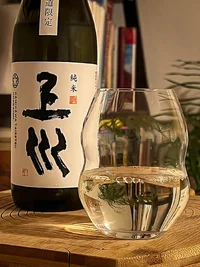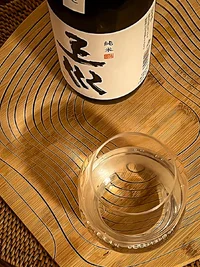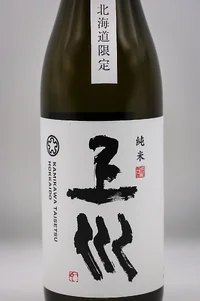
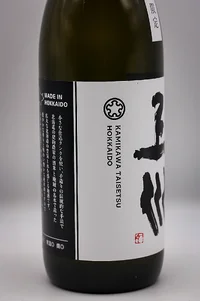
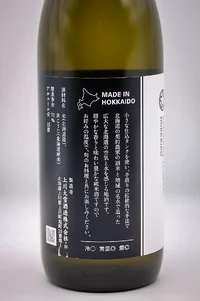
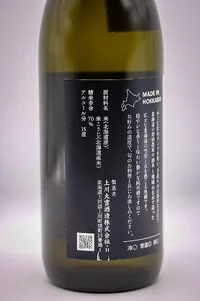
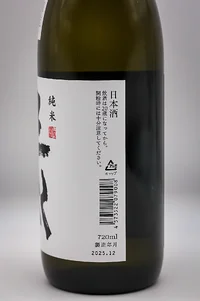
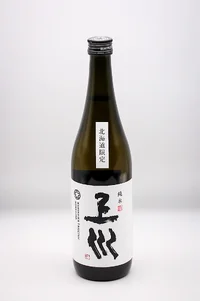
Sake specs
- Prefecture
- Hokkaidō (北海道)
- Rice type
- Domestic rice (国産米)
- Polishing rate (semaibuai)
- 70%
- Alcohol content
- 15%
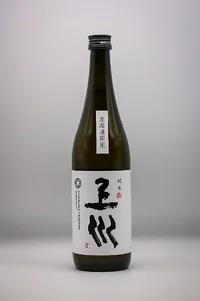
Kamigawa Junmai (上川 純米) is brewed with Hokkaidō-grown rice polished to 70% and prepared with moderately hard water drawn from the Satsunai River system. The profile combines clarity of texture with depth, rather than pursuing either extreme.
The style is described locally as nomasa-ru sake (飲まさる酒), a Tokachi expression suggesting a drink that tends to invite another cup without much deliberation. Tokachi (十勝) is a sub-prefecture in eastern Hokkaidō, centred on the city of Obihiro (帯広). It is positioned as a full-bodied junmai with a clean finish, intended for regular consumption rather than special occasions. The brewery also frames it as a versatile accompaniment to meals.
Aroma is generally characterised as soft and lightly fruity, with a restrained, airy impression. On the palate, it begins clean and smooth, without harsh edges, then fuller savoury flavours develop. A mild sweet-and-tart hint, often likened to berries, sits within the rounded body typical of junmai sake. After swallowing, the taste fades in an orderly manner, leaving only a short, quiet aftertaste.






About the brewery
- Brewery
- Kamikawa Taisetsu Shuzō
- Name in Japanese
- 上川大雪酒造
- Address
- 25-1 Asahimachi, Kamikawa, Kamikawa-gun, Hokkaidō 078-1761
- Phone
- 01658-7-7380
- Website
トップページ - 上川大雪酒造株式会社
2017年、北海道に創設した地方創生蔵 上川大雪酒造です。食の王国・北海道ならではの酒造りをし、地域や自治体と連携しながら日本酒と食文化の可能性を広げていきます。上川町の緑丘蔵、十勝の碧雲蔵で北海道の風土を感じる地酒を醸しています。kamikawa-taisetsu.co.jp
Expansion came in stages. A second brewery opened in 2020 on the campus of Obihiro University of Agriculture and Veterinary Medicine in Tokachi, followed by another in Hakodate the next year. Both sites were chosen in areas that had not previously housed a sake brewery, a decision the company links to its intention to root production in local communities and, at least in part, to support regional economic activity.
The brewing philosophy centres on the basic raw materials of sake, water and rice, while placing weight on Hokkaidō's environmental conditions. Water for fermentation is drawn from springs fed by the Daisetsuzan mountain range, where perennial snowfields supply groundwater that remains close to 7°C, a temperature generally regarded as favourable for brewing. Rice is sourced through contracts with growers in Hokkaidō and selected from established sake varieties including Suisei, Ginpū and Kitashizuku. The stated aim is not uniformity across facilities, but rather to allow differences in local water and climate to be reflected in the character of each batch.