Difference between ~て下さい and ~て下さいませんか.

healer

Sempai
Joined
13 May 2019
Messages
687
Reaction score
10
How would one translate the two constructions above?

I understand both means "please" while negative questions are usually used for invitation.

Could I say for the latter "Don't you want to ...?" I guess this is an indirect request which could be more polite.
 
It is a more polite and indirect request but I wouldn't think of it as "Don't you want to?' despite the negative verb.
Maybe 'Could you please...' ? 'Or would you be kind enough to...?'.
There are people on this board with much better Japanese than me, so hopefully they'll be along soon.
 
~て下さい could sound too strong when used as a request to people you don't know, therefore ~て下さいませんか is more preferred in those cases. It's OK to use ~て下さい as an invitation, for instance どうぞ食べて下さい/お食べ下さい.
 
お食べ下さい
Is this an honorific form? Should it be お食べになってください? How would one form お食べ? 食べ is not an verbal noun, isn't it?
IMG_2422 (1).webp
 
That's another example of "お + -masu stem of verb + ください", as same as お教えください or お答えください.

 
Is this an honorific form? Should it be お食べになってください? How would one form お食べ? 食べ is not an verbal noun, isn't it?
View attachment 29392
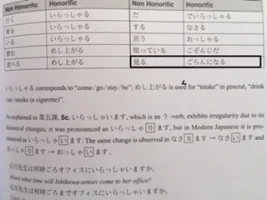
From what I understand, although お食べください is grammatically correct and such forms are often used (少々お待ちください) in honorific language,
the irregular honorific form 召し上がってください is used much more often.
 
召し上がってください
Is there any preference between お食べ下さい and お食べになってください? Perhaps 召し上がってください is mostly preferred for this verb.
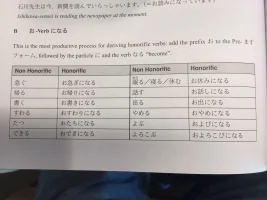
What about for example お書きになってください and お書きください? I guess I'm asking when to use one not the other.

By the way I often wonder if the special honorific verbs could sometimes be replaced with those created with the お + stem of verb + になるformat.
IMG_2412.webp
 
Last edited:
masu stem of verb + てください is a standard form.
Not "-masu stem of verb + てください" but "-te form of verb + ください".

That's the polite form. The casual/non-polite one is just the -te form (e.g. 食べて).

The above is an honorific form.
Right.

Is there any preference between お食べ下さい and お食べになってください? Perhaps 召し上がってください is mostly preferred for this verb.
What about for example お書きになってください and お書きください? I guess I'm asking when to use one not the other.
The order of respectful/polite level is (from top to down);

お召し上がりになってください
お召し上がりください
召し上がってください
お食べになってください
お食べください
食べてください

I think お召し上がりください is the most common in business scenes since お召し上がりになってください is too long.

Incidentally, お召し上がりになる is a double honorific (二重敬語) since 召し上がる is an honorific verb by itself. 二重敬語 is usually considered wrong, but お召し上がりになる is an exception because it's already widely accepted and used. This is probably another reason why お召し上がりください is more preferred.

Similarly, お書きになってください is more polite than お書きください.

By the way I often wonder if the special honorific verbs could sometimes be replaced with those created with the お + stem of verb + になるformat.
Special honorific verbs are more respectful than "お + stem of verb + になる". ご覧になる, おいでになる or お見えになる are just a few examples used as special honorific verbs.
 
Not "-masu stem of verb + てください" but "-te form of verb + ください".
Sorry I did know about this and I just somehow made such mistake. Thanks again for reminding me.

Your detailed response is very helpful regarding the level of politeness.
 
Back
Top Bottom