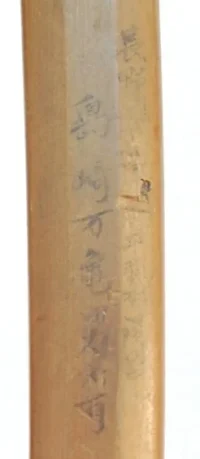
I would like to request help translating the kanji on this wood scabbard from a Japanese sword. Some of these are faint and I can try to get a better picture. Any help you can provide would be greatly appreciated.
I can only make out the main characters 「島崎万亀男」 which would be the name of a person (male) SHIMAZAKI Makio. I can't quite make out the other characters.
Thanks very much for your help. I am grateful for the input you have shared.
My apologies for the quality of the picture. No flash was used but it is hard to control the light as it is reflecting off three planar surfaces.
Here is a better picture I think that shows all the kanji. Also, there were kanji on the handle but they are partially worn off. Any additional insight you can provide would be greatly appreciated.
.
Much better - the characters to the right are "Nagano-ken, Shimotakai-gun, Hirao-mura, Yudanaka
If you are unfamiliar with Japanese addresses, the above refers to a location. Yudanaka is a location in the town/village of Hirao, in the county/region of Shimotakai which is in the prefecture of Nagano. On the hilt part of the scabbard there is again the name Shimazaki Makio, and to the left of the name is a reference to the inscription on the sword (銘) but I cannot make out any of the characters under that.
This may be surplus to your requirements, but the wooden scabbard (or shirasaya) is where Japanese swords are generally kept for safekeeping. The shirasaya itself is perceived to be of little value, and will generally be replaced as needed: that is, whenever the inside becomes dirty from years of oil accumulation, or when the outside becomes grimy. Its common for the shirasaya to have calligraphic writing indicating what kind of sword is inside. It is rarer - for me anyway - to see one that has the name of the owner.
This site uses cookies to help personalise content, tailor your experience and to keep you logged in if you register.
By continuing to use this site, you are consenting to our use of cookies.