

Navigation
Install the app
How to install the app on iOS
Follow along with the video below to see how to install our site as a web app on your home screen.
Note: This feature may not be available in some browsers.
More options
Style variation
System
Light
Dark

You are using an out of date browser. It may not display this or other websites correctly.
You should upgrade or use an alternative browser.
You should upgrade or use an alternative browser.
furigana version of かわいそうな像
- Thread starter letslearn
- Start date

- 15 Mar 2002
- 16,758
- 2,298
furigana version of かわいそうな像
実話 says Wikipedia:
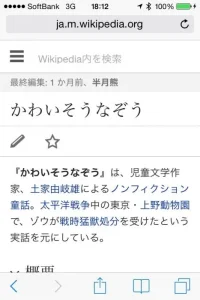
Some googling reveals that some people take issue with the departures from the truth of the story.
At any rate, the book is still in copyright and still available for purchase. It is a children's book so I would presume it is either all kana or has full furigana provided.
実話 says Wikipedia:
Some googling reveals that some people take issue with the departures from the truth of the story.
At any rate, the book is still in copyright and still available for purchase. It is a children's book so I would presume it is either all kana or has full furigana provided.

letslearn
先輩
- 11 Sep 2013
- 890
- 14
- Thread starter
- #3
Thanks mikesan, I take it that there must be a lot of versions of the book?
I have started to read a version that I found a transcript of. I am using an furigana generator to help me, so you obviously get some incorrect readings but overall it is quite good.
There is one grammar point I think I know the meaning but it would be good to see if I'm right. In the following it uses one of those 気 set phases (there seems to be hundreds of them) あまり気の付く人はありません
その賑やかな広場から、少し離れた所に、一つの石のお墓があります。
あまり気の付く人はありませんが、動物園で死んだ動物たち を、 お祭りしてあるお墓です
My interpretation is
I little bit away from the square is a stone tomb. Not many people realise that the tomb is there for the purpose of holding festivals for the animals that have died in the zoo.
よろしくお願いします
I have started to read a version that I found a transcript of. I am using an furigana generator to help me, so you obviously get some incorrect readings but overall it is quite good.
There is one grammar point I think I know the meaning but it would be good to see if I'm right. In the following it uses one of those 気 set phases (there seems to be hundreds of them) あまり気の付く人はありません
その賑やかな広場から、少し離れた所に、一つの石のお墓があります。
あまり気の付く人はありませんが、動物園で死んだ動物たち を、 お祭りしてあるお墓です
My interpretation is
I little bit away from the square is a stone tomb. Not many people realise that the tomb is there for the purpose of holding festivals for the animals that have died in the zoo.
よろしくお願いします
- 15 Mar 2002
- 16,758
- 2,298
I'm pretty sure that here it means not many people notice the tomb at all.
After you finish reading the book, you might want to read the page I linked below the Wikipedia screenshot. It would appear that some Japanese adults who were exposed to the book as a child were chagrined to find out the book took liberties with the facts, apparently to advance an agenda.
After you finish reading the book, you might want to read the page I linked below the Wikipedia screenshot. It would appear that some Japanese adults who were exposed to the book as a child were chagrined to find out the book took liberties with the facts, apparently to advance an agenda.

- 22 Feb 2008
- 18,266
- 4,926
Sorry for nitpicking, but that's 象, not 像.;-)
- 15 Mar 2002
- 16,758
- 2,298
furigana version of かわいそうな像
The "it couldn't be helped" needs somehow to be fused into the "they weren't given food" through rephrasing, but that's the general idea. The animal wasn't fed because there just wasn't anything to give it (or the law forbade it. I haven't read the book)....not because they didn't want to give it anything or refused it food out of cruelty. That's the 仕方がない aspect of the thing. Sometimes to render into more natural English you have to break from the phrasing of the original here and there. "They had no food to give it...." or "They were forbidden to feed it...." or the like
The "it couldn't be helped" needs somehow to be fused into the "they weren't given food" through rephrasing, but that's the general idea. The animal wasn't fed because there just wasn't anything to give it (or the law forbade it. I haven't read the book)....not because they didn't want to give it anything or refused it food out of cruelty. That's the 仕方がない aspect of the thing. Sometimes to render into more natural English you have to break from the phrasing of the original here and there. "They had no food to give it...." or "They were forbidden to feed it...." or the like
letslearn
先輩
- 11 Sep 2013
- 890
- 14
- Thread starter
- #10
Hi Guys,
I was wondering what the Interpretation of bakari in this sentence is?
They have been talking about the state of the elephants. How ttey are becoming very thin and there eyes are starting to protrude from there thin faces.
Next they talk about the ears...
耳ばかりがものすごく大きく見える悲しい姿に変わりました。
Are they saying that because they are so thin, their ears appear gigantic and changed the elephants appearance?
耳ばかり merely ears? nothing but ears?
is ものすごく大きく見える悲しい姿に describing the appearance of the ears? to seem to be extremely large?
よろしくお願いします
I was wondering what the Interpretation of bakari in this sentence is?
They have been talking about the state of the elephants. How ttey are becoming very thin and there eyes are starting to protrude from there thin faces.
Next they talk about the ears...
耳ばかりがものすごく大きく見える悲しい姿に変わりました。
Are they saying that because they are so thin, their ears appear gigantic and changed the elephants appearance?
耳ばかり merely ears? nothing but ears?
is ものすごく大きく見える悲しい姿に describing the appearance of the ears? to seem to be extremely large?
よろしくお願いします

FinancialWar
Sempai
- 19 May 2006
- 1,065
- 44
can't just you get the normal version and then use software to add furigana for you?
letslearn
先輩
- 11 Sep 2013
- 890
- 14
- Thread starter
- #14
can't just you get the normal version and then use software to add furigana for you?
I have done that so far. I was sort of hoping that there was a e book version or similar as the generator I have used so far often makes mistakes, which is not so bad because I use these mistakes to practice kanji search. I haven't found a children's story book version on line yet, but I might not be searching correctly.
Similar threads


- Replies
- 14
- Views
- 59K
