I am the author of all of the texts for all Beyond Calligraphy sites, with the exception of guest articles, as well as the co-founder of the project. Glad you like the sites

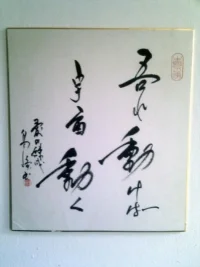
Yes, the phrase is really nice, after I read your post, I actually sat down and wrote the phrase by myself, here is my interpretation of this text:
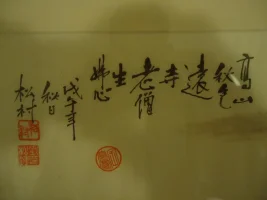
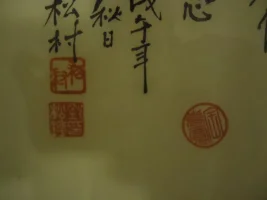
The calligraphy you have is not that bad, it was written by an older person, who was not a professional calligrapher, but had a fairly decent grasp on handwriting. The use of seals is incorrect, and the white space management could be a bit better, but as he wrote (I said he as it seems its a man's writing), it was a training.
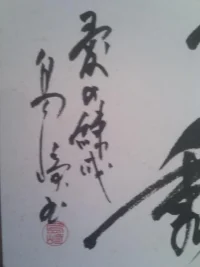
The bottom left seal is not a calligraphy seal, but a family name seal and its not a hanko but inkan, i.e. a seal used for a daily affairs in Japan. It should not be round, and since its a seal in relief, it should present calligraphers pen-name and not his real last name. His knowledge of the cursive script is rather poor, and you can see the mannnerisms which are evident in the character "move (動), which he wrote in virtually identical way. That is a faux pas in calligraphy art.
See my other work below, a fragment of Dao De Jing by Laozi, in which character 者 (person) appears 8 times (3rd from the top in first 6 lines and second to the last in last two lines, read from right to left), yet all of them differ. Some other characters are repeated as well (知,勝,自, etc.), yet they all differ from one another. I place the translation of the text below the picture.
知人者智。自知者明。勝人者有力、自勝者強。 知足者富。強行者有志。不失其所者久。死而不亡者壽
One who understands others is clever.
One who knows self is enlightened.
One who conquers others is forceful.
One who conquers self is strong.
One who can be content is rich.
One who is contentious is ambitious.
One who doesn't lose one's position endures.
One who dies but is not forgotten lives on.