I think kanji is driving me insane..

GoldCoinLover

後輩
Joined
24 May 2004
Messages
1,046
Reaction score
12
So I'm watching the 'numa numa' romanian japanese 2ch cat verison of the song (The dancing dude was a hit) so I saw a kanji, that looked just like the one for 'study' which is this "学 "

However, see those little spikey things at the top? It didn't have that.

I use JWPce. This program is like flying an airplane, it is so complicated! So I look up the radical, I thought the radical was the 'base' of the more advanced kanji, because I found a kanji on the video that looked like it:
Japanese Version of Numa Numa - i am bored

Here's the radical for the 'study one' (Please note, this is *NOT* the one in the flash movie I was trying to figure out):羊

That doesn't look ANYTHING like the study kanji above! What the heck? :( :( :(

This is so hard!

Not to mention, I just saw another way to say no in japanese, which is weird cause in english there's really only one way to say no, "no."

Here it is:
No, no, no, it's murder 違う、違う、違う、肉食は殺人と同じ

Now, it looks like the 'no' means 'to differ.' Ugh, odd.

What I want to do though, is be able to look up any kanji in JWPce.

Stroke order? Do that? I can't! I thought the kanji 学 had let's see:
1, 2, 3, 4, 5, 6, 7, 8 strokes.
It doesn't
Ok, maybe 1, 2, 3, 4, 5, 6 strokes?

I guess the 'base' of it is one stroke.


😅
 
GoldCoinLover said:
Stroke order? Do that? I can't! I thought the kanji ナ?w had let's see:
1, 2, 3, 4, 5, 6, 7, 8 strokes.
It doesn't

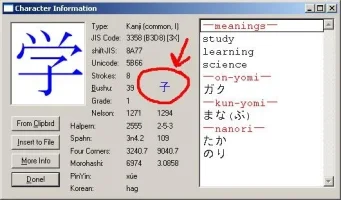
Yes it does. And the radical for it is 子, not 羊.
I would advise you not to bother with radicals in this stage of study, especially considering you don't even know how to write kanji in 漢...
 
Not to mention, I just saw another way to say no in japanese, which is weird cause in english there's really only one way to say no, "no."

Here it is:
No, no, no, it's murder 違う、違う、違う、肉食は殺人と同じ

Now, it looks like the 'no' means 'to differ.' Ugh, odd.
I know it doesn't look like it here, but trust me. Try to think of "chigau" as "different" or "wrong" or "I disagree" which translates more precisely as you are WRONG, WRONG, WRONG and "iie" as an answer to a yes/know question.
 
kumo said:
Yes it does. And the radical for it is 子, not 羊.
I would advise you not to bother with radicals in this stage of study, especially considering you don't even know how to write kanji in 漢...

Yes, I know how to write some (well, type rather) some kanji and their meaning and usage.

Well, JWPce says 羊 is the radical. Obviously, it isn't and 子 makes sense! I wonder why it did that though.
 
GoldCoinLover said:
I use JWPce. This program is like flying an airplane, it is so complicated! So I look up the radical, I thought the radical was the 'base' of th emore advanced kanji, because I found a kanji on the video tha tlooked like it:
Japanese Version of Numa Numa - i am bored

I don't know how you got what you did for the radical of 字 but it should be 子.

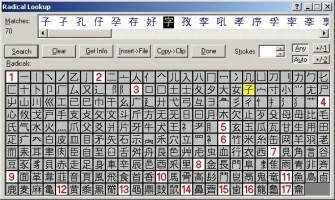
Actually, in JWPce, even if you don't know the stroke number of a radical, you can go to Radical Lookup(either by Ctrl-L or Kanji|Radical Lookup...) and find 子. You can select 宀 which is right next to it also but even if you don't, 字 will be early on the list.
 

Attachments

  • jwpce_screen.webp
    jwpce_screen.webp
    71 KB · Views: 281
  • jwpce_screen2.webp
    jwpce_screen2.webp
    28.1 KB · Views: 224
GoldCoinLover said:
Yes, I know how to write some (wel, type rather) some kanji and their meaning and usage.

Well, JWPce says 羊 is the radical. Obviously, it isn't and 子 makes sense! I wonder why it did that though.
According to the paper kanji character dictionary I use, the radical of 羊 is the two spiky things on top and for 学 is it the three on the roof. I think there are various radical schemes and JWPce may be using a different (perhaps older) one. 😅
 
RockLee said:
JWPce kinda sucks imho.
I completely agree. Nowadays I normally use 広辞苑(koujien) when looking up a word, but when I was a beginner I always found wakan to be much better than JWPce. I really can't understand why more people don't use it.
 
kumo said:
RockLee said:
JWPce kinda sucks imho.
I completely agree. Nowadays I normally use 広辞苑(koujien) when looking up a word, but when I was a begginer I always found wakan to be much better than JWPce. I really can't understand why more people don't use it.

I don't mean to disagree but the reason is because I don't have a need for it and haven't heard of it until now. JWPce is the first thing I've found. The second was the IME(in terms of typing in japanese in the first place).

For dictionary, I use jwpce because it's already installed and convenient and then go to wwwjdic for more entries and for examples. I've never needed a really good kanji dictionary. As far as I know, JWPce has suited my limited needs.

I don't know. Maybe you do more high level stuff or something but I installed wakan and it feels like overkill. JWPce is nice because it's compact and convenient(its at the top of my start menu most commonly opened programs). I only feel the need to use the radical lookup shown in the screen I attached. Of course I got a canon wordtank IDF-3000 for christmas so that may become my new lookup reflex. :-)
 
You can get all those example sentences from WWWJDIC and install them on wakan, so that you don't need to go Jim Breen's site everytime. The dicitionary database wakan uses is also the same as JWPce (EDICT).
To me the best thing about wakan is it's popup tool, the fact that you can find words even in their inflected forms (both "tabemasu" an "taberareru" will come up with "taberu", good for begginers) and that you can make it start automatically on dictionary mode (unlike JWPce, at least I couldn't find a way to do it), besides lots of other little improvements.
 
As Elizabeth said, 違う means "wrong" or "different". You actually hear it more than いいえ. In Osaka it sounds something like "chow chow".
 
Bucko said:
As Elizabeth said, 違う means "wrong" or "different". You actually hear it more than いいえ. In Osaka it sounds something like "chow chow".
そらちゃうで!で。:mad: :D
大阪弁は 友達同士で使うカジュアルな言い方みたいですよね。
 
acquiredtarget said:
That just made my day. Thanks, I needed that.

Thanks. Numerous verbal attempts to point out that the OP is getting the cart before the horse have all failed, so I thought a picture might help.
 
It looks like the efforts of someone interested in learning to read before communicate, which actually isn't a bad way to go (in conjunction with grammar and a book) if that is your goal. Hopefully things will all come together eventually. :-)
 
Elizabeth said:
It looks like the efforts of someone interested in learning to read before communicate, which actually isn't a bad way to go (in conjunction with grammar and a book) if that is your goal. Hopefully things will all come together eventually. :-)


Thanks. I am learning both actually, but I want to be able to read video game text, etc.
 
There is very much of a difference between wanting something and making it happen. Make sure you learn stuff and don't unlearn it. Find something to work through and memorize. You need some kind of focus. Any beginner vocabulary list will do. Just find a list of 10 words or so and memorize them. Don't cheat. Then find some more words. Repeat the process about 20 times and come back with another question. :-) Just kidding....or am I....
 
An excellent book for beginning to learn kanji (or maybe even who have been learning for awhile) is Read Japanese Today. It's a really easy and fun read, and it illustrates how the kanji are put together and their origins. Plus, by the time you're done with it you'll know a few hundred of the most common characters.
 
Back
Top Bottom